
Horror Movies
Looking back at HALLOWEEN ENDS: Time to Stop, Sir
It is very unfortunate that Myers’ story ends this way. Halloween Ends may serve as evidence that it is probably no longer worth returning to this universe.


Everything good comes to an end. Everything bad does too. Basically, everything ends; that is how the world works. Let this handful of truisms guide us through a reflection on the final episode of David Gordon Green’s sequel-reboot trilogy, which on the fortieth birthday of John Carpenter’s cult slasher once again invited us to play cat and mouse with Michael Myers, clad in his iconic mask. Halloween Ends.
It emphasizes with its very title that it places the final period in the story of the famous killer and his opponent, Laurie Strode – both her most recent incarnation and the franchise spanning over four decades. Unfortunately, this is neither a spectacular nor a satisfying final chapter.
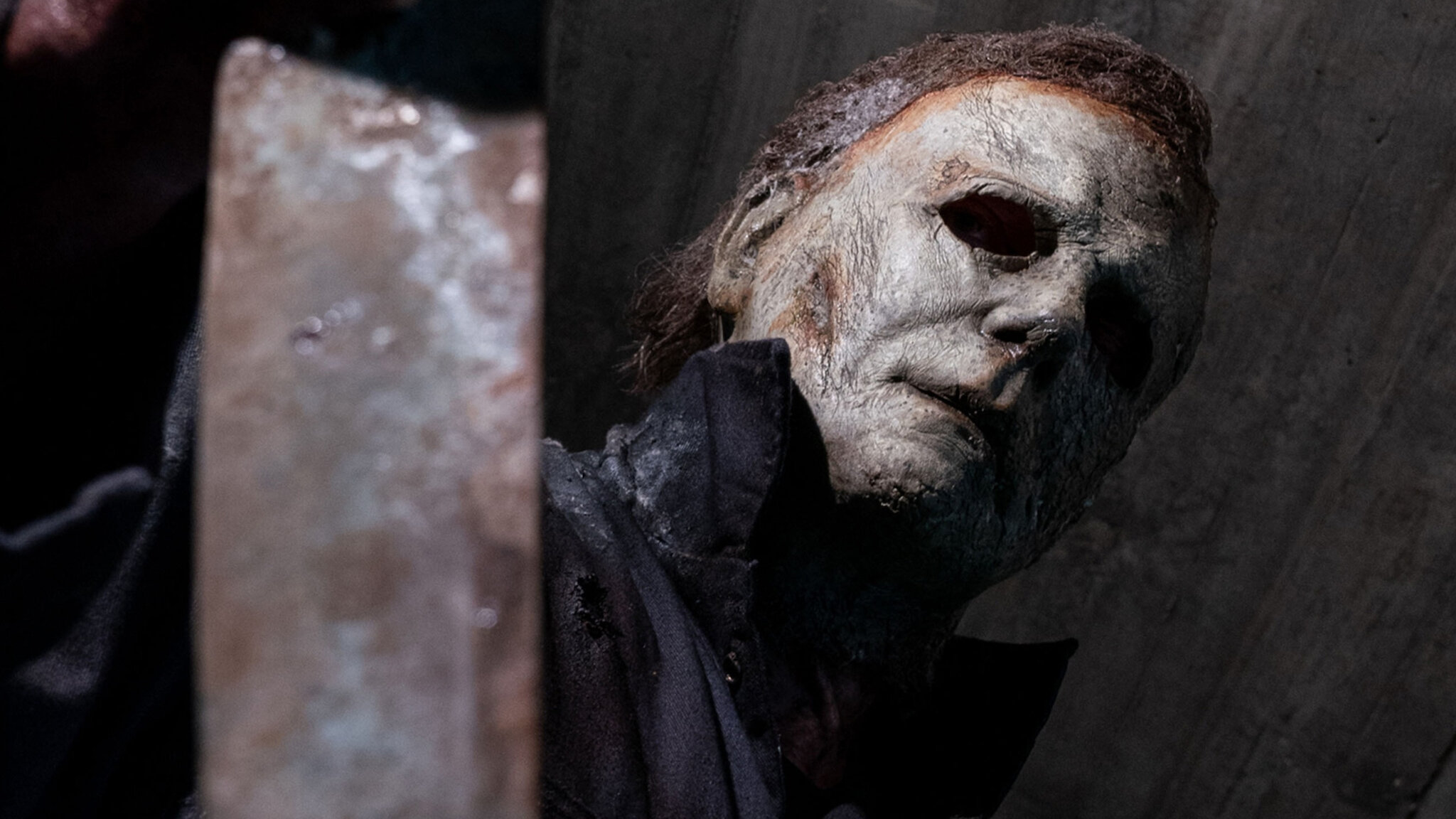
While Halloween and Halloween Kills took place during the same night from October thirty-first to November first, 2018, the third installment moves to later times. The prologue of the film is set in 2019 (when the magically fresh trauma of absolute chaos and destruction caused by Myers the year before becomes merely a curiosity in the urban legends section), while the main action catches up to the viewers’ present, set in 2022. In the meantime, Laurie Strode has rebuilt her life, Haddonfield has returned to small-town normalcy, and the fact that at the end of Halloween Kills Myers escaped and remains at large seems to concern no one.
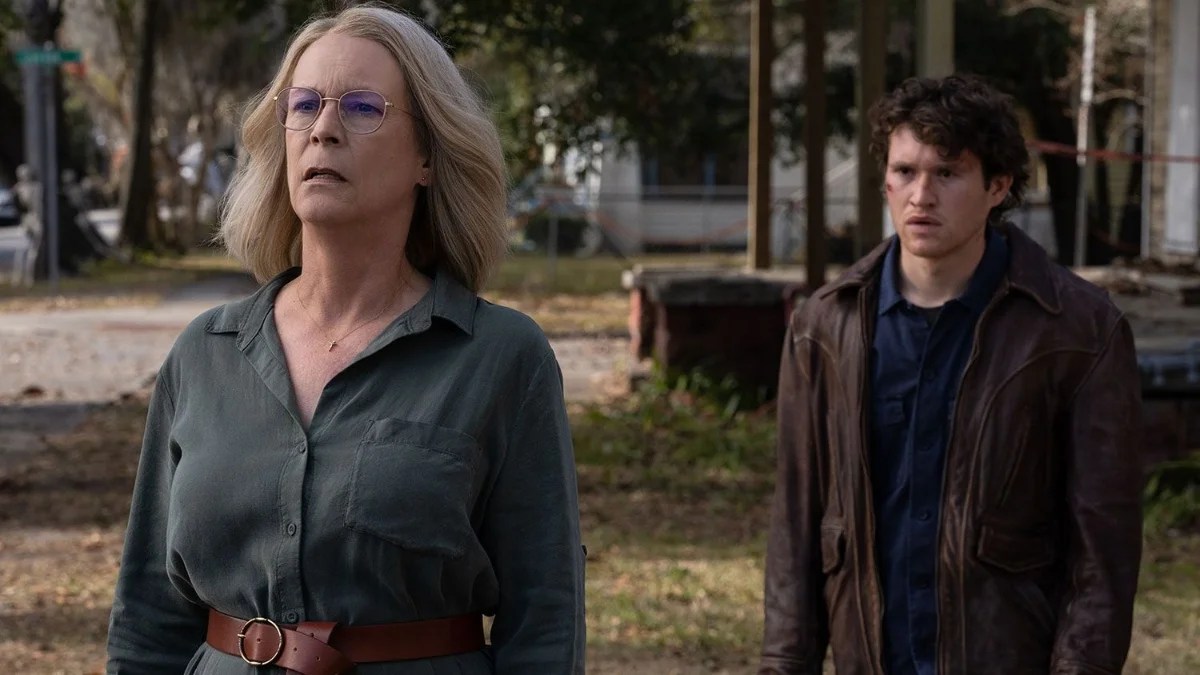
Everything seems fine, except for the fact that, as Laurie informs us in voice-over, a sinister shadow looms over the town, and the evil embodied by Myers still subtly eats away at the local community. We return to the starting point, where the ominous presence of the masked killer once again intrudes on the town’s orderly life. One might think that the idea for continuing the previous films and building the drama for the series finale is at best mediocre.
Misguided conclusions
The strength of Halloween (2018) was its unpretentious dive into slasher convention and the unleashing, through a pretextual plot, of a bloody spectacle focused on genre entertainment without greater obligations. In Halloween Kills, Green maintained the high pace of the spectacle and once again offered fun staging of Myers’ murderous march, unnecessarily adding a rather clumsy social subplot that disrupted narrative clarity. I imagine that before the third installment, the creator and his team of co-writers reviewed what worked and what did not in the previous two films to steer the finale in the right direction.
If they indeed did that, they drew completely misguided conclusions in Halloween Ends. The emphasis is shifted almost exclusively to the social-morality layer, with a few gore scenes seemingly added just for decoration. Looking at the progression of Green’s trilogy, it seems as if during the filming of the middle part, the director lost his fascination with James Wan and his approach to revitalizing horror classics, and instead became absorbed by socially tinged horror cinema in the style of A24, deciding to change the original direction of his series.
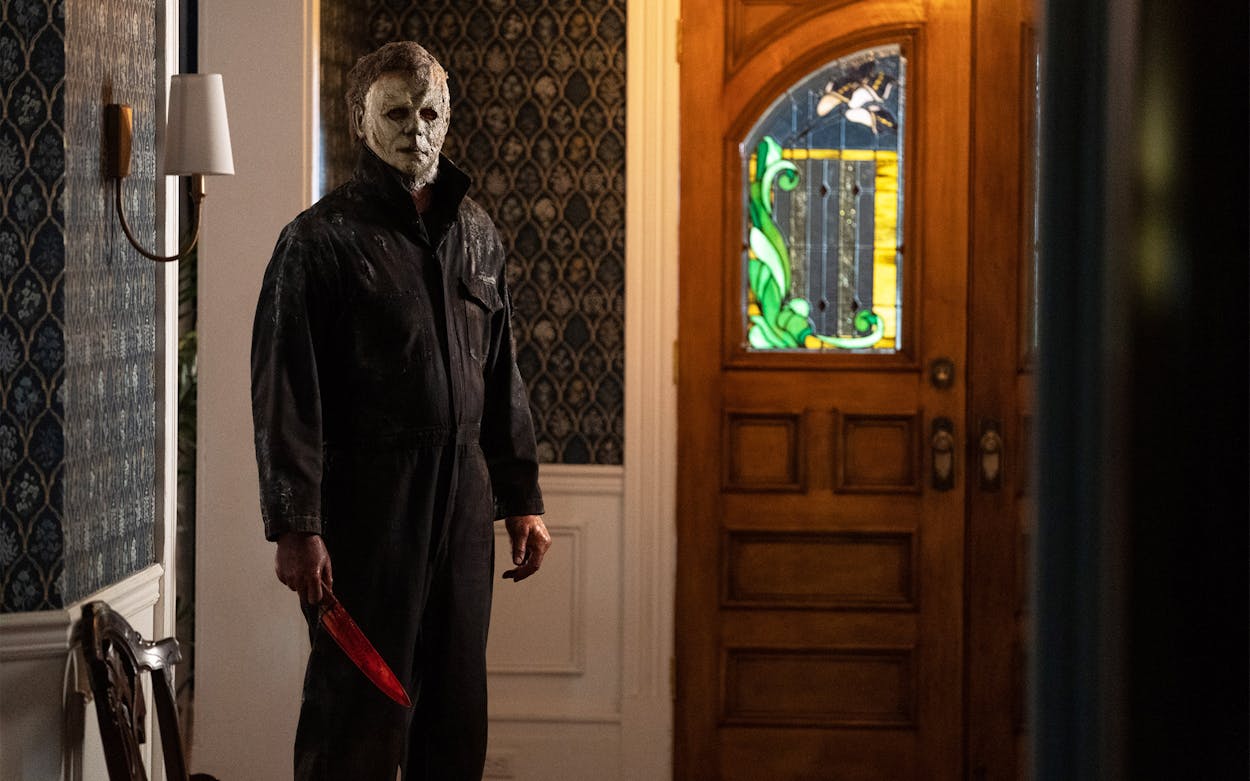
As a result, in the finale, he suffocated all the staging momentum of his Halloween and offered an uninteresting, simply boring morality tale based on motifs from Carpenter’s classic film. In Halloween Ends, there are many bizarre script decisions, lacking flair in the reprises and giving the impression of merely ticking off mandatory action scenes. At times, I wondered if the screenwriters even remembered the previous films – the story of the “third” film barely connects with the 2018 and 2021 movies.
There is also a lack of coherence within the film itself. Green introduces or reminds us of certain tropes only to completely ignore them later, depending on what suits his vision at the moment. This vision, moreover, is devoid of flair – here is Green, apparently feeling like a horror sage in the vein of Wes Craven, serving us deep reflections on the nature of evil, its birth, and what it does to its victims.
And indeed, in the hands of a better director, this could have been an interesting story. But David Gordon Green is clearly not a creator who has anything compelling to say here beyond a collection of banalities, awkwardly incorporated into a framework borrowed from one of the greatest classics of the genre.
A patchwork of threads
Speaking of the framework. In his incomprehensible pursuit of a quasi-philosophical meta-commentary on the ruins of the slasher, the creator completely marginalizes what was the heart of the Halloween series and the driving force of Halloween and Halloween Kills: the confrontation between Laurie and Michael Myers. Both characters are pushed from the forefront in favor of Corey, a stigmatized boy who, after an unfortunate accident, begins to teeter on the line between good and evil.
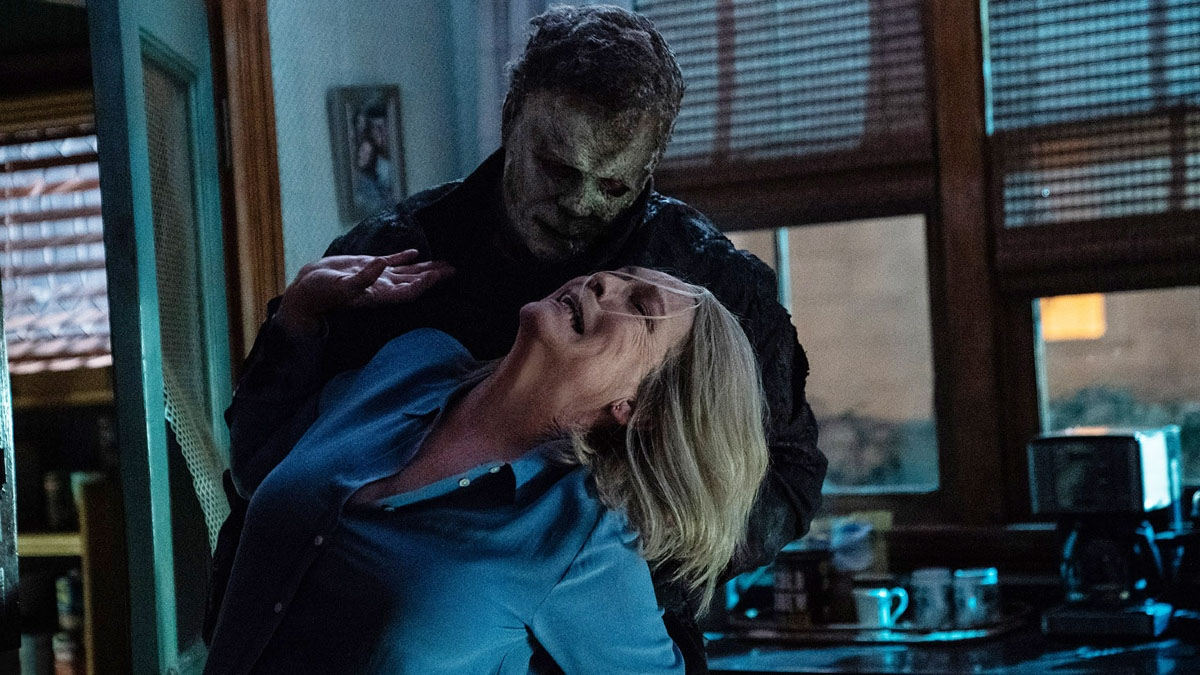
Green constructs a clumsy parallel between Corey’s developing relationship with Allyson, Laurie’s granddaughter, and the fated bond connecting Strode and Myers, forcing the latter duo into merely secondary roles in a film that should and was meant to be a story about their final confrontation.
Departing from the main characters would not be bad in itself, but here, firstly, there is no interesting proposal for what could fill the space they leave, and secondly, it undermines from within the entire convention established in the series reboot – and in a bad way. As a result, the final Halloween is an incoherent patchwork of threads, seemingly connected to Michael Myers’ story and the previous films merely out of decorum, whose message is reduced to explanatory dialogue about evil can be within us or society allows evil to exist.
It is very unfortunate that Michael Myers’ story ends this way. Especially considering that in 2018, David Gordon Green offered something refreshing, corresponding with the original, giving hope for a meaningful trilogy. Unfortunately, all he achieved was, perhaps for good, sending the cult killer off the cinema screens. The finale may serve as evidence that it is probably no longer worth returning to this universe, and it is better to focus on other stories.
If that was Green’s message, then fine, he succeeded – but at the cost of simply making a bad film. Because in the end, Michael Myers was used by Green only as a marketing lure for a theoretically interesting, yet clumsy, genre paraphrase lacking dramatic fluidity and skill in handling genre elements.

So let us thank Halloween for its service and, at most, return to the best moments of the series, but let us not make the aged Myers haunt Haddonfield again.

