
Review
OUTSIDE THE WIRE: How Not to Make a Blockbuster
I approached Outside the Wire with an open mind — I knew it wouldn’t be any sort of revolution in the blockbuster category, but I expected solid action cinema with plenty of thrills and strong characters.

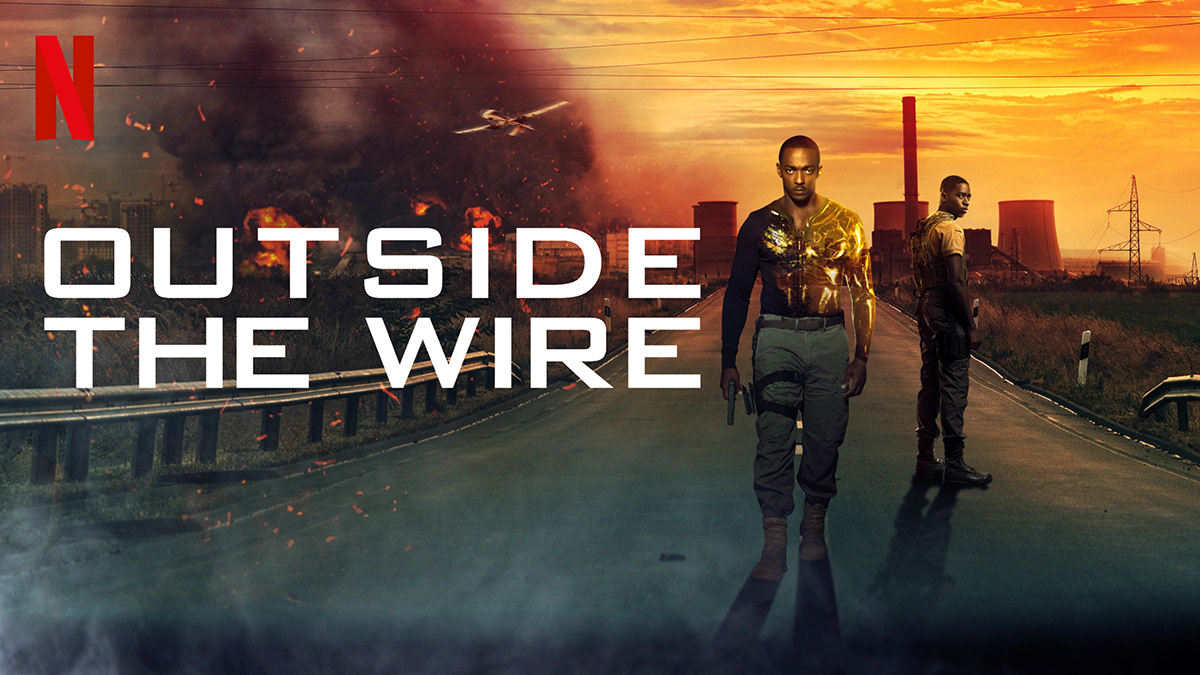
“Netflix and series” and “Netflix and films” are like two completely separate stories. The first is a genuine success story, like the career of a millennial in an international corporation — a few minor stumbles, many successful projects, and a generally positive impression. The second story is a bit like the Polish national football team — generally weak, but once in a while there’s a valuable victory achieved in decent style, and then everyone starts thinking that maybe now everything will finally change for the better. And then comes a defeat against Azerbaijan, for example. For Netflix’s film branch, Outside the Wire is exactly that kind of loss to Azerbaijan.
And the thing is, there are plenty of elements here that could have given hope for success. On the one hand Mikael Håfström, a Swedish director with considerable Hollywood experience, on the other Anthony Mackie, who in recent years has been gaining confidence on the acting scene. Add to this a respectable budget, a talented young lead actor (Damson Idris), and a topical subject, and you get an almost ready-made recipe for a successful blockbuster. Or do you? With blockbusters, if they aren’t fronted by a top-tier star — and ideally also a director of equally great stature — it may be a sign that something about the project is off.

Either there wasn’t enough budget for a big name, or the script didn’t appeal to any major stars. Everything becomes clear within the first several minutes, when Lieutenant Harp (Idris), a drone pilot reassigned to a ground unit for disobeying an order, ends up under the wing of Captain Leo (Mackie) — and that’s when the chaos begins. Even the explanation of the mission objective feels like gibberish: some Russian terrorist, some vaccines, nuclear warheads — basically, everything you’ve ever heard in spy-military films shows up in Outside the Wire in one form or another. Many adjectives could be used to describe Håfström’s film, but “original” or “coherent” are not among them.
I approached Outside the Wire with an open mind — I knew it wouldn’t be any sort of revolution in the blockbuster category, but I expected solid action cinema with plenty of thrills and strong characters. Of the two protagonists, only Captain Leo stands out — an android officer who doesn’t coddle the inexperienced Harp and, in a way, uses him for his own purposes.

Damson Idris does what he can, but the character of an irritating idealist/oversensitive millennial is simply not likeable — on the one hand capable of insubordination in the name of personal beliefs, on the other spouting asinine phrases straight from the Marine Corps handbook. Harp is a caricature of a hero one simply cannot root for. Somewhere in the background of all this sits Ideology with a capital I — an anti-war message, the issue of using robotics in combat (there are soldier-robots here, called Gumps — a Forrest reference, perhaps?) and responsibility for collateral damage. All of these topics, however, are cruelly flattened, trivialized, barely sketched.
No one even attempts to pretend there’s a comprehensive approach to modern warfare or global threats — as in 90s action films, we have a Russian terrorist and American saviors who are always ready to rescue the world in the name of grand, yet empty ideals. Even if they are soldiers who picked up guns and marched into battle only a few hours earlier.

I watched Outside the Wire late in the evening, and I sat down to write the review the next morning — and even then I had to concentrate hard to recall certain plot elements. Håfström’s film is essentially a film-like product, where narrative chaos reigns and worthwhile characters are lacking.
There is no deeper reflection on the themes it raises, nor are there memorable scenes. A handful of well-executed battle sequences is the absolute minimum for a production of this type, not a reason for satisfaction. After the premiere of Outside the Wire, Netflix was once again on its film-making trajectory akin to suffering a loss against Azerbaijan or Gibraltar.

