
Review
SPHERE. Shallow Science Fiction Pretending to Have Depth
Sphere is an A-class film in terms of cast and production values, but revisiting the film years later reveals that the negative reception was entirely justified

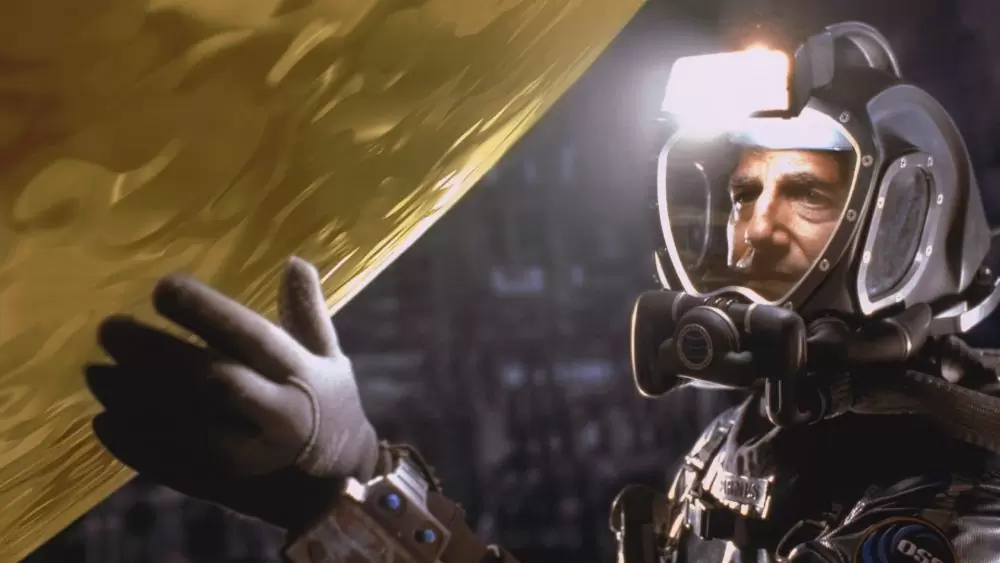
Sphere is an A-class film in terms of cast and production values – and B-class in every other respect. At the bottom of the Pacific Ocean, a massive spacecraft wreck is discovered, one that calculations suggest sank nearly three hundred years ago. Experts suspect that alien life forms might be aboard. The U.S. government secretly sends a team of scientists to the site: psychiatrist Norman Goodman, biologist Beth Halperin, mathematician Harry Adams, and astrophysicist Ted Fielding. Accompanying them are Navy Captain Barnes and two female staff members of a state-of-the-art underwater research station. To their astonishment, the scientists discover that the ship is not of alien origin but from the future; its human crew had encountered a black hole in deep space that hurled them three centuries into the past.
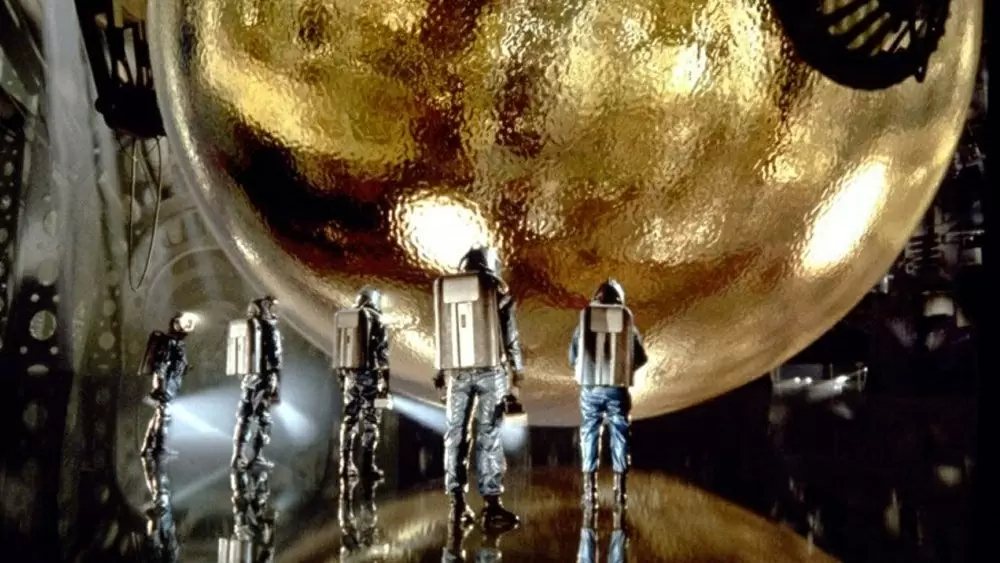
Inside the wreck lies something else: a golden sphere with a liquid, impenetrable surface. Contact with this mysterious object triggers terrifying events on the station.
In the 1970s, Michael Crichton enjoyed major success through adaptations of his bestselling novels — The Andromeda Strain (1971) by Robert Wise — as well as his own films like Westworld (1973) and The Great Train Robbery (1978), though there were also commercial stumbles, such as the brilliant but overlooked The Terminal Man (1974) by Mike Hodges.
The next decade brought him a string of failures: Looker (1981), Runaway (1984), and Physical Evidence (1989) were panned by critics and bombed at the box office. Crichton’s popularity surged again with the massive success of Steven Spielberg’s Jurassic Park (1993), based on his three-year-old novel. Hollywood producers rushed to cash in on the Crichton craze, producing several more — and uneven — adaptations of his works. Barry Levinson directed two of them: Disclosure (1994) and Sphere (1998).

Sphere was designed as a big-budget sci-fi spectacle: it cost around $80 million, with shooting taking place at the former Mare Island naval base in Northern California, where massive water tanks were built for underwater scenes. Nearly thirty specialists worked on both practical and digital effects. The cast included big-name stars like Dustin Hoffman (Goodman), Samuel L. Jackson (Adams), Sharon Stone (Halperin), and Liev Schreiber (Fielding). The release, originally planned for December 1997, was pushed to February the following year to avoid competition from James Cameron’s Titanic, Roger Spottiswoode’s Bond entry Tomorrow Never Dies, and other likely blockbusters. The strategy failed: Sphere was a box office flop and, worse, was shredded by American critics. And rightly so?
Revisiting the film years later reveals that the negative reception was entirely justified. The premise is intriguing — even if not particularly fresh, given Stanisław Lem’s Solaris and Andrei Tarkovsky’s 1972 adaptation — but its execution disappoints.
Sphere quickly devolves from a work with near-philosophical ambitions into a routine, predictable, and frankly dumb action flick filled with chases, monsters, and explosions. The plot is riddled with absurdities: a potentially dangerous alien contact mission is staffed with a single soldier, two assistants, and four unarmed, untrained scientists who likely have never dived in deep ocean waters; the communication code with the “alien” is mistranslated, but the error inexplicably affects only some words, while in others the letters still match their intended numerical values, defying logic, mathematics, and basic coding principles.
Such idiocies abound, making suspension of disbelief impossible. The film’s credibility is further undermined by the cast — good actors miscast in roles they can’t inhabit convincingly. Hoffman works passably as a psychologist, but Stone is wholly unconvincing as a biologist: she comes across more like a 1990s celebrity than a scientist. The worst casting misstep is Jackson as a mathematician; at the time, he still seemed to be channeling Jules from Quentin Tarantino’s Pulp Fiction (1994), complete with the same mannerisms and expressions. It’s impossible to buy him as a brilliant academic rather than a contract killer.
Ironically, the least experienced actor here, Schreiber, fares best, though he too doesn’t look or act like an astrophysicist. That’s the core issue: none of these characters resemble real scientists in either behavior or appearance.
Although the film cost $80 million, that money is nowhere to be seen on screen — perhaps it all went to the cast’s salaries. The spaceship and station interiors look artificial, exactly what they are: sets and props. The golden sphere’s animation looks worse than that in contemporary computer games, and the final sequence of the sphere soaring into space resembles a cheap TV movie, not a Hollywood tentpole. All of this could be forgiven if the story were gripping and the filmmakers didn’t treat audiences like fools who’d never seen Forbidden Planet (1956), The Abyss (1989), Event Horizon (1997), or countless other films from which screenwriters Stephen Hauser and Paul Attanasio seemed to borrow liberally. Unfortunately, they failed to add even a spark of originality.

