
Review
SEQUENCE BREAK: The Worst Science Fiction Movie Ever?
Sequence Break is said to be inspired by the urban legend of Polybius—an arcade machine that supposedly appeared in a handful of Portland suburbs in 1981

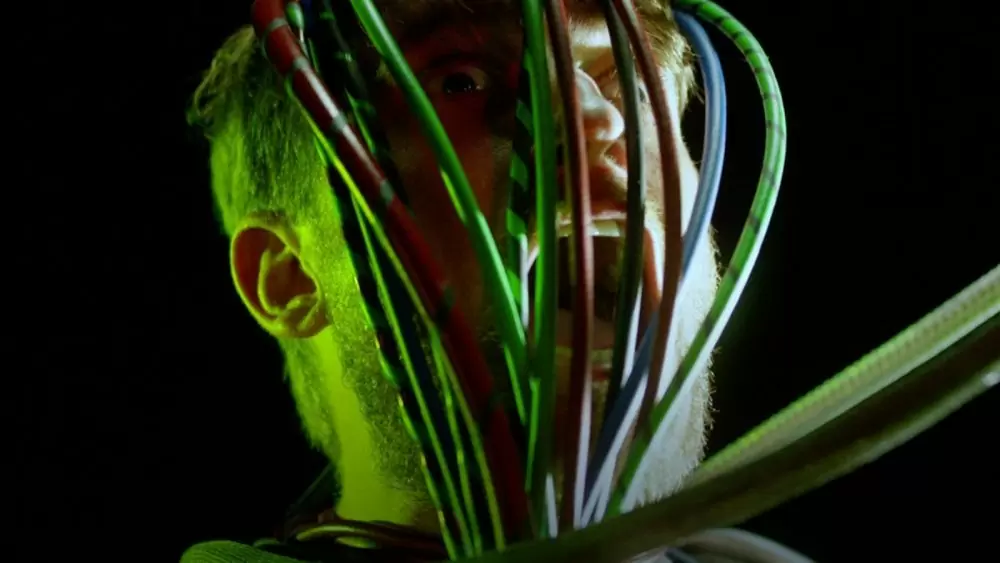
“Look between zero and one,” says the heroine of Sequence Break, offering viewers an apt assessment of the film.
A young man named Oz works in a store that sells old video game consoles. Technological artifacts from the ’70s, ’80s, and ’90s are his entire world: Oz spends every spare moment repairing broken equipment and quietly dreams of a career as a programmer. But his professional future is thrown into doubt when the shop’s kindly owner, Jerry, tells him he has to shut down due to financial troubles. That same evening, Oz meets Tess in a bar—an eccentric and outspoken girl who had previously stopped by the shop.
After a brief conversation, Oz and Tess go on a date and quickly fall in love. Meanwhile, a mysterious package arrives at the store containing a motherboard, which Oz connects to a console. Doing so reveals a strange, unfamiliar game. Playing it, however, brings disturbing side effects: loss of time, violent nausea. To make matters worse, a shadowy man lurks nearby, somehow connected to the dangerous game.

Sequence Break is said to be inspired by the urban legend of Polybius—an arcade machine that supposedly appeared in a handful of Portland suburbs in 1981. The gameplay was rumored to be addictive and to cause harmful effects in players (usually minors): amnesia, seizures, night terrors, hallucinations, mental breakdowns, even disappearances and sudden deaths. Fueling the legend were reports of “men in black” allegedly showing up at arcades, recording data from the Polybius cabinets, and then vanishing, which led to speculation that the game was actually a covert government project designed for social experiments akin to MKUltra. Yet the existence of Polybius (often compared to real games like Cube Quest and Tempest) has never been officially confirmed.
The fascinating story of Polybius was the only valuable takeaway from watching Sequence Break, since I haven’t seen a film so disastrously executed on every level in a long time: a paper-thin plot, a forced romance, wooden acting, cheap special effects, strobe-like editing, clumsy direction, incoherent dialogue… It’s clear Skipper was aiming high—there are hints of inspiration from Ken Russell’s Altered States (1980) and David Cronenberg’s Videodrome (1983) and eXistenZ (1999)—but those ambitions were buried under sheer amateurism.
And the problem isn’t the low budget, because small funds can yield great achievements [see Shane Carruth’s Primer (2004)], but rather an absurd screenplay. The film simply makes no sense and is a strong contender for the title of the worst science fiction movie in history, tied with Luigi Cozzi’s Starcrash (1978). But at least that one was fun.


