
Review
MARS AND APRIL: A Sci-Fi Film by Denis Villeneuve’s Brother
Mars and April unfolds at the intersection of magical realism, sci-fi, and symbolism, where the conquest of Mars rhymes with the first experience of love.

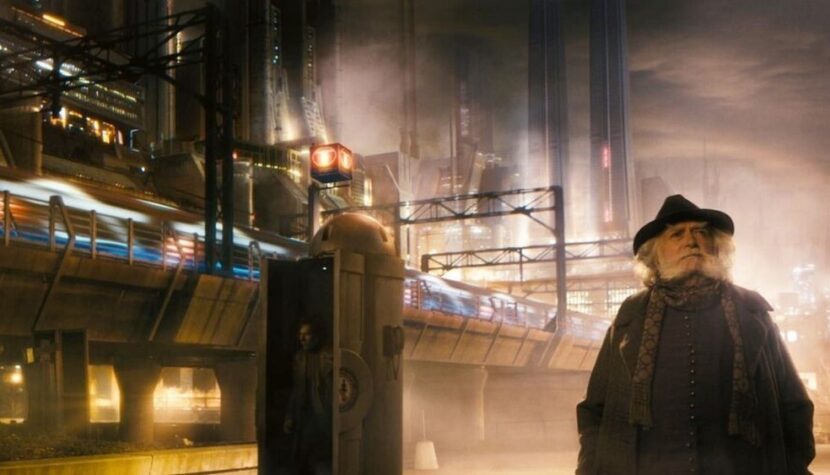
Every cinephile knows that thanks to films like Arrival and Blade Runner 2049, Denis Villeneuve almost single-handedly revived top-tier science fiction for cinema with a philosophical touch. But perhaps not everyone is aware that his younger brother, Martin, attempted to do the same before him in Mars and April.
The story unfolds in Montreal in an unspecified future.
Jacob Obus is a charismatic, mysterious musician adored by the public and desired by women despite his advanced age. Jacob plays a blend of jazz, ambient, and electronic music on unique wind instruments, each inspired by the shape of the female body and generating previously unknown sounds that seem to slow down time. Jacob’s friends, young artist Arthur Spaak and his father, controversial cosmologist and engineer Eugène, are responsible for designing and constructing these unique instruments. Suddenly, the beautiful photographer Avril enters the lives of Jacob and Arthur, and she reciprocally falls in love with both men. Meanwhile, humanity prepares for its first manned flight to Mars, despite Eugène’s warnings that the red planet is merely a product of collective imagination.

The work on Mars and April took seven years. Initially, it was a graphic novel by Martin Villeneuve, which Robert Lepage wanted to adapt into a film in 2005. However, when his production company went bankrupt, the project fell into the hands of Villeneuve, who managed to raise over 2 million dollars and collaborate with François Schuiten, a Belgian comic book artist and author of the Dark Cities series. Due to budget constraints, pre-production of the film took nearly a year, during which the team prepared the screenplay, set sketches, and special effects designs. Approximately 1,200 storyboards were created, piecing together the various sequences of the film, framing compositions, and camera movements.
Thanks to meticulous preparation, Mars and April were shot in just 25 days in 2009, almost exclusively against a green screen and using a digital RED camera. Post-production took another three years.
The Benedictine work paid off, resulting in a complete world with unique architecture, music, and fashion, drawing inspiration from retrofuturism, steampunk, Luca Besson’s The Fifth Element, Enki Bilal’s Immortal, and Jaco Van Dormael’s Mr.
Nobody

Villeneuve’s film narrative unfolds at the intersection of magical realism, science fiction, and symbolism, where the conquest of Mars rhymes with the first experience of love (in both cases, it’s about discovering new worlds). The future depicted by the Canadian director is utopian: a universe untouched by wars but full of empathetic individuals sensitive to truth, goodness, and beauty. It’s a contemporary fairy tale—charming and captivating in its way, yet somewhat murky and inconsistent. However, despite certain inconsistencies, a production that, generally departing from the stereotypical science fiction with chases, explosions, and violence, is a value in itself. It’s a thought-provoking, peculiar, distinct film that could be an adaptation of one of Ursula K. Le Guin‘s works, such as “Always Coming Home” about the Kesh tribe, a future people enamored with music and poetry.


Looking back at DEAD SNOW: A Blizzard of Nazi Gore Fun

DEAD SUSHI: Exotic, Spicy, and Wildly Entertaining

Revisiting ALICE, SWEET ALICE: Dread and Religious Symbolism

PUPPET MASTER: LITTLEST REICH – Achtung! It’s Good!
