
Review
NEMESIS. B-class SCIENCE FICTION MASTERPIECE
Nemesis, a film just as cult-worthy as Pyun himself. A movie that, more than 30 years after its premiere, can confidently be regarded as a B-movie masterpiece.


Albert Pyun deserves to be called a cult director. He didn’t make great cinema, but he never aimed to. He played with cinema. He sold emotions using kitschy aesthetics. In 1992, that play resulted in Nemesis, a film just as cult-worthy as Pyun himself. A movie that, more than thirty years after its premiere, can confidently be regarded as a B-movie masterpiece.
The VHS-dominated era of the 1980s and 1990s shares something with today’s world of streaming media.
I’m referring mainly to the pace of production, the multitude of titles, and the quality-to-budget ratio. Alongside mainstream theatrical distribution, something peculiar and powerful emerged that began to live a life of its own. What flopped at the box office could successfully recoup losses through VHS. In fact, many lower-budget titles were only able to exist thanks to VHS, bypassing traditional theatrical release and going straight to home media. Albert Pyun was a creator who sensed this trend at the time and ran with it.

The Sword and the Sorcerer from 1982 was the film that kicked off Pyun’s adventure with low-budget cinema in a big way.
With a $4 million budget, the fantasy spectacle earned ten times that amount. That’s roughly how big money was made from B-grade, kitschy productions (a practice that continues to this day). Pyun later began collaborating with Cannon Films. In the late 1980s, he made the now-famous Cyborg for the studio, starring Jean-Claude Van Damme. The film was a hit and opened the door to another project steeped in cyberpunk aesthetics. However, the script for Nemesis had been in development for much longer and went through various forms over the years.
At one point, there was even a version set… on Mars.
Ultimately, it stayed grounded—though not in the present. The action takes place in the year 2027. Humans are fighting for dominance over the world with cyborgs. Terrorism is a global plague, countered by a special task force made up of half-human, half-machine operatives. One of them, Alex Rain, is accused by his former employers of killing the leader of an underground resistance group—who also happens to be his ex-lover. Rain uncovers a plot by the cyborgs to take over global governments. The problem is, he’s on his own. All he can do is run and shoot anyone who stands in his way.

It’s hard to believe, but the original script supposedly featured a 13-year-old girl as the main character, working undercover for the police. Megan Ward was considered for the role and even initially agreed to participate, despite concerns about violent and nude scenes. When Pyun was looking for producers, he filmed a few scenes with Ward and sent them to the Shah brothers at Imperial Entertainment. They agreed to fund the film—but on one condition: the main character had to be a man. They proposed Olivier Gruner, a French kickboxer they had previously discovered.
Pyun agreed, with the caveat that he didn’t want any more changes to the script. What was delayed eventually came to pass—the idea of a female protagonist was used in the Nemesis sequels. The 1992 film was the first in a series that included four direct sequels and one spin-off.
I’m glad Pyun gave in to the studio’s demands and hired Gruner. The world of B-movie cinema became a better place because of this discovery. A fantastic role, perfectly tailored to the tone of the film. The character is full of exaggeration, yet incredibly charismatic. Preparing for the role, Gruner reportedly reduced his body fat to just four percent.
Deborah Shelton, who appears in a supporting role, also trained hard. Although she has just one memorable scene in which she dramatically reveals her body, it’s known that she put a lot of effort into looking flawless for that moment. In the background, we also see familiar faces often cast as movie thugs—like Cary-Hiroyuki Tagawa (Mortal Kombat) and, of course, Brion James (Blade Runner).
The cast in Nemesis is well-chosen, though admittedly schematic.
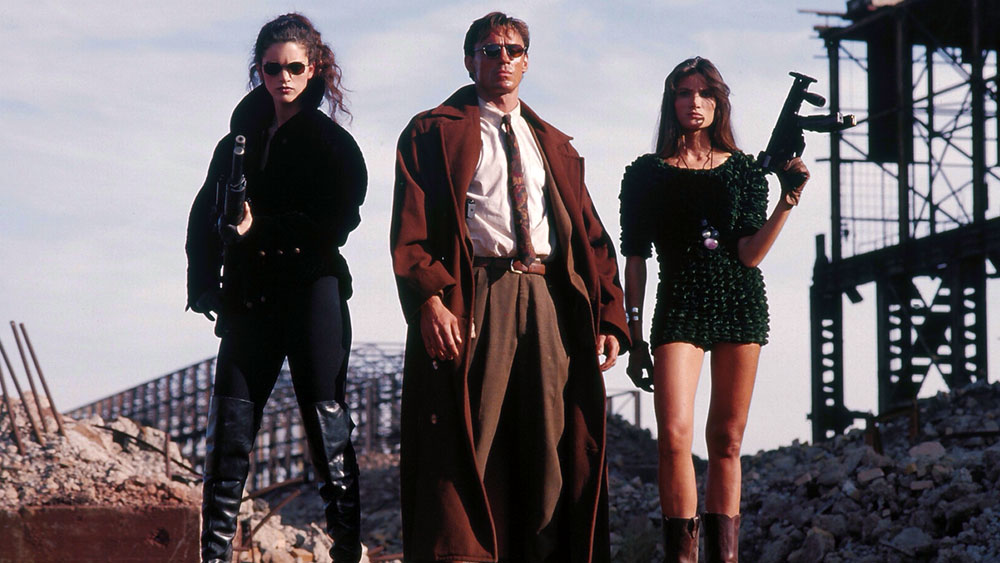
It’s hard to claim that Nemesis is original—at least in terms of the script. The idea of implanting a bomb in Alex Rain as “insurance” was borrowed from Escape from New York. But the film is full of echoes from other action and sci-fi classics. The entire concept of putting the protagonist in a hunted-man situation came from The Six Million Dollar Man.
The cyberpunk elements, especially the enhancement of the protagonist’s body with cybernetic parts, were lifted from RoboCop and The Terminator.
What does feel original and fresh is the execution. Nemesis features plenty of practical effects, which, given the film’s modest $2 million budget, turned out surprisingly solid. Pyun deliberately chose a warm earth-toned color palette, in contrast to the cold hues typically expected in futuristic cyborg films. The film also boasts a great pace, with short but punchy dialogue scenes interspersed with brilliantly directed action sequences. The scene where Rain shoots through the floor to escape, or the one where characters slide down a chute while continuing to shoot (reportedly injuring the cameraman), delivers a level of cinematic energy that’s hard to compare to anything else.

Much of that success is owed to the stunt team.
One story stands out: Olivier Gruner’s stunt double, Bob Brown, dislocated his shoulder during a window jump scene. Brown didn’t want to continue, but Pyun refused to replace him with another stuntman. To persuade him, Pyun offered him an additional credit as stunt coordinator, which came with a significantly better paycheck. There’s also a crazy scene where an elderly woman shoots at a cyborg while tossing out some bitter parting words. That woman was Mabel Falls, a non-professional. Pyun was initially worried she wouldn’t manage to hold the heavy weapon, but thankfully he was wrong—the scene turned out great.
Nemesis is, in many ways, a film that seems determined to go against the grain and provoke its audience.
One such way is through its portrayal of violence against women—a stark contrast to the original idea of a female lead. There are several moments in the film (especially the prologue) that would likely not sit well with today’s audience due to the negative depiction of women. It’s especially surprising considering the screenwriter is listed as a woman—Rebecca Charles. But that’s a ruse. It turns out the name was a pseudonym for Albert Pyun himself, encouraged by the studio to use a female alias.
Why? No one knows for sure. Perhaps the studio wanted to avoid accusations of sexism. Then again, who in the late ’80s or early ’90s even cared about that?
https://youtu.be/bNHcVS6EUQg What stands out most in Nemesis today is its uncompromising nature. It’s a trait that’s become exceedingly rare in today’s sanitized, carefully crafted cinema. It’s also a film that proves that even with a kitschy approach and a drastically low budget, one could still create a unique atmosphere—a mix of charismatic acting, lovingly made effects, clever locations, and energetic action scenes.

