
Review
MEN. Garland’s Film Doesn’t Entirely Succeed
Men is further proof of Alex Garland’s directorial talent. The English filmmaker fits seamlessly into the A24 tradition of horror


Horror has always acted as a catalyst for social anxieties, giving shape to the demons lurking in our culture. It’s no surprise, then, that one of the recurring themes in the genre is the often-toxic dynamics between men and women. Despite the achievements of feminism, the problem of gender asymmetry in contemporary society hasn’t disappeared, making it fertile ground for reflection. Into this vein falls a film suggestively titled Men , the third directorial work from one of the most interesting contemporary filmmakers, Alex Garland.
The concept of Men is simple: Harper, a solitary protagonist, retreats for two weeks to a rural estate in a remote, stereotypically provincial area. She stays in a large stone house set amidst rolling meadows, forests, and hills, practically uninhabited. In this classic “sleepy village,” Harper hopes to process the fresh trauma of her husband’s tragic death, from which she had intended to part ways. The seclusion she seeks, however—as anyone familiar with horror cinema can predict—has enormous potential to turn against her, transforming a haven of solitude into the isolation of a besieged victim.

Exactly that happens in Men. While walking through the woods, Harper encounters a mysterious figure that seems to be following her. From that point on, increasingly unsettling events unfold, as do disturbing encounters with the locals, who, in Harper’s words, appear “peculiar at best,” including the landlord renting her the house. What was supposed to be a retreat to regain calm and process grief gradually devolves into a nightmare, forcing her to confront not only what she hoped to escape, but—literally—the very masculinity embedded in the world around her.
After exploring science fiction in Ex Machina and Annihilation, Garland here delves deeply into folk horror, though he remains faithful to the foundations of his creative identity. Men is structured as a psychologically unsettling thriller, blending multiple genre conventions. The intimate psychological drama is smoothly integrated with home invasion suspense, spiced with body horror and graphic gore. Overlaying all of this is the aesthetic of contemporary elevated horror: through long takes and sophisticated use of color grading, Garland creates an uncanny atmosphere, using the rural setting to build a sense of almost gnostic dread.
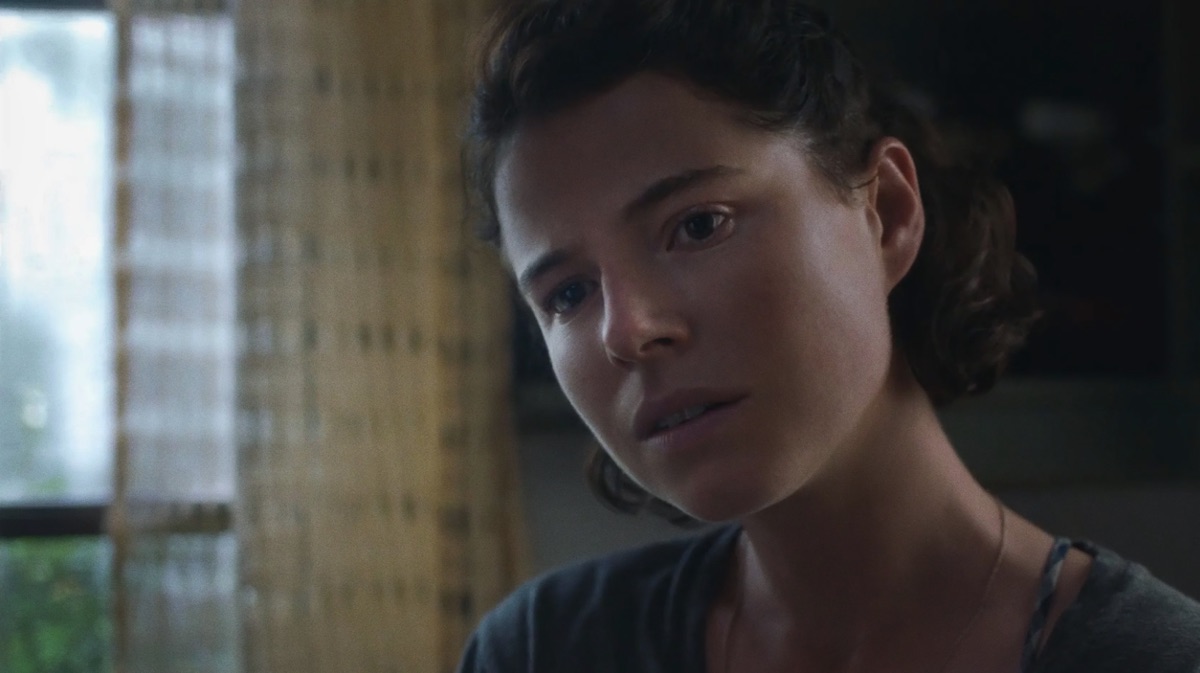
Above all, the narrative of grappling with trauma is extended through a gendered lens, amplified to its extremes within the titular metaphor. The malevolent force haunting Harper is masculinity itself—the androcentric structures of the world. It surrounds her, from minor details like the formal address “Mrs./Miss” to enforced self-sacrifice, caretaking, and imposed guilt. In Garland’s vision, this force takes a literal physical shape in the form of men brandishing phallic violence—sometimes figuratively, sometimes literally. Or perhaps one man, since all male roles (aside from Harper’s husband) are played by Rory Kinnear.
The effect is… peculiar. The exaggerated, sometimes brazen stylization disrupts realism and creates cognitive dissonance. Yet this serves to convey Harper’s psychological state, through whose perspective the audience ultimately experiences the story. The audacious concept immerses viewers in a demonic space where predatory masculinity—embedded in culture—is the central threat.

This device doesn’t entirely succeed. Garland reveals both the narrative and metaphorical cards fairly quickly, exhausting the central tension long before the finale, which ends more like a straightforward slasher climax than a cathartic resolution. Men doesn’t offer a novel argument about toxic masculinity, instead compiling familiar motifs in a new form. Its saving grace lies in execution: Garland expertly uses audiovisual craft to escalate the horror, seamlessly shifting between different horror traditions while maintaining relentless pacing. Realistic and surreal sequences blend, masking the story’s literalness and superficiality, turning its simplicity into an engine of fear—a highly effective horror puzzle.
The lead actors contribute significantly. Kinnear excels in transforming into multiple characters, emphasizing grotesque elements that enhance the narrative. Jessie Buckley, as Harper, continues to build on the elevated acting she demonstrated in Charlie Kaufman’s I’m Thinking of Ending Things, merging two of her strongest previous roles: the disoriented young woman from Kaufman’s film and Maggie Gyllenhaal’s The Lost Daughter-like struggle against societal expectations and inner desires. Her nuanced, suggestive portrayal of uncertainty complements Garland’s vision perfectly.

Men is further proof of Alex Garland’s directorial talent. The English filmmaker fits seamlessly into the A24 tradition of horror that processes social tensions, crafting genuinely compelling genre entertainment. Though not flawless in script and not a groundbreaking work, the film offers a provocative voice in contemporary feminist discourse. Its technical precision and stylistic command elevate it above mediocrity, delivering tension, aesthetic sophistication, and sharp social commentary. Garland, once again, proves that horror can be as thought-provoking as it is frightening.

