
Review
HAMNET. The Revenge of a Mortal Hand [REVIEW]
Hamnet is not, contrary to one English-language promotional tagline, a perfect film.


During a literary theory class, the lecturer provocatively declared that all the novels in the world could more or less be divided into two types: those that tell stories about love and those that tell stories about death. The purpose of this blatant oversimplification was simple — to spark a discussion about the two most popular themes in art. For Eros and Thanatos, although seemingly incompatible at first glance, love to walk hand in hand. The proof? Any of Shakespeare’s tragedies, or the first Hollywood melodrama you come across. Love is almost always accompanied by death, which balances out the positive emotions and forms the foundation of the final catharsis. A similar dynamic is at play in Hamnet, where Chloé Zhao uses the structure of a melodrama to explore two powerful emotions — a marriage of love and despair: the fate of a young couple whose life is shattered by the death of a child
But this is no ordinary marriage. Maggie O’Farrell, the author of the novel on which the film is based, avoids using the surname for several hundred pages. Zhao also reveals it relatively late, only once the action shifts to London — though the ruthless promotional materials strip away the mystery from the start, informing viewers that the main characters of Hamnet are William and Agnes Shakespeare. The first part of the film is a period domestic drama. Romeo and Juliet, but without the tragic ending.

The protagonists fall in love and decide to marry despite the disapproval of both families. He is, after all, a daydreaming slacker, the poor son of a glover, paying off his father’s debts by tutoring Latin. She is even worse off — a forest-wandering orphan whose mother, well-versed in herbal medicine, was considered the local witch. Neither of them is regarded as a good match by the small-town community, and perhaps that is precisely why the marriage comes to pass.
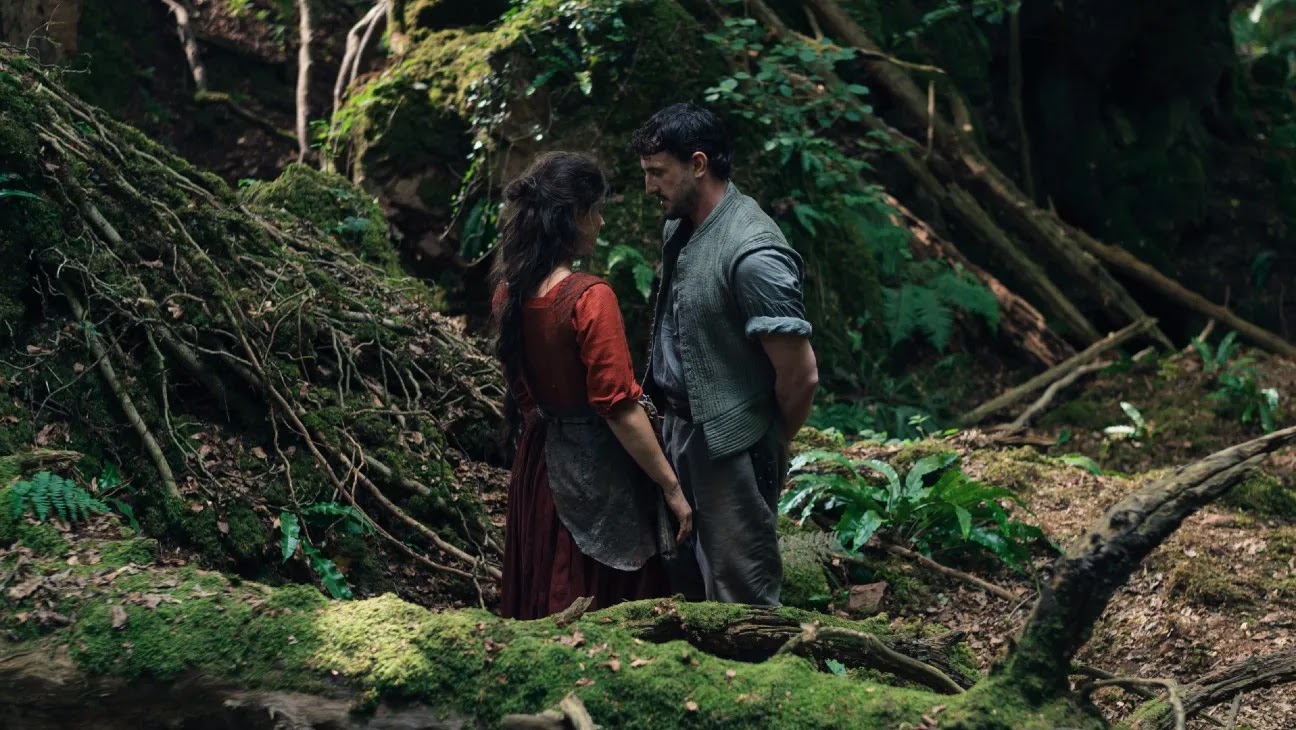
Zhao intercuts scenes of domestic bliss with genuinely naturalistic images (see: the very long and emotionally exhausting childbirth sequence). Łukasz Żal’s camera smoothly adapts to the moment. When things go well in the Shakespeares’ life, it lets us breathe — capturing events from a distance, in wide and full shots. At critical moments, it moves closer to the characters, clinging to their faces and catching the emotions tearing them apart from within. Visually, Hamnet is without a doubt one of the most beautiful films of the season. Among Zhao’s major aesthetic inspirations she lists, among others, the cinema of Terrence Malick — a reference that is clearly visible on screen, especially in the way nature is portrayed.

Nature, in fact, plays an immensely important role in Hamnet. It becomes psychologized, reacting to turbulent human relationships. When a deadly illness looms on the horizon, the sky darkens and the nearby bees begin to behave strangely — Agnes notices this but cannot interpret it. Zhao and O’Farrell, who serves as co-screenwriter, draw the main characters in accordance with the ancient Nature–Culture dichotomy. Agnes, consistently filmed against a forest backdrop, represents the former; William, shown surrounded by piles of papers, the latter. Their marriage is suspended between the rational and the irrational, the spoken and the hidden.
This dichotomy is reflected in their performances. While Jessie Buckley uses a full palette of emotions and acts in an expressive, energetic way, Paul Mescal remains withdrawn, locked inside himself, much like in his memorable role in Aftersun. William steadily suppresses everything within him, allowing himself only occasional outbursts — he processes his grief over his child’s death through art. Though the performances are very different, both are equally fantastic, and everything suggests they will rank among the Oscar contenders.
Hamnet is not, contrary to one English-language promotional tagline, a perfect film. It has its highs and lows. It often balances on the edge of kitsch, and at times crosses that line — especially in scenes where Zhao openly flirts with metaphysics. She even attempts to visualize the afterlife — completely unnecessarily. Yet all missteps and false notes are forgotten once we reach the stunning final sequence, set during the London premiere of Hamlet.
Max Richter’s music — Zhao once again uses the classic composition On the Nature of Daylight, previously employed by Denis Villeneuve and Martin Scorsese, among others — guides us through a performance during which extraordinary things take place. The dead rise from their graves and appear on stage. This is true metaphysics — “the revenge of a mortal hand,” as described by Wisława Szymborska and Stanisław Barańczak. “The only form of reprisal available to us against the laws of Nature.”
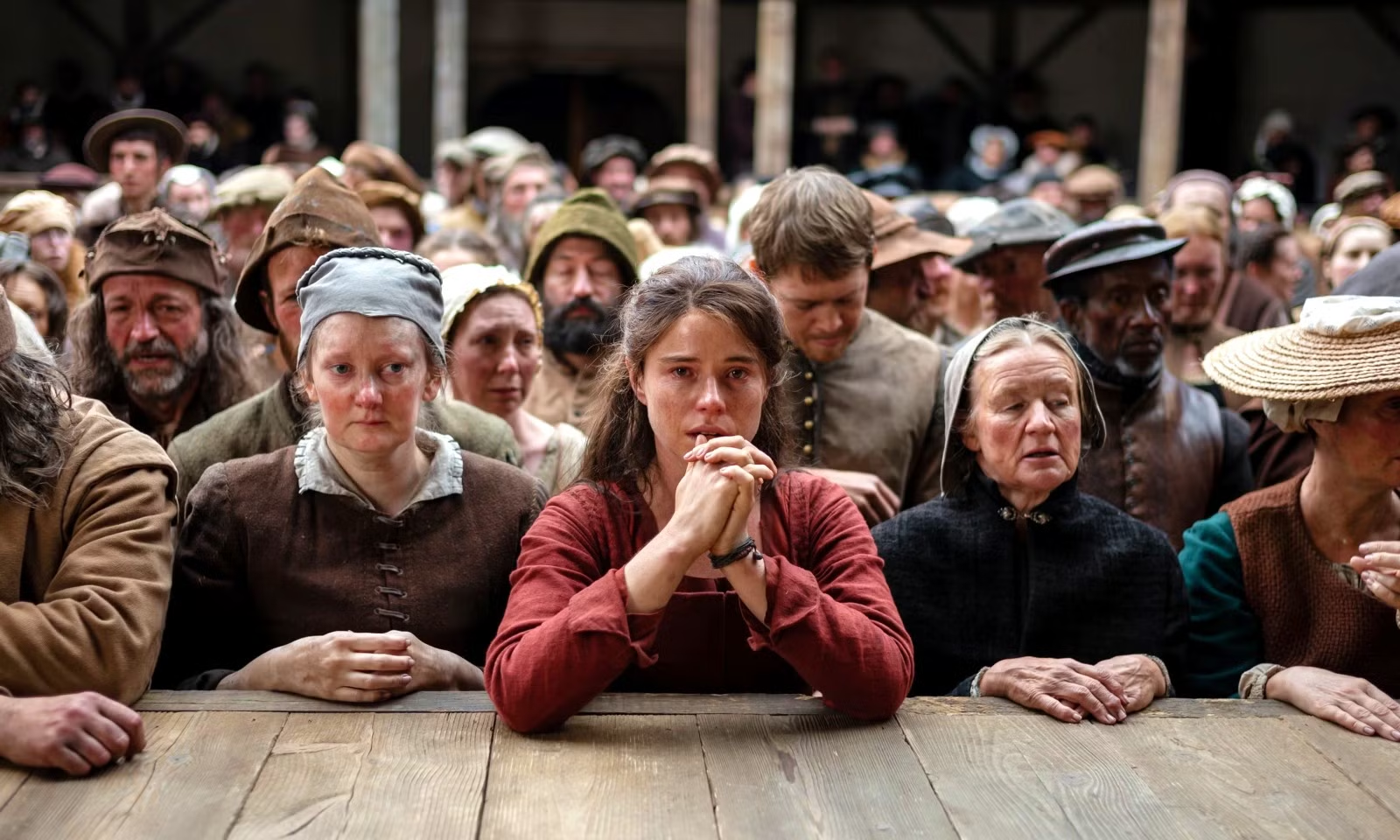
In the heart-wrenching finale, the boundary between fiction and reality dissolves. Agnes looks at the actor but sees her son. For a brief moment, she experiences the same cognitive dissonance as the neighbor of Filip Mosz, the protagonist of Kieślowski’s Camera Buff, while watching a short documentary film featuring his late mother. “The person is no longer alive, and yet here she still is,” the man comments, kneading the priceless strip of film in his hands. We sense that Agnes says the same thing in Hamnet’s final moments, even though she does not utter a single word. A close-up of Jessie Buckley’s face is enough — we understand everything.

