
Movies Explained
20,000 LEAGUES UNDER THE SEA. Steampunk Sci-fi Classic
20,000 Leagues Under the Sea is still surprisingly strong both in terms of spectacle and acting, as well as the timeliness of its pro-ecological message.


One can oppose human laws, but never – oppose nature. — Jules Verne
A man may think he has sufficiently learned about Earth to be able to escape from it. Dreams of space exploration, partly driven by curiosity and partly by the need for evacuation, inadvertently push aside a certain undeniable fact – there are still areas on Earth where human feet have never set foot. And they are under water. The Earth is only 30% land, with the remaining 70%, an astounding portion of the planet’s surface, occupied by oceans. Perhaps we have truly explored their surface, but what about the vastness of the deep sea? Is it really easier for us to create technology with the aim of escaping beyond the boundary of the Earth’s atmosphere and settling on another planet, than to immerse ourselves in our own homeland, survive underwater, and explore the mysteries it hides? 20,000 Leagues Under the Sea.

But that is exactly what science fiction is for – to explore these regions and ignite the imagination of both engineers of the future consumed by research and pop culture audiences seeking escapism. The French writer Jules Verne, one of the pioneers of the sci-fi genre, addressed the theme of exploring the ocean depths in his famous 1870 novel 20,000 Leagues Under the Sea.
The book, later published as part of the Extraordinary Voyages series, tells the story of the submarine Nautilus, commanded by the mysterious Captain Nemo. The story is told from the perspective of Professor Pierre Arronax, a zoologist from the Paris Museum of Natural History, who, along with his companions – servant Conseil and harpooner Ned Land – ends up aboard the Nautilus. The submarine had previously been considered a sea monster, and the three of them were part of an expedition formed to locate it.
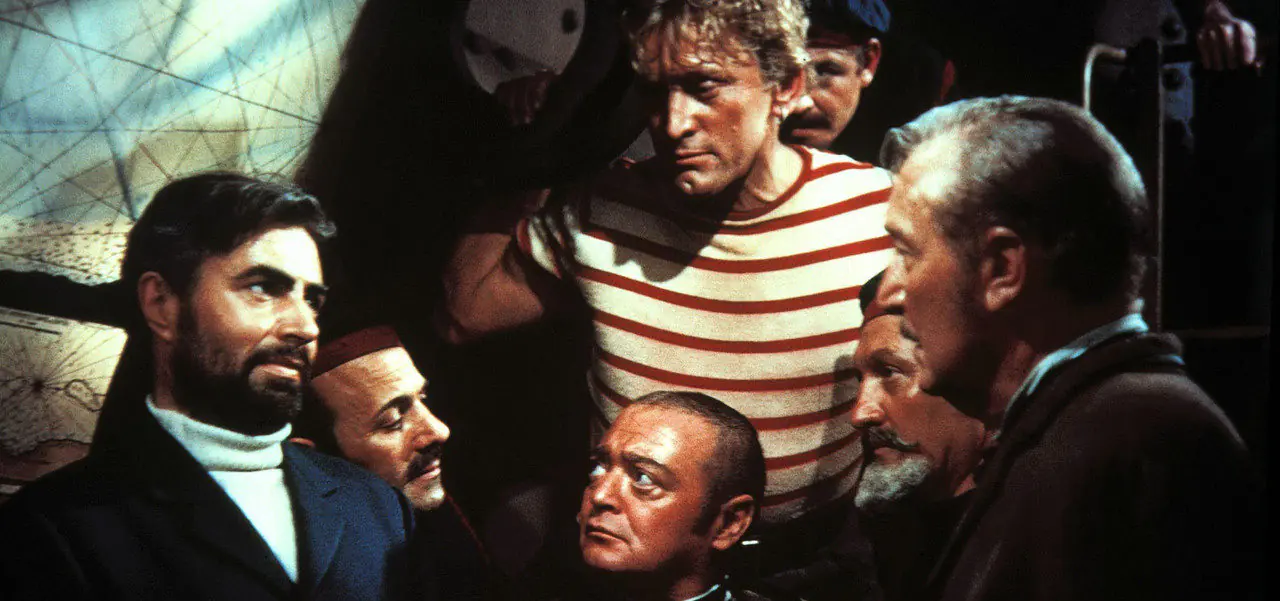
This fantastic journey, described in the pages of Jules Verne’s novel, was adapted into a film in 1954. It is the best, most award-winning adaptation, but not the first. That took place earlier, in 1916, with a silent film directed by Stewart Preston. However, let’s return to the 1950s. The film’s production was handled by Walt Disney’s studio, which was actively involved in the production, including choosing the director.
At the helm of 20,000 Leagues Under the Sea was a relatively unknown Richard Fleischer, who was initially surprised by the offer, given that he was the son of Max Fleischer, the creator of animated films (including Popeye), one of Disney’s main competitors. However, the creator of Mickey Mouse convinced him that he was the best person to direct the story of Captain Nemo.

Interestingly, in the case of 20,000 Leagues Under the Sea, Walt Disney, given his experience, first envisioned the adaptation as an animated film. It was only after Harper Goff, responsible for the visual arrangements, convinced him that it would be possible to portray Verne’s vision in the form of a live-action film. The risk paid off. The film’s financial success was immense: with a budget of five million dollars, it earned thirty million dollars worldwide (in the US alone, with eight million dollars, it became the second-highest-grossing film of the year).
The film made Fleischer’s name famous, and from that point until the 1980s, he became a specialist in big spectacles filled with special effects.

There were also awards. The film was nominated for three Academy Awards: for editing, set design, and special effects. The latter two nominations turned into Oscar statues. If anyone has doubts about whether these awards were deserved, I encourage them to take a look at the scene where the Nautilus crew battles a giant squid.
Truly, it still holds up today. Interestingly, Fleischer had quite a dilemma about how to film the fight to divert the viewer’s attention from technical imperfections (including the visible mechanisms controlling the monster). When he went to Walt Disney for advice, he supposedly recommended that the scene take place during a fierce storm. Applying this practical advice, which also emphasized that cinema is, in fact, an art of illusion, helped make the scene spectacular and ahead of its time.

Although Fleischer’s film is mainly associated with its spectacular nature, we should not forget that it was also brilliantly acted. The main roles were played by sought-after actors: James Mason (Captain Nemo), Peter Lorre (Conseil), and of course, Kirk Douglas (Ned Land). This was Disney’s first film with such a distinguished cast, which meant that the producer had to reach deeper into his pockets, paying higher-than-usual salaries for the roles.
Kirk Douglas, for example, received a hefty $175,000 in salary – notably, Walt Disney had never paid anyone that much before. However, the money was not wasted. Kirk Douglas’s performance stands out with characteristic boldness and liveliness. It should be noted that the adventurous nature of Ned Land’s character was largely shaped by the actor. It was at his request that screenwriter Earl Felton added several scenes to the script where the actor could dazzle his opponents in a fight or simply stand in the embrace of beautiful ladies. This way, Kirk Douglas wanted to create a particularly temperamental persona, which would help him in future roles.

The 1954 film is considered a precursor of a peculiar subgenre of science fiction, known as steampunk. It presents an alternative version of the nineteenth-century technological revolution. Unlike the popular cyberpunk, where technology is based on advanced electronics, here we deal with mechanics.
The film adapting Jules Verne’s novel is no different. But it should be noted that this French author, as a true visionary, went a step further by depicting mechanisms far beyond what nineteenth-century engineers could achieve – mechanisms that even contradicted the technological progress of the time. The most important invention in 20,000 Leagues Under the Sea was, of course, the submarine – powered, importantly, not mechanically, but by nuclear energy. Simon Lake, the future twentieth-century creator of submarines for the U.S. Navy, admitted that it was the Nautilus that inspired him.
Verne is one of many science fiction creators who managed to anticipate future technological solutions.
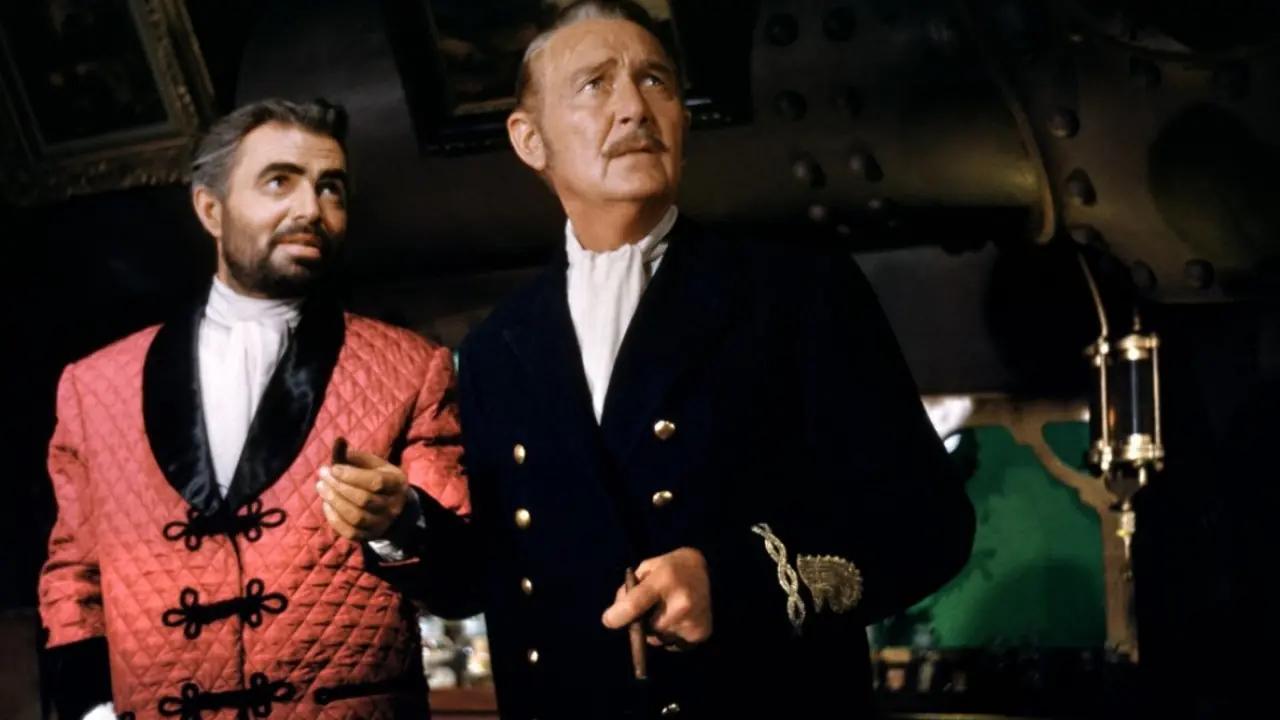
For all ecological movements, as well as avant-garde and nonconformist ones, Captain Nemo and his stance remained an inspiration.
Verne built the character of Nemo based on Homer’s Odysseus. The analogy here is not just the will to travel through the endless sea. When the cyclops Polyphemus asked Odysseus his name, he replied “Utis,” which simply means “nobody.” And “nobody” in Latin is “nemo.” In the case of the captain of the Nautilus, what is important is that the hero consciously renounced civilization, considering it the source of wrongs and miseries (it’s worth noting that Verne originally envisioned Nemo as a Pole opposing the Russian invader; only under pressure from publishers did he decide to reveal in The Mysterious Island, the sequel to 20,000 Leagues Under the Sea, that Nemo was an Indian conflicted with British colonialism).
He decides to establish his own system on his ship and make his own laws, which gives him a sense of true freedom and independence. Although at first Nemo makes a positive impression on Professor Arronax, who considers him a true visionary, it gradually becomes clear that he is driven by anger and a thirst for revenge for the death of his wife and child. This highlights the tragic nature of Captain Nemo’s character – one of the strongest-drawn characters among all those appearing in Jules Verne’s works.

Perhaps because of the extraordinary impact of Captain Nemo’s character, later cinema, from creating a remake of 20,000 Leagues Under the Sea, was more interested in either continuing the hero’s journey (Return of Captain Nemo) or combining his story with those of other famous characters (The League of Extraordinary Gentlemen). However, the remake was made in 1997, but only for television audiences.
Michael Caine took on the role of the famous captain. Plans for a new theatrical version have been in the works practically since 2009, when Variety first announced that McG would direct the project. Later, David Fincher was involved, even considering replacing Kirk Douglas with Brad Pitt, who would play Ned Land. Ultimately, the director preferred to focus on thrillers about… girls (The Girl with the Dragon Tattoo and Gone Girl), and the money for the new remake of 20,000 Leagues Under the Sea eventually went into new Pirates of the Caribbean movies. But interestingly, since 2016, a new project has appeared in the producers’ minds, tentatively titled Captain Nemo. James Mangold is expected to take the helm. What will come of it – we don’t know.

I won’t deny that I would be very curious to see how the new version of this science fiction classic would look on the big screen. The truth is, however, that the 1954 adaptation is still strong both in terms of spectacle and acting, as well as the timeliness of its pro-ecological message. Therefore, repeating this artistic success will be difficult.

