
Review
THE SAFE HOUSE. A History Lesson at Home [REVIEW]
The Safe House is one of the most charming, intimate, and heartwarming films of this year’s Berlinale—as well as a perfect fit for the upcoming summer.


In The Safe House, Christophe Boltanski’s carefree childhood tastes of strawberry tartlets. That pivotal moment between brisk spring and sweltering Parisian summer becomes, for him, a bridge to a dreamlike realm to which he will long to return as an adult. In May 1968, however, Christophe is only nine years old and perhaps entirely unaware that a key stage of his growing up coincides with one of the most momentous periods in French history. The student protests, which gradually evolve into a true grassroots uprising of Parisian residents, are observed by the imaginative boy from the small apartment of his beloved grandparents. While his parents fight in the streets of the French capital for a better future for their youngest family member, little Christophe (played by Ethan Chimienti) explores the nooks and crannies of the charming, mysterious Boltanski family apartment—a space that remembers every joy, doubt, and historical trauma of generations past.
And although it’s the adults who will directly experience one of the greatest socio-political upheavals of 20th-century France, the history lesson young Christophe absorbs during his brief stay in this time-capsule of a home may prove far more meaningful than whatever unfolds a few streets away. 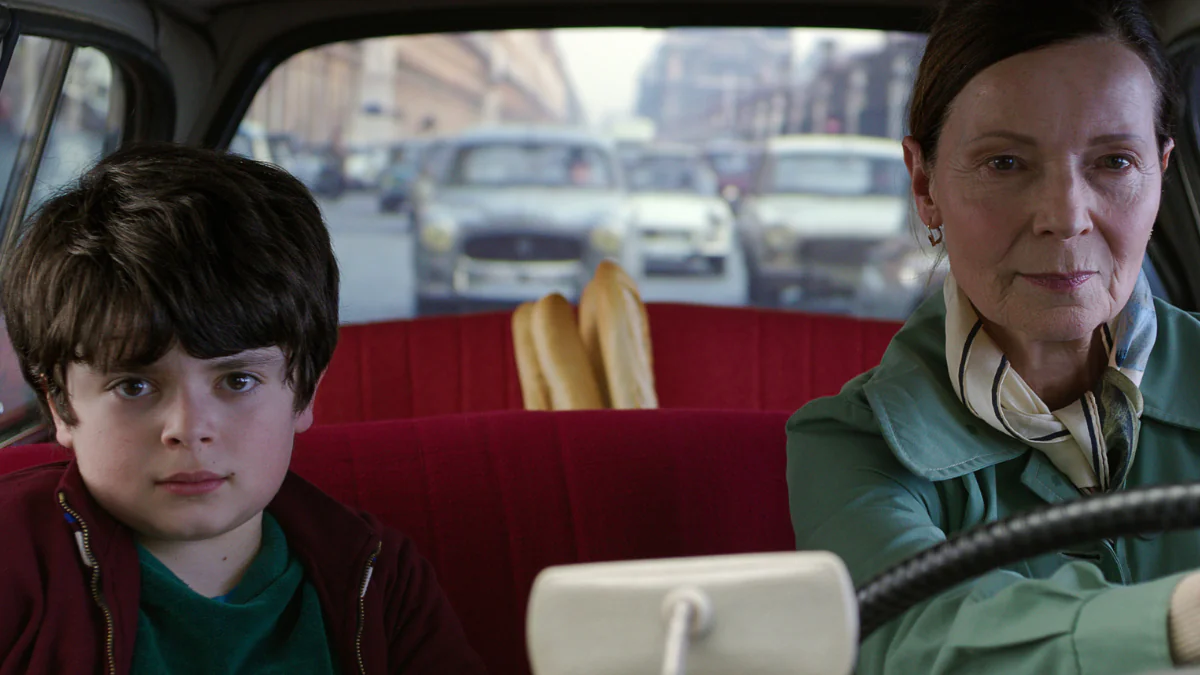 His eccentric great-grandmother (Liliane Rovère) shares with him her longing for the youth she spent in Odessa.
His grandmother (the wonderful Dominique Reymond), who insists on being referred to as “auntie” around strangers, takes him on thrilling scouting missions into the heart of the student protests. The elder uncle (William Lebghil) and younger uncle (Aurélien Gabrielli) explain how to navigate life in postwar France. His grandfather (a moving final performance by Michel Blanc) subtly weaves his own history—intertwined with the rise of fascism—into their ordinary yet touching conversations. The Boltanskis’ home is like a long-lost treasure island, rich with memories, experiences, and the scars of war passed down through generations.
This warm family comedy, shaped by haunting recollections, seamlessly transforms into a poignant reflection on postwar wounds, the enduring weight of the Holocaust (especially seen in the grandfather’s PTSD), and the essence of Jewish identity—explored through the eyes of a nine-year-old boy. As Christophe himself observes, those who go through life without imagination don’t realize how much flavor and color they are forever depriving themselves of.
All the more remarkable, then, that we as viewers experience such a pivotal moment in France’s history through the perspective of this lively, mischievous child. Here, historical pathos is replaced with childish humor, protesting citizens become special agents on secret missions, and the loved ones with whom Christophe spends this extraordinary time show him how crucial it is never to lose the ability to dream.  The Safe House is one of the most charming, intimate, and heartwarming films of this year’s Berlinale—as well as a perfect fit for the upcoming summer. An adaptation of Christophe Boltanski’s acclaimed novel, the film celebrates both the beauty of a child’s gaze on the world and the resilience of those who have endured the darkest chapters of modern history. Like Boltanski, director Lionel Baier plays with defining moments in French national identity, seasoning them with mystery, uncertainty, and fairytale whimsy. This is particularly evident in the still-unexplained hours-long disappearance of President Charles de Gaulle—who, from the perspective of dreamy young Christophe, was hiding in the Boltanski household, forever becoming part of the family’s legendary lore. What really happened during the president’s disappearance? Did the Boltanski family’s shelter and the advice of the eldest uncle truly influence his decisive political moves? To the very end, we are left with one great unknown. But Baier’s atmospheric tale isn’t about discovering what really happened—nor what Boltanski actually remembered from his childhood and what he embellished with literary imagination. The Safe House uses this unique moment in French history to tell a deeper, more touching, and inspiring family fable—one about survival, generational wisdom, and acceptance of life as it is: full of surprises, twists, bitter defeats, and small joys. It’s a story you’re likely to remember for a long time. Because sometimes, all we really need is to lose ourselves again in the boundless imagination of childhood and see the complex adult world through its sincere, unfiltered lens. And in this, Safe House succeeds almost flawlessly.

