
Review
TABOO. Isn’t It a Case of Style Over Substance?
Taboo. 1814, Tom Hardy, in a hat and bearing a sizable scar over his eye, strides through the filthy streets between high society and much less refined company.


London, 1814. Tom Hardy, in a little hat and bearing a sizable scar over his eye, strides through the filthy streets between high society and much less refined company. Sometimes he growls, other times he stabs someone, but mostly he remains silent and menacing, clad not only in stylish black but also in exotic tattoos and markings. These go hand in hand with equally mysterious visions that Tom frequently experiences in broad daylight, suggesting that something is seriously off with the man. In the meantime, our protagonist, whom everyone eyes warily (from a safe distance), also sets up a shady but lucrative business, fights off serious sharks in that field, and looks for a ship capable of staying afloat in deep waters.
Taboo.
That, in short and with a touch of irony, is how one could describe the eight-episode series by the British Broadcasting Corporation. In it, an adventurer disowned by his own family, James Keziah Delaney (Tom himself), literally returns from the grave – after a decade of silence, presumably spent in the jungles of wild Africa. Declared dead, he unexpectedly appears at… his own father’s funeral – a man just as hated in society as his son. Soon it is revealed that daddy left him the entirety of his estate, not a single penny for the rest.

As one might guess, this turn of events suits no one – from James’s lovely sister (with whom he seemingly shares more than a gentleman should) and her feisty husband, to the late patriarch’s many creditors, to the greedy overlords of the East India Company. The latter are especially interested in a certain valuable piece of land that would significantly aid the English in their struggle against the increasingly powerful United States. Thus, Delaney – a man with a dark past and a nasty reputation that precedes him – becomes a part of a dangerous game between two empires…
Sounds like another convoluted spy story, this time dipped in Dickensian sauce and the rot of 19th-century London. In reality, however, Taboo feels more like a superbly staged television theatre, in which – aside from florid dialogue and carefully woven Shakespearean intrigues (I go fuckim, but he sellim, so you killim)… not much actually happens. Whether that’s good or bad depends entirely on personal preference. Some like car chases and shootouts on screen; others prefer verbal duels and a thick period atmosphere.

Still, it’s hard to shake the feeling that after a brilliant opening, the atmosphere wanes slightly, the plot barely progresses, and initially intriguing characters become bland and passive. In short: form begins to overshadow content, and style triumphs over substance. And while we’re at it, fans of so-called eye candy may be disappointed – because this is public television, not HBO, so despite a few brazen sex scenes, everything remains suggestive (while the foul language and frequent bloodshed stay intact). Ah, life in the “enlightened” 21st century.
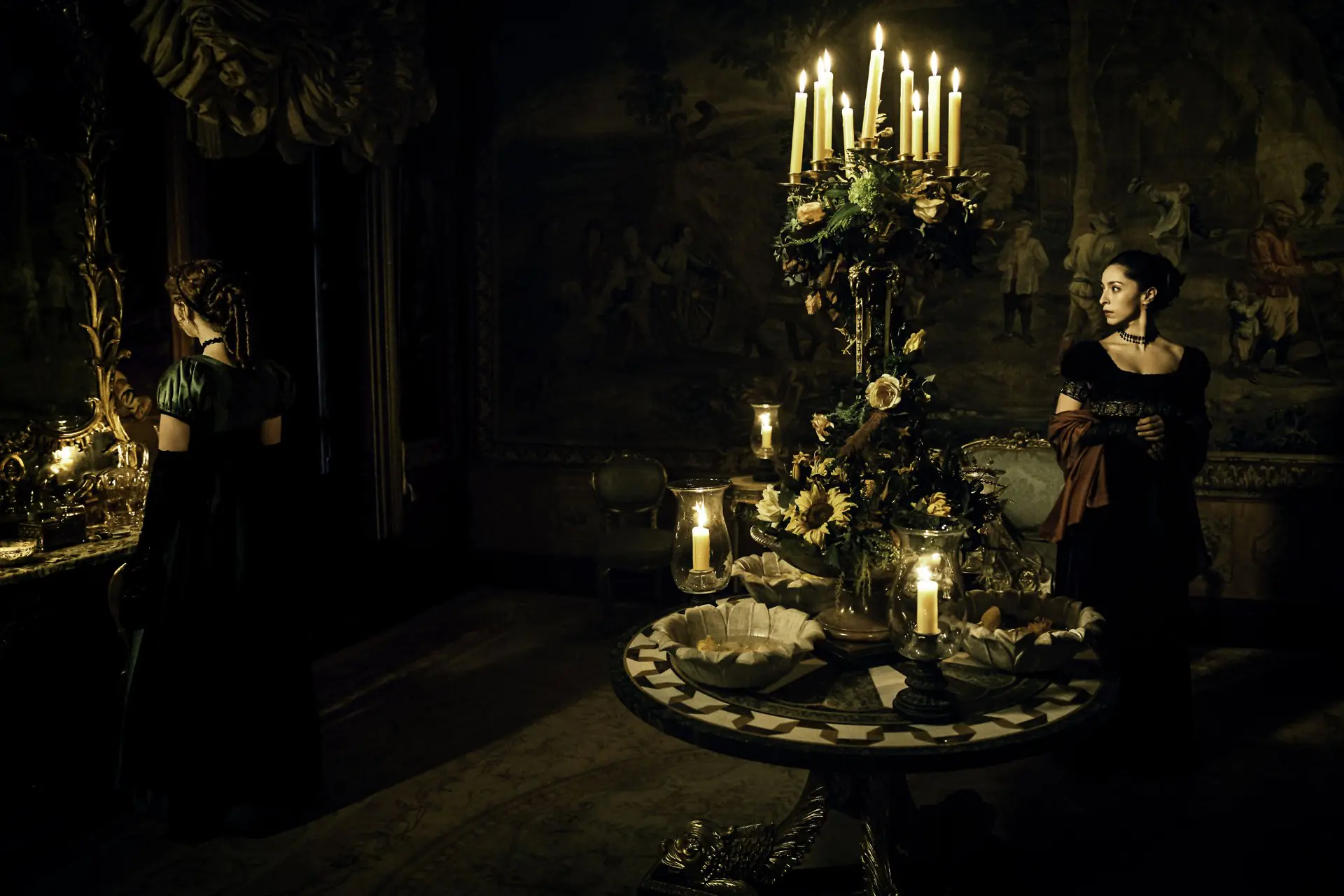
Taboo looks so good at times you forget its flaws and narrative shallows. The cinematography by Mark Patten, with the help of filters and a touch of CGI, is a true feast for the eyes.
And the mystical, brooding score by Max Richter (the mind behind the unforgettable themes in The Leftovers) – notably the series’ only Emmy-nominated element – complements it perfectly, helping immerse viewers in a grim vision of a world full of bastards and scheming.

That, despite a number of significant shortcomings and missteps, it’s still hard to tear your eyes away for nearly eight hours is due in large part to the stellar cast. It includes familiar and/or distinctive faces from both big and small screens: Oona Chaplin, Jonathan Pryce (both Game of Thrones), Leo Bill and Edward Hogg (The Borgias), Stephen Graham (Hardy’s buddy from Band of Brothers), Michael Kelly (House of Cards), Franka Potente (The Bridge and of course the Bourne trilogy), Jessie Buckley (War and Peace miniseries), Richard Dixon (Victoria), Tom Hollander (The Night Manager), Christopher Fairbank (Murphy from Alien 3), Nicholas Woodeson (Rome), David Hayman (Macbeth), and a nearly unrecognizable Mark Gatiss, aka Mycroft from Sherlock, under layers of grotesque makeup. The cherry on top? A cameo from the legendary Edward “The Jackal” Fox and… one of the first roles of Louis Ashbourne Serkis, son of Andy Serkis. Needless to say, everyone delivers outstanding performances that lend gravitas to the production.
Yet Taboo would not exist without its star and series creator – Mr.
Tom Hardy, unquestionably a true acting animal (as confirmed by him nonchalantly parading nude on set in scenes later cut by the producers). He doesn’t exactly reach the pinnacle of his craft here, conveying a whole range of emotions with just three expressions – the most prominent being a brooding, menacing scowl. With his constant grunts in place of dialogue, he walks a fine line between stylization and self-parody.

Luckily, he never crosses it. Instead, he devours the rest of the cast with a mix of undeniable roguish looks and charisma that even the audience can feel.
Just like in The Dark Knight Rises and Dunkirk, where he was mostly hidden behind a mask, Hardy needs only a few gestures, curt lines to the camera, and, above all, killer glances to dominate the screen. And, as in those films, he does so with an offhand ease that is oddly charming. Above all, Hardy instills real dread while still maintaining a strange, underlying bond with the viewer (and a few side characters).
The problem is that the story he devised with his father, Edward “Chips” Hardy, doesn’t quite hold together, exciting only at first. Together with Steven Knight (Locke, which starred Hardy in exchange for his help on the script), they skillfully sowed seeds of unease through supernatural elements, recurring visions of a terrible past, and frequent use of the shamanic-sounding Twi language. But it’s often hard to justify their presence. These elements feel more like theatrical tricks than meaningful storytelling. They return regularly and eventually start to irritate – especially since the creators don’t bother to even hint at their origins or offer breadcrumbs for fan theories.

It doesn’t help that the solid but uninspired direction by Scandinavian directors Anders Engström and Kristoffer Nyholm lacks flair. They fumble several key dramatic scenes, including the visually impressive but painfully dumb and clichéd finale, from which – like the series as a whole – nothing of substance emerges. Along the way, they also diminish the character of James Delaney, stripping him of the menace and unpredictability that marked his entrance.
He is, overall, a slightly overblown protagonist. Hardy has admitted in interviews that he wanted to create a hero combining the traits and skills of Bill Sikes from Oliver Twist, Heathcliff (Wuthering Heights), Sherlock Holmes, Hannibal Lecter, Oedipus, Charles Marlow (Heart of Darkness), Rodrigo Mendoza (The Mission), and Lope de Aguirre (Aguirre, the Wrath of God). And… unfortunately, you can tell. Delaney is certainly a unique character, but he’s almost too cool in his blandness.
He evokes emotion, is threatening, intelligent, and highly effective, surviving every ordeal. At the same time, he lacks depth, discernible skills (aside from knife-handling), or motivations that could explain his behavior, power, and position. He’s a loner shrouded in such dense mystery that, without it, the king would be as naked as Hardy in those leaked on-set photos. He’s a man with balls but no soul. A larger-than-life character, in the worst sense of the phrase.
Still, much of this criticism could be moot if this is just the beginning of a longer adventure.
The finale of the first season and statements from Hardy and co. suggest that three parts were planned from the start (the next is due early next year). According to Knight, season one was the “escape,” the second will be about the “journey,” and the final will be the “arrival.” Whether that’s a satisfying destination for Delaney? Well, if we believe the creators, it will definitely go against viewers’ expectations. So we wait, patiently, for what’s to come.
Personally, I hope Taboo will eventually break more molds, that it becomes bolder. Less theatrical, more cinematic, more emotionally affecting and meaningful; that it gains scope and depth, and reveals the mystery behind both Delaney’s African expeditions and the disputed island between the two nations.
Most of all, though, the show needs to finally address its own title. Its biggest issue is that, while it has a strong look and can be genuinely absorbing, it leaves a massive sense of unfulfillment. It remains very safe, almost “family-friendly” entertainment that certainly doesn’t challenge any sacred cows. Let alone break any taboos.

