
Review
OUTLAND, or what SEAN CONNERY Has in Common with ALIEN


If, while watching Outland, the 1981 science fiction film, you get the feeling that you’ve already experienced a similar story somewhere before, your impression is correct. Not only is Peter Hyams’ movie essentially a space version of the classic western High Noon, but it also clearly bears the influence of Alien. More than forty years after its premiere, I encourage you to revisit this somewhat dusty SF classic, graced by the presence of none other than Sean Connery.
I like 70s and 80s science fiction films partly because of the male characters. Those rough, grounded tough guys simply aren’t around anymore. Today everything has flipped upside down—paradoxically, it’s women who often create more testosterone-fueled characters (see Furiosa from Mad Max), they wear the pants better. Back then, we had Clint Eastwood, Sean Connery, Gene Hackman—men who, with a single look or a slight grimace, could awaken the spirit of masculinity in a young boy sitting in front of the TV. There was so much charisma on screen that even if lightning had burned the film reel, we could be sure that these heroes would survive with us forever.
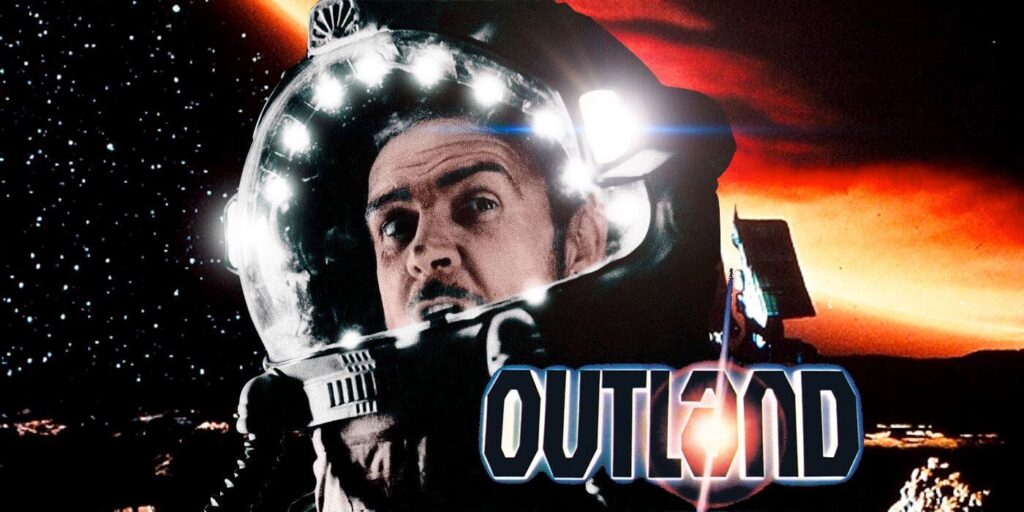
The same goes for Sheriff O’Niel, played by Connery—already a former 007 at the time. He brought to a fairly predictable movie a priceless spark of originality. I have the impression that it’s thanks to this role—if not above all—that Outland is so easy to remember after all these years, and so easy to distinguish from the flood of other, similar plots. Connery didn’t appear in many SF films, and to be more precise, Sheriff O’Niel is his best genre performance—because watching Zardoz without a few stiff drinks is simply impossible.
“You can’t make a western. It’s a dead genre.”
What surely attracted the British actor to working with Peter Hyams was the fact that the script for Outland was based on a film that everyone admired back when Connery was a young man. High Noon remains one of the most important works of the classic western, still exerting strong influence on filmmakers. It was admired above all for its uncompromising nature and nihilistic undertones, which suggested that heroism doesn’t always stem from genuine virtue, but from the desperate situations we find ourselves in. These messages were reshaped into a new story that replaced the dusty, noisy Wild West with the distant and terrifying silence of outer space.
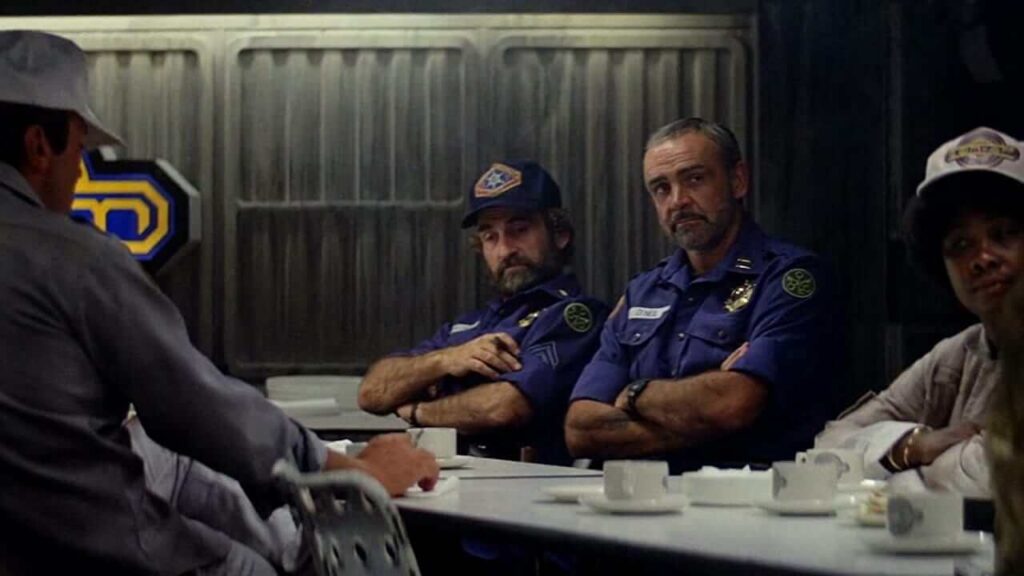
Hyams wanted to make a western, but was told the genre was dead. He didn’t give up, deciding instead to slightly change the style. After the excellent Capricorn One, he once again used the trappings of science fiction to formulate timeless messages. His inspiration was Alien, released a few years earlier. The similarities between the films are visible in their visual layers, their claustrophobic atmosphere, and even in the music. Both productions (as well as Capricorn One) had scores composed by Jerry Goldsmith. This is also why, to this day, SF fans theorize that Outland is actually part of the universe created by Ridley Scott. There’s something to that—when we follow Connery through the mining platform on Jupiter’s moon, it’s hard not to feel at times as if we’re aboard the tight and stifling Nostromo.
The film’s atmosphere owes a lot to its production design and, above all, to its cinematography. This is where I should praise the director of photography, but I won’t—because it turns out that Hyams himself was responsible for the camerawork more than the credited DP. Reportedly, he hired Stephen Goldblatt mostly to operate the camera whenever he couldn’t. Still, Goldblatt had plenty to do, as Outland was the first film in history to use “Introvision,” a kind of front projection that allowed filmmakers to track compositions in real time—for example, combining miniature photography with live action. This greatly sped up the creation of special effects.
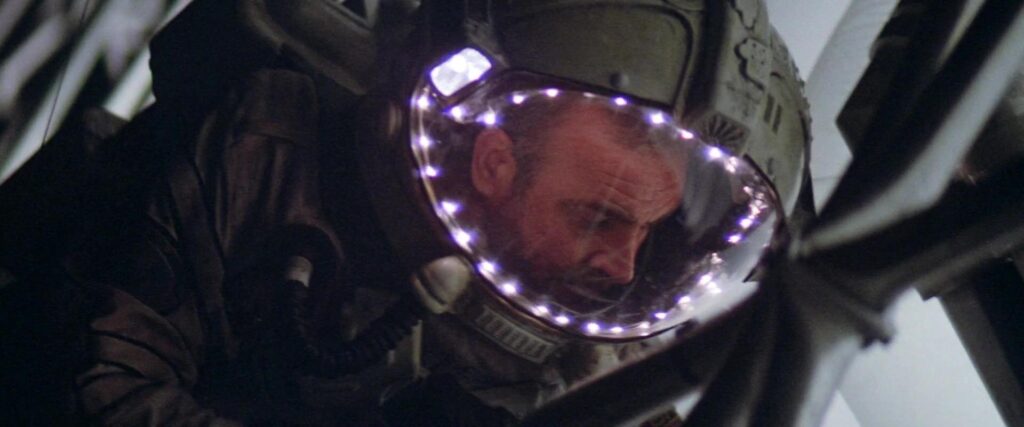
The film’s original title was simply IO, to indicate its setting on Jupiter’s moon. But producers rejected the idea, fearing that in promotional materials the title would look like the number ten. The catchy title Outland was supposed to ensure the film’s success. That, however, didn’t happen. The movie received mixed reviews, which translated into weak box office results. With a budget of 16 million dollars, it earned just over 17 million. Fortunately, the booming VHS market at the time gave the 1981 film new life, with several re-releases featuring improved sound and picture.
The story of a sheriff fighting for justice, left alone in the face of corruption, only seemingly repeats the plot of High Noon. In fact, it adds a new, very interesting conclusion: capitalism has its dark sides, because even light-years away we can still be corrupted by money. And as for its ties to Alien—well, in some ways Outland is the scarier film. It proves, after all, that the greatest monsters lie within ourselves.


Mark Wheeler
October 24, 2025 at 13:50
Sean Connery plays Marshal O’Niel. OK, it’s a pedantic point but the exchange (with Frances Sternhagen’s Dr Lazarus, if I recall correctly) in which Connery says: “That’s a Marshal joke.” doesn’t work if he’s only a Sheriff. By the way, in High Noon, Gary Cooper plays a Marshal.