
Review
NIGHT AND THE CITY. A gripping study of escalating depravity
In Night and the City, Widmark wins over the viewer with the smallest gestures—even while playing a character who is almost the definition of an anti-hero.


Jules Dassin is one of the most important creators of film noir. Born in the USA to a family of Russian-Jewish immigrants, he trained under none other than Alfred Hitchcock. Like the famous master, he often began his films with an earthquake—and didn’t stop there. His feature-length debut was a highly successful crime drama, but it was the brilliant noirs he made year after year—Brute Force, The Naked City, and Thieves’ Highway—that brought him real fame. Unfortunately, due to a brief earlier involvement with communism, the acclaimed director was quickly blacklisted in Hollywood.
As a result, he was soon forced to leave his homeland, relocating to the streets of Greece, Italy, and France (where, five years later, he would make the legendary Rififi). But before all that, he managed to create one more (master)work in the genre, a film that perfectly summarized his American career—even though it was made outside the United States: Night and the City.
This guerrilla style only adds to the authenticity, continuity, and grim atmosphere of the production. Dassin supervised the editing remotely—already exiled by the studio and his own country. It’s not hard to see the film’s protagonist, Harry Fabian, as Dassin’s alter ego: an American in exile, forced from the very first shadow-drenched frames to flee from evil lurking both in the darkness and in human hearts.  Fabian knows a thing or two about that, being a born schemer—a small-time hustler and conman determined to become somebody at any cost, with no regard for how.
He’s energetic, hungry for success, full of risky ideas. A natural fast-talker who can sell any lie in the world, even for a shilling. But he doesn’t realize his efforts are doomed from the start. He’s a loser—without honor, principles, or morality. But does that also mean he has no chance at redemption? At turning his misfortune around, if only briefly? We only find out in the final scene—spending most of the film on edge. The filmmakers expertly maneuver the plot, intrigue, and cast of characters—many of whom are even more desperate than Fabian, who, no matter what scheme he pulls, remains a mere pawn. Richard Widmark gives the performance of a lifetime as this tragic yet slippery figure. Though the talented actor had a rich career, he arguably never delivered a role as powerful, believable, and unsettling as this one. Both he and Dassin considered it one of his best. Years later, Dassin regretted that Widmark, like Fabian, never became a top-tier star despite his efforts—something he certainly deserved. In Night and the City, Widmark wins over the viewer with the smallest gestures—even while playing a character who is almost the definition of an anti-hero. Rotten to the core and entirely unsympathetic, Fabian perfectly fits the noir archetype. But unlike many classical heroes of the genre, he is a 100% scoundrel who makes only one truly human gesture—and far too late.
That moment, along with a nostalgic recollection by his girlfriend (one of the genre’s classic dames, Gene Tierney) of happier times when they were full of life and optimism, saves him from complete disdain—but only in our eyes. 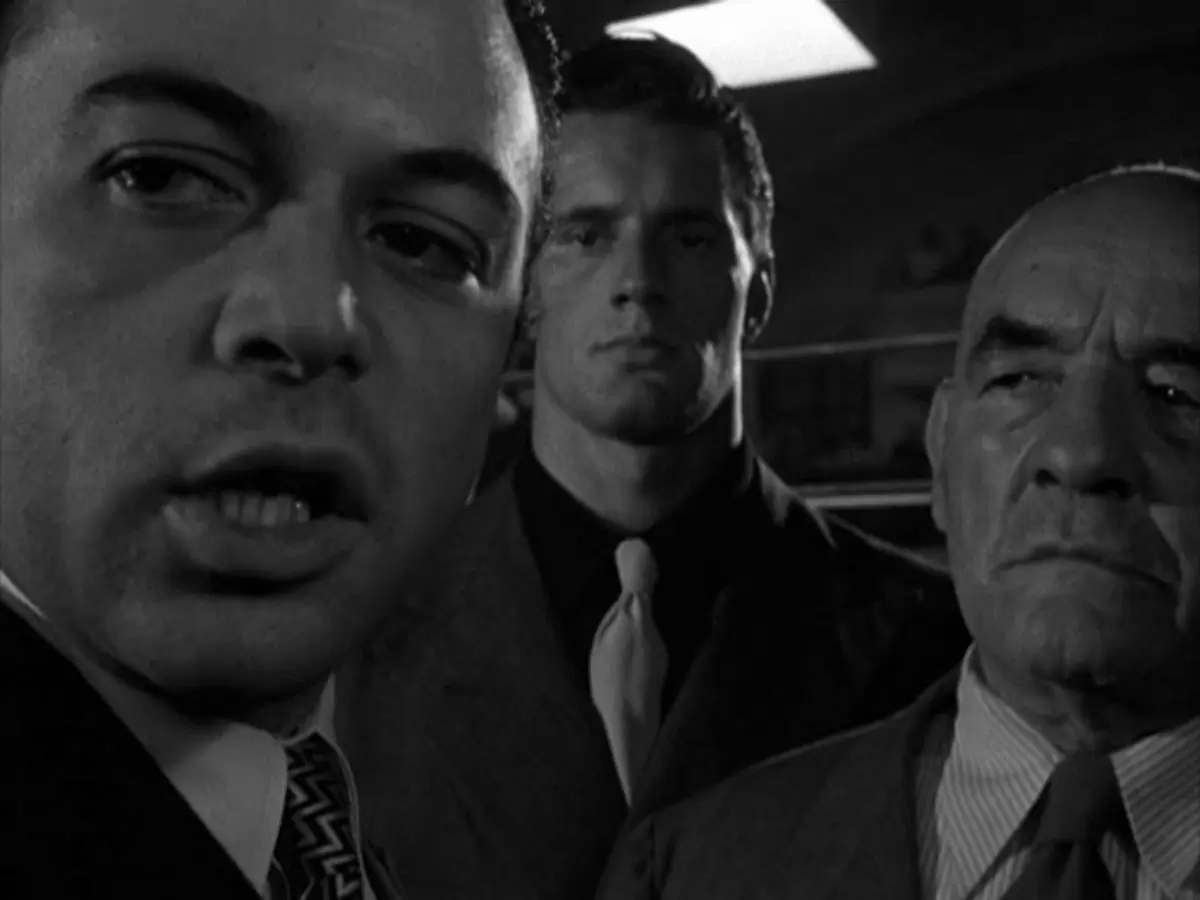 Because London, as portrayed in the film, is populated with equally repulsive characters—nearly all with something to hide. Tierney’s Mary is, by contrast, a model of virtue and perhaps the only sincere person in the entire story. Yet even she has passed her prime, wasting away as a “hostess” in a nightclub.
Its owner, Philip Nosseross (the formidable Francis L. Sullivan), regularly lends Fabian money, while Fabian flirts with his unhappy wife Helen (Googie Withers), who dreams of opening her own place. Nosseross despises Fabian as much as he’s amused by his scheming. He’s not alone—Kristo (the always-reliable Herbert Lom, later known as Inspector Dreyfus from The Pink Panther series) shares that view. Kristo is the local underworld boss and father of the legendary wrestler Gregorius (played by Polish mat star Stanislaus Zbyszko, born Jan Stanisław Cyganiewicz, whose on-screen opponent is another real-life wrestler of Polish descent, Mike Mazurki).
Fabian sees in Gregorius his next “big chance”—by winning over this old-school man, he hopes to stage the match of the century, a bout sure to bring him fortune and, for once, positive attention… Yet the real strength of Jo Eisinger’s screenplay isn’t in the plot itself—though it’s perfectly structured. Based on Gerald Kersh’s novel, the script shines through its unconventional characters, the tightening web of their relationships, and its outstanding portrayal of the criminal world—unprecedented at the time in its brutal honesty and lack of sentimentality. Dassin—who hadn’t even read the novel before shooting and whose voice we hear as the narrator in the prologue—captured the postwar spirit just as effectively as in Rififi.
It was a time full of poor, desperate people living on the edge of decency, often crossing that line just to survive. Words like hope, honesty, respect, trust, and sanctity don’t appear in this film’s dictionary, even if the characters sometimes invoke them while reaching for what’s “theirs.” 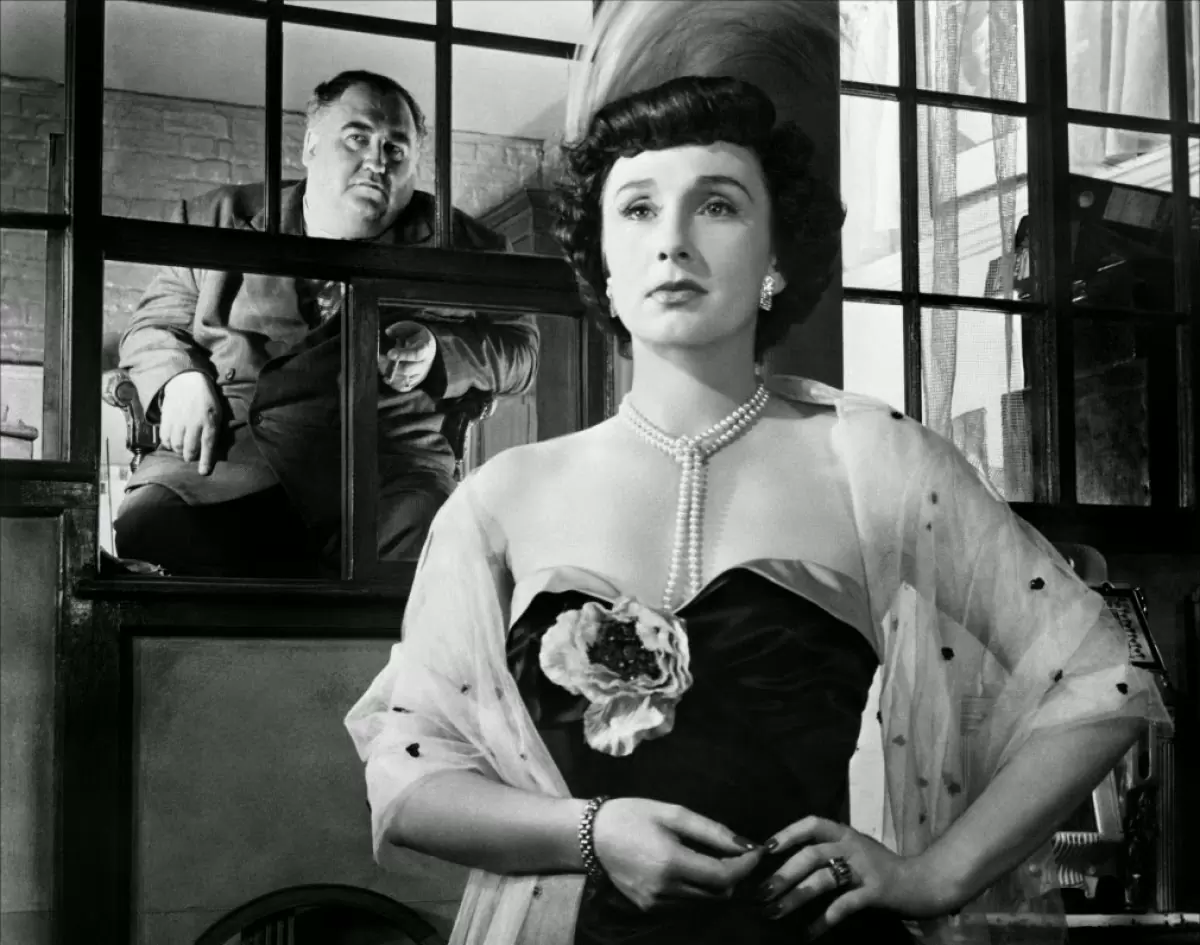 The author of the novel—himself of Slavic descent—knew this world intimately. During the Great Depression, he lived a very similar life. Ironically, the film adaptation significantly sanitizes the original, using only fragments of the book.
The novel is far darker, packed with more characters and filth, and Harry is, quite bluntly, a pimp. Dassin’s adaptation is so loose that Kersh joked he had earned the highest rate ever for a film title—forty thousand dollars for four words (ten grand per word). Nonetheless, Dassin managed to capture the novel’s spirit, using Mutz Greenbaum’s lens with artistry and intensity reminiscent of German expressionism. Though critics were initially lukewarm, and the film took time to reach classic status, today it still strikes with its realism and resonates deeply in many ways.
Irwin Winkler learned just how difficult that was when he made the 1992 remake—a tribute to Dassin’s film, titled identically: Night and the City, with a star-studded cast featuring Robert De Niro, Jessica Lange, Jack Warden, and Eli Wallach. Shot in color and widescreen, the remake moved the story from London to New York and swapped outdated wrestling for the more mainstream sport of boxing. Unfortunately, they also replaced night with day, and turned Harry into a likable rogue nearly everyone roots for.
In Winkler’s version, he’s not a petty hustler but a down-on-his-luck, third-rate lawyer with a chance at redemption. The film itself isn’t bad—it has solid pacing and snappy dialogue. But ultimately, it becomes an overcooked caricature with zero understanding of the original material. It’s a bland, atmosphere-less, and implausible adaptation that depicts greedy people from the upper-middle class. Unsurprisingly, it flopped at the box office, earning only a quarter of its production cost.
Meanwhile, Dassin’s original unexpectedly got a second version for the UK market—made without the director’s knowledge, which he only discovered a decade later. And what does this version contain?  First, different opening titles and a new, less effective and less thrilling score by Benjamin Frankel (the US version uses Franz Waxman’s more striking composition). There are also alternate scenes, most notably a completely different introduction to the main character—again, less exciting. Editing and certain shots differ too, along with a few plot points (like a photo of the lovers or Harry’s money-making ideas).
The final fight is shorter and less dramatic, and the ending is notably softened. In general, the UK version is a lightly censored cut—but paradoxically longer by five minutes, featuring ten unique scenes and seven extended ones, while the American cut has four unique scenes and eleven extended. Yet regardless of the version, we’re witnessing a gripping study of escalating depravity—one that infects almost everyone faced with the chance not necessarily to get rich, but simply to escape hellish social and moral conditions. Dassin proves—again—that people without purpose or solid foundations, yet filled with ambition and a desire to be better than others, will go to any lengths to validate their worth, often at the cost of others’ lives. In this world, compromise is impossible, and the consequences are always painful, stripping away any joy from whatever vague hopes remain on the horizon. Even revenge tastes like expired bittersweet chocolate. The night takes everything, and the dawn offers nothing in return. And life goes on…

