
Review
Looking Back at EASTERN PROMISES: We Demand More!
For some, a simply good film is enough—and great, that is commendable. However, one should demand much, much more from David Cronenberg.


Ah, Cronenberg. My favorite director boldly entered middle age and began to explore cinematic territories one would hardly have suspected him of—action, thriller, gangster film, crime. The excellent A History of Violence foretold nothing, after all, because it was an efficient drama, classically told, which for an eccentric Canadian meant—non-classical, deeply surprising, avant-garde. And what is the Eastern Promises like?
Another surprise: once again a surprise-another conventionally led narrative, whose quality is good and whose author once again breaks away from the patterns he had been building for many years. Fantasies, hallucinations, and nightmares have been replaced with a more precise insight into psychological nuances. Cronenberg has exchanged a sociologizing gaze for deliberations of a philosophical and moral nature.

He has fallen out of love with repulsiveness, illness, loneliness, and wildness, and ignited a passionate feeling for spheres that are normal, exclusively human, scarcely abstract, and certainly not surreal. Fascination with corporeality and technology—a marker of style, practically a directorial motto!—has been set aside. For some time? Forever? An astonishing stance, isn’t it? Is the leading experimenter of the screen slowly transforming from an unpleasant-to-watch grub into a universally admired butterfly?
That would be an irreparable loss for world cinema, because Cronenberg is one of the few true authors of film, clearly signing his works and always going against the grain of genre expectations. But that does not mean that Cronenberg has disappeared, gone stupid, ceased to exist, and will not return. In Eastern Promises the author of the brilliant Videodrome descends one level lower: from oneiric clouds straight onto the asphalt of a London street, as if undergoing an anti-drug treatment that allows him to look at human beings from a different, less hallucinogenic perspective.

He is not interested in the demons residing in man, but rather in the man in whom demons reside. Seemingly the same thing, but the difference is significant, because it reveals what was most important to the director, and at the same time—unfortunately—what was detrimental to his authorial style.
Eastern Promises is a fairly interesting story about an evil, very evil Russian mafia and an innocent, very innocent midwife who opposes evil with her innocence. This cursory outline of the plot suggests derivative, unoriginal, and unsurprising cinema. Films depicting the mafia usually gravitate toward naive and catchy stereotypes, because it is easier that way and because organized crime evokes such associations, more or less justified. Cronenberg does not flee from such connotations at all, because he knows there is no escaping The Godfather, The Sopranos, or Scarface.
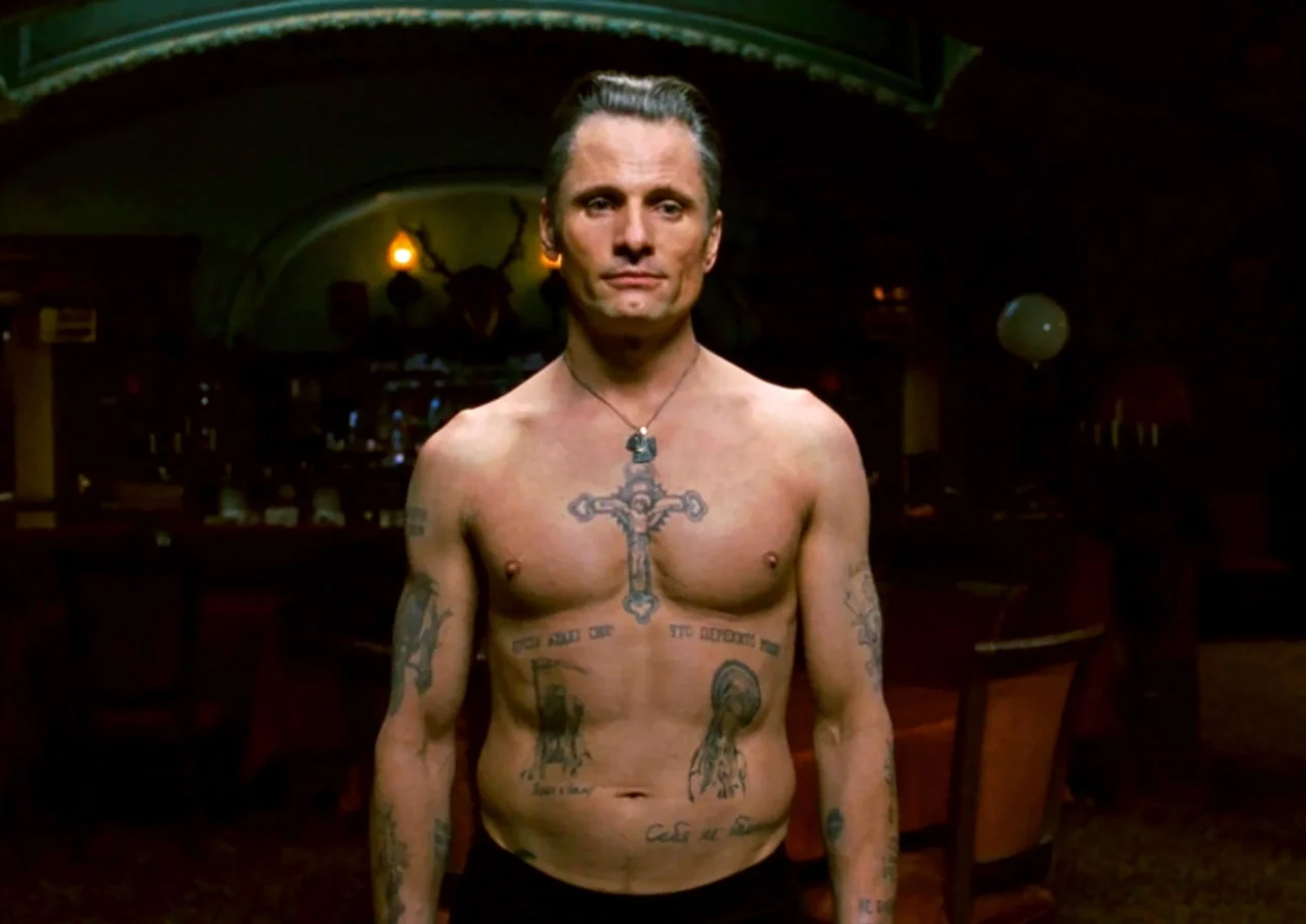
He therefore plays in a similar vein, with similar schemes, arrangements, and character types. The deadly seriousness of the older boss goes hand in hand here with the recklessness of young bandits and the cold-bloodedness of killers. Rebellious glances, steely stares, spectacular tattoos, a leather coat, fashionable sunglasses, a luxury limousine, a striking Russian accent, local sounds, glasses of vodka in hand (most often without any snack, strangely enough)—all of this builds a gangster atmosphere that is familiar and well liked.
But Cronenberg would not be himself if he did not leave his handprint on the film stock. The demon residing in man mentioned earlier would be an appropriate trail for a deeper exploration of the soul. Interestingly, Cronenberg follows this path, but not very consistently. The Vory v Zakone are a group of people devoted to criminal rules; it is a mafia that guards an Eastern code in which it is clearly written that the greatest danger sometimes comes from the stupidest things. Hence eternal caution, limited trust, the elimination of the weakest links. Because one cannot afford to be careless. And one must always have someone who can be trusted, who would carry out simple tasks.

Relations of dependence and subordination are very clear, and ethnic and family ties are strong as Russkij Standard, even if the head of the mafia is an old man, at first glance a kindly grandpa, and the immediate superior is an uncouth idiot, the boss’s son. There is some kind of identifiable evil in these people; an evil that breaks the norms upon which the social sense of security is built. In this way, Cronenberg shows demons that frighten with unpredictability, explosiveness, lack of restraint, and brutal violence.
These are, however, very vague deliberations, concerning the mafia in general, ignoring individual characters, their problems, hopes, and needs. Cronenberg does not go where he used to go; where he always looked, what he always listened in on, even if at times he strayed from his own familiar path (for example on the occasion of M. Butterfly). Russian mobsters, aside from the gangster trappings, are simply hollow.
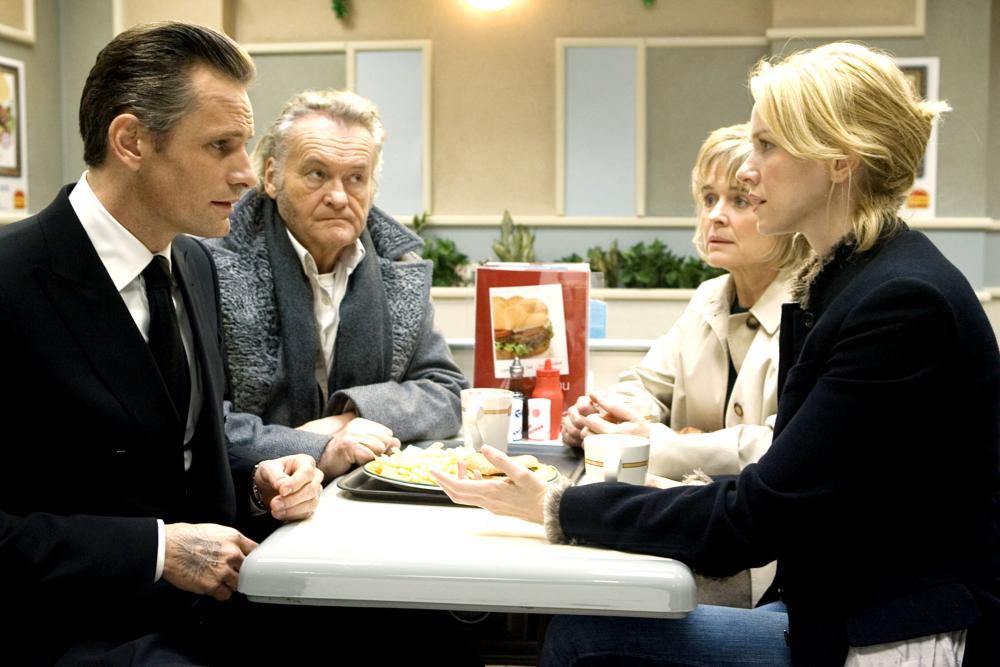
True, realistic, at moments intriguing, but at the same time predictable in their violent gestures, judgments, views, and expectations. Even the main character, excellently played by Viggo Mortensen, is interesting only until suspicions arise in connection with an important plot twist (and believe me, those suspicions arise very quickly—unfortunately…). This is deeply disappointing.
David Cronenberg does, however, add something of his own, something finally Cronenbergian—violence. Unfortunately, he introduces it into the form, not the content. The prologue At Azim’s is truly powerful—the slitting of a throat does not consist merely of drawing a razor across a neck. It is a damnably sadistic attack, reminiscent of the primitive slaughtering of an animal rather than the neat gesture of a calculating murderer.

Similarly, Viggo’s fight in the bathhouse with two Chechen thugs looks the same—naked, with knives, with a deep gash from a sharp blade across the back and an eyeball rolling across the floor. What purpose does this serve? Essentially none—just a flashy gimmick, quite rare in cinema in such a naturalistic form.
And for this rather trivial reason, Eastern Promises cannot be ignored, although it is also not worth strongly encouraging anyone to watch it. It is a picture of a different Cronenberg—a competent craftsman without much imagination. For some, a simply good film is enough—and great, that is commendable. However, one should demand much, much more from David Cronenberg.


