
Review
I’M YOUR WOMAN. Rachel Brosnahan as criminal’s life partner
I’m Your Woman is a film that clearly stands in opposition to typical gangster cinema. The protagonist here is not a criminal, but his life partner.


Eddie and Jean met and fell in love. Eddie and Jean got married and bought a house. Eddie and Jean were going to have a child, but they don’t. So every morning, Eddie kisses Jean and leaves the house, and Jean stays alone. With these words, we are greeted by Jean, dressed in a purple robe, holding a cigarette in one hand and a glass of wine in the other. Although this image might suggest a transition into a marital comedy in the next few cuts, nothing of the sort will happen. Instead, one day Eddie returns home holding a baby in his arms, announcing as if nothing had happened: “This is our baby.” And to make matters worse, a moment later Eddie’s coworker bursts into the house, clearly agitated, starts packing Jean’s things and tells her to flee with the taciturn Cal, a bodyguard and – as he claims – an old friend of Eddie’s.
So is this the starting point for a sensational crime story? Not that either. I’m Your Woman is a film that clearly stands in opposition to typical gangster cinema. The protagonist here is not a criminal, but – as the title suggests – his life partner. The family motif, so often emphasized in such stories, is formed almost casually, and certainly without consulting the other side of the marriage. Eddie’s (Bill Heck) illegal activities never unfold before our eyes – what’s more, we don’t even hear about them; we literally have to glean scraps of information thrown out by the other characters. Jean (Rachel Brosnahan), being dragged into the conflict, mostly ends up bouncing off the walls of various rooms and houses where she finds herself.
Even when shootouts or assaults occur, the camera stays with the protagonist, limiting the viewer’s perception to her own. Frustrating? Definitely. 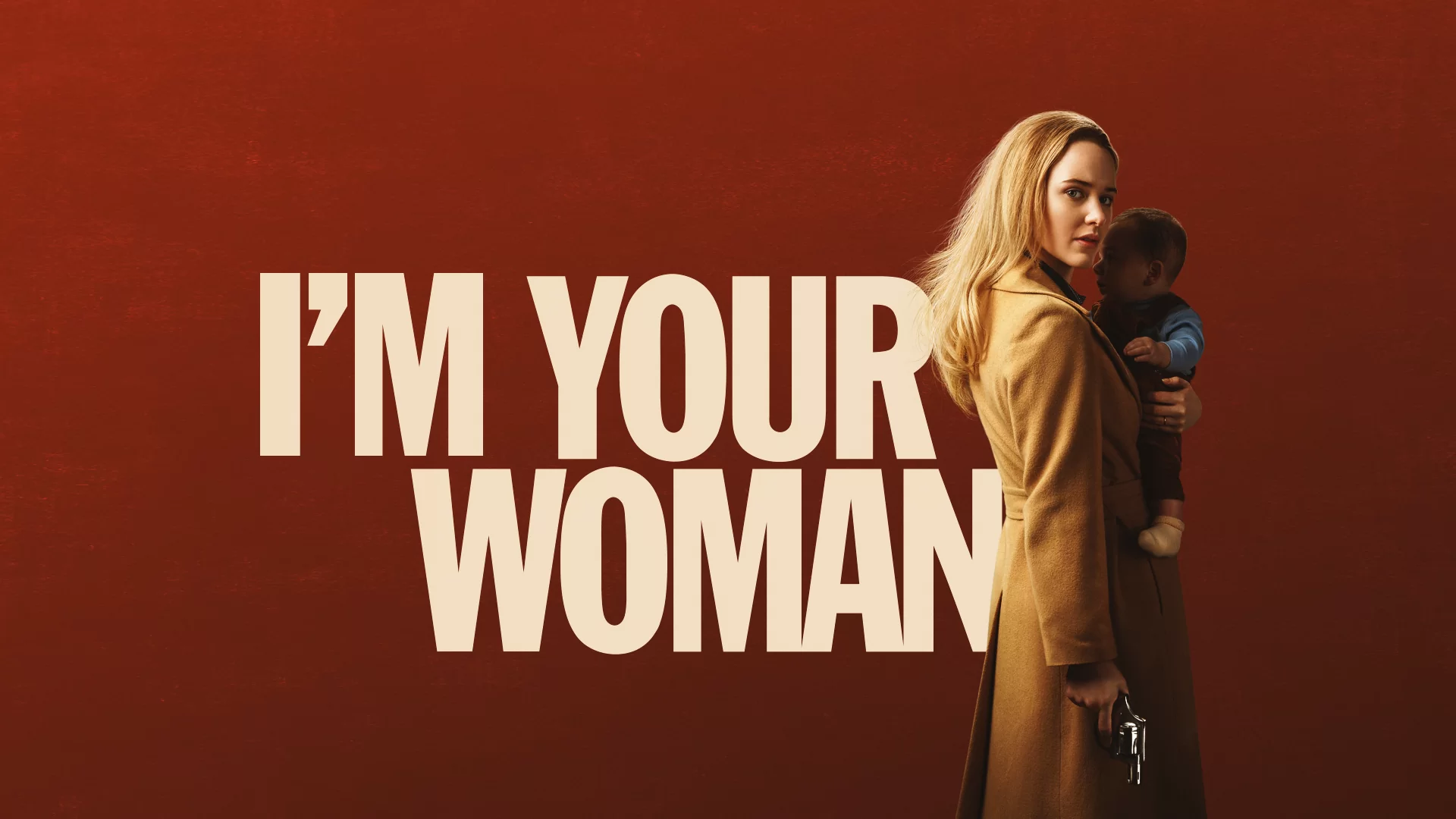 Of course, this is an intentional choice. Jean, who lives beside her partner – supposedly aware of his criminal life but in reality ignorant of the details – was never included in her husband’s plans and actions. The film could show us a broader picture, but it deliberately avoids doing so, coding itself instead as a psychological drama with thriller elements. Thus, the characters who appear in her path are as much a mystery to us as they are to her. Is that kind elderly woman an informant for Eddie’s enemies, or really an acquaintance of the home’s former residents? What exactly did Eddie do? Where is he hiding? When will he return? What are Cal’s (Arinzé Kene) motivations? Questions pile up, but we shouldn’t expect quick answers. We’ll have to wait until the final act for those, and by then, we’ll have formed a few more doubts – including whether it’s all really worth the wait. The decision to limit the viewer’s knowledge to the protagonist’s is – even if intentional – deeply discouraging, especially when paired with the sluggish pace of events.
I wasn’t exaggerating when I said Jean mostly just bounces off walls. These long pauses, letting us feel the protagonist’s impatience, might not be compensated for by the otherwise well-shot scenes in which firearms come into play.  And those aren’t the only well-shot scenes. Director Julia Hart has an eye for color, so admiring the compositions prepared by her and the production design team can be a pleasure of its own. It’s no coincidence that the couple’s house is blue on the outside, just like the car Jean travels in with Cal, or the latter’s coat (verging on navy).
Nor is it a coincidence that Jean wears shades of beige and yellow, and in the final sequence drives a car in a color matching those tones. The symbolism of colors is extremely important in this film and marks the various stages of the protagonist’s transformation. Naturally, her journey leads from entrapment to liberation – both literal and metaphorical – from a patriarchal relationship in which decisions were made by the husband, and the woman’s role was limited to interior decorating.
In this context, Jean’s passivity in the face of events is justified by her character, and when she finally takes matters into her own hands, it will be as surprising as it is satisfying. Until then, however, we may grow tired of the slowly unfolding plot and constant lack of information. This is a film for the patient, the very patient, willing to follow Jean’s emancipation story, even if it’s far from flashy in many respects. If I had to compare, it’s closest to the New Horizons festival hit Holiday. In both cases, we’re dealing with female protagonists trying to prove that the possessive pronoun in the reviewed film’s title is entirely unnecessary.

