
Review
COLOSSAL. Radiated a Deep Love For Cinema
Even if the film lost certain threads along the way and lacked subtlety in developing some of its elements, Colossal ultimately radiated a deep love for cinema.


Nearly a decade separated Nacho Vigalondo’s feature debut Timecrimes from Colossal, the film that ultimately confirmed his status as one of the most idiosyncratic genre filmmakers of his generation. Timecrimes had been a genuinely surprising twist on the time-travel formula, and in the years that followed the Spanish director consistently demonstrated a talent for aggressively bending genre rules.
Sometimes his films buckled under the weight of overcomplicated ideas, sometimes he pushed a single concept too far—but he never stopped thinking outside the box. That impulse was evident in Extraterrestrial, a skewed take on the alien-invasion movie, and in Open Windows, a Hitchcock-inflected exploration of the digital age that brought together, among others, Elijah Wood and Sasha Grey, only to tangle its narrative so thoroughly that viewers could only stare in disbelief.

Vigalondo’s unconventional approach to cinema had already been recognized back in 2003, when he received an Academy Award nomination for his brilliant short 7:35 in the Morning, a clever and unexpected riff on cinematic romance. For that reason, his work could be frustrating and occasionally disappointing, but his talent was never in doubt. And when he truly locked onto a concept—without overindulging in eccentricity—he delivered films that felt genuinely singular.
This was precisely the case with Colossal , a story about a woman struggling with alcoholism and on the brink of a nervous breakdown who leaves New York in desperation and returns to her small hometown in rural America, only to discover—to her horror—that for reasons unknown she controls… a giant monster wreaking havoc in Seoul.

At the time of its release, Vigalondo’s film stood out as a remarkably fresh genre hybrid built on an entirely unexpected fusion of conventions. A small-town drama about addiction—the kind usually knocking on Sundance’s door—was fused with kaiju cinema depicting the destruction of Asian metropolises. Structurally, the whole thing strongly evoked an episode of The Twilight Zone, while treating each of its elements with a surprising degree of care and understanding. A lack of originality was the last accusation that could reasonably be leveled at this production. Yes, some building blocks were familiar, but by constantly shuffling radically different cinematic traditions, Vigalondo offered audiences a genuine breath of fresh air.
Throughout the film, the director carefully planted clues leading toward the mystery of the connection between Hathaway’s character and the monster. Whenever the story threatened to slow down, sinking too deeply into the protagonist’s delirious, self-destructive existence, a plot twist arrived—perhaps not especially subtle and somewhat abrupt, but emotionally effective. These turns linked the scattered hints and helped assemble the narrative’s core: while the monster mattered as a source of physical destruction, the truly dangerous forces were human flaws—accumulated resentment, the desire to control others, and the constant urge to run away from one’s problems.
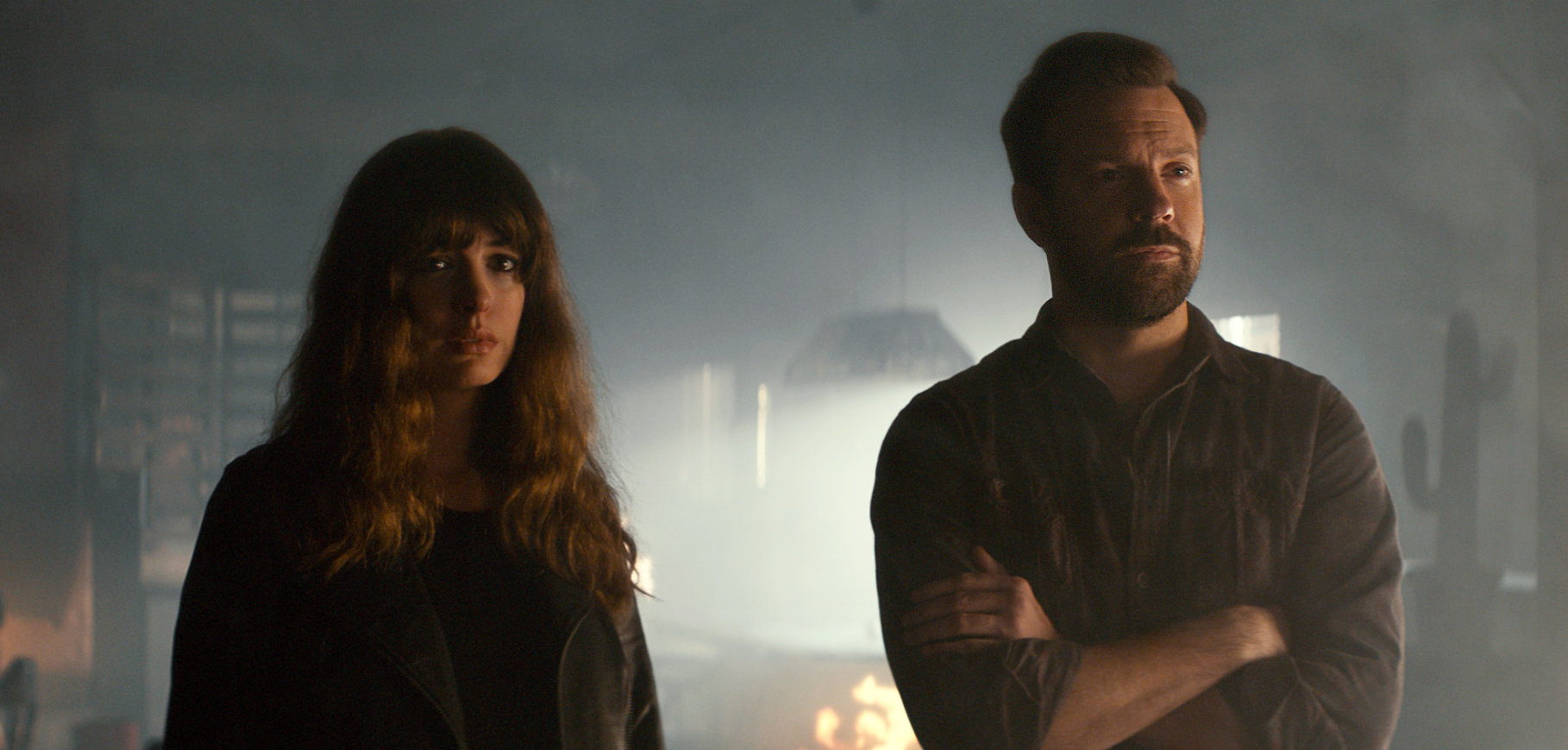
Thanks to this mechanism and the effective blending of the human and the monstrous, Vigalondo brought his story to a surprisingly coherent conclusion. The themes themselves were hardly new, but the film demonstrated how bold genre mixing could breathe life into familiar frameworks. The only real misstep came when the director became too enamored with a single idea related to the relationship between certain characters, causing the alcoholism subplot—so prominently foregrounded for much of the film—to become little more than an accessory with limited impact on later developments.
Even so, the narrative remained tight, and the cast strongly supported the director’s vision. It was admittedly difficult to fully buy Anne Hathaway as a woman spiraling into alcoholism—she consistently projected the image of a fresh, girl-next-door presence, and the script often asked viewers to take her blackouts on faith—but her internal transformation felt convincing. As in The Twilight Zone, the strange, inexplicable events commanded attention, and Hathaway navigated the bizarre material with confidence. She was particularly well supported by Jason Sudeikis, whose character occasionally swung too sharply between extremes (a flaw more attributable to the script than the performance), but who ultimately injected energy and momentum into the story. It was a shame that the potential of the excellent Dan Stevens went largely underused, though he at least had a brief chance to charm with his British accent.

Based on its trailers, Colossal could easily have been mistaken for a quirky comedy, but humor was dispensed here in strictly measured doses. At its core, the film functioned as a sharp drama—a wildly imaginative take on the idea of a psychological return to the past through confronting one’s inner demons in the place where one grew up. It suggested that formative experiences shape us permanently, and that at some point—perhaps this is the true marker of adulthood—we are forced to face the painful memories we have long pushed to the margins of our minds. Once again, Vigalondo thumbed his nose at contemporary cinema, proving that it was still possible to craft something fresh from seemingly worn-out ideas.
Even if the film lost certain threads along the way and lacked subtlety in developing some of its elements, Colossal ultimately radiated a deep love for cinema as a machine capable of processing trauma through extraordinary means. In retrospect, it stood as a flawed but fascinating work—one that embraced imperfection while reaffirming Vigalondo’s belief in genre cinema as a space for bold experimentation and emotional truth.

