Horror Movies
Revisiting LET THE RIGHT ONE IN: Extraordinary Coming-of-Age Horror
Let the Right One In draws one in, enchants, leaving the final interpretive path to each individual viewer.

Cinema by its very nature serves an escapist function, yet at the same time, almost from the very beginning, filmmakers have tried to inspire the viewer to step beyond their own limitations, beyond the safe distance of the cinema seat, and to devote time to reflecting on the content contained in a given film. Participating in a dialogue with the creator can bring otherworldly satisfaction, and uncovering layers of interpretation can become almost an intellectual addiction. Let The Right One In.
From time to time, films appear that cannot be defined unequivocally and that, thanks to their carefully thought-out yet ultimately open-ended construction, leave behind a multitude of interpretive gateways. I would like to take a closer look at one such film: the Swedish production Let the Right One In (Låt den rätte komma in). The film is mysterious, atmospheric, and resistant to clear-cut interpretation. It invariably brings to my mind Richard Kelly’s Donnie Darko, both on the narrative level (the protagonists are outsiders, and one of the main themes is coming of age) and because of the layering of multiple interpretive levels and the scattering of hints and keys throughout the entire film.

The film tells the story of a vampire girl who, amid the scenery of Swedish housing estates, befriends a shy, lost boy, changing his life forever. Although it takes up a vampire theme, Let the Right One In is not a horror film, but rather a kind of extraordinarily lyrical parable. Even the bloody moments, when Eli must satisfy her hunger or when her guardian procures food for her, are shown by the creators through a combination of sober realism and gentle artistry. As a result, alongside the brutal taking of a human life, one admires the metaphorical beauty of red pressing against the snowy whiteness of the landscape.
The most intriguing aspect of this unusual story is its ambiguity and, at the same time, the difficulty of encompassing everything its creators have to offer. Tomas Alfredson, the film’s director, and John Ajvide Lindqvist, the screenwriter adapting his own novel, tell their story with intensity while preserving delicacy and subtlety in depicting events such as a first kiss or a first encounter with death. They combine innocence with bluntness, the beauty of a blossoming feeling with the drama of passing time, in such a way that the film is watched with a particular kind of enchantment, accompanied by a sad realization of the events unfolding on screen.

The thematic scope addressed in the film is a multicolored spectrum, on which the creators unfold a range of motifs—from friendship, identity, and initiation to reflections on nature, time, and transience. All these threads complement one another perfectly, creating successive layers of interpretation. The filmmakers lead the viewer by the nose, offering new content and questions, leaving them alone in search of answers. To dig them out, one must watch attentively, without haste, rejecting the blockbuster habit of laying everything out plainly on a shiny platter.
Let the Right One In draws one in, enchants, leaving the final interpretive path to each individual viewer, while at some point making one realize that a return to the Swedish housing estate will be inevitable. The most basic interpretive route is a parable about otherness, the search for one’s own identity, and finally friendship and growing up (also, and perhaps above all, through friendship). Oskar is a timid twelve-year-old boy who cannot stand up to the school bullies who torment him psychologically and physically.

He lives in a world of books and bold fantasies, in which he takes brutal revenge on his tormentors. This lasts until the moment he meets Eli, a strangely pale new neighbor who bluntly tells him that they cannot be friends. Yet otherness attracts otherness, and the two begin to spend more and more time together. And although at some point Oskar begins to understand what the girl meant, he accepts this state of affairs as natural. Being in Eli’s company gives the boy self-confidence, and he slowly leaves behind the safe world of childhood.
They grow close to each other, though for completely different reasons. Oskar begins to feel something for Eli that, because of his age, he cannot define or name, while the girl, long aware of her fading humanity, simply needs another partner, a link to the world from which she has been condemned to eternal banishment. In short—she needs a guardian. The older man who takes care of the girl at the beginning of the film is not related to her by blood. Once, several decades earlier, he was the same kind of young boy as Oskar. Back then, he met Eli, befriended her, and took the place of the previous guardian.

During that time, he ensured her smooth functioning in the human world and protected her from exposure. Now he has grown old and is no longer able to perform the role to which he devoted his life. Oskar takes over his role. He will be Eli’s friend, her guardian, and as he grows up, he will begin to channel an incomprehensible feeling (only beginning to sprout in the film) into loyalty and attachment to the girl who will never grow old. In the end, he will understand that he will have to give way to another child, beautiful in their innocence.
This is an intentional metaphor of life, showing transience through cycles from which there is no escape. School age is a time of growing up, of discovering the rules of life through an adolescent mind; later, youth begins to fade ever faster, leaving behind memories of happy moments worn down to pain in an eternally young soul; and then comes the autumn of life, sometimes golden, sometimes gray, changing one’s attitude toward the surrounding reality, of which one ceases to be a part. Individual cycles cannot be noticed until they have passed, but one must try to make use of each in one’s own way.
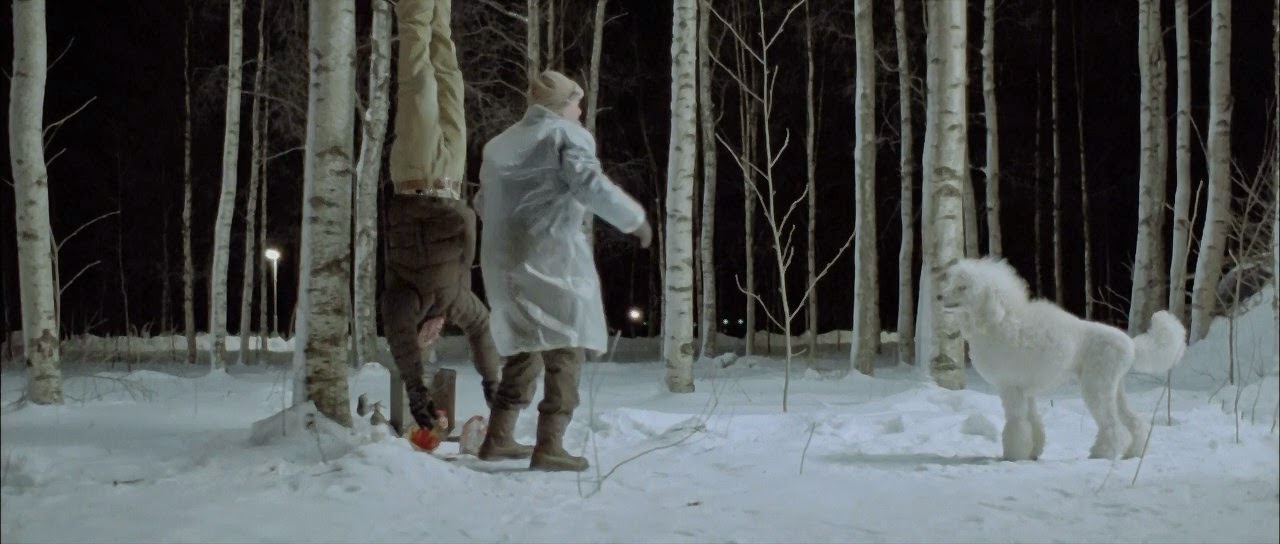
Through the example of the unchanging little girl, small yet overly experienced, about whom so little is known, Alfredson makes palpable the transience to which everyone must submit. By contrasting time-frozen Eli with Oskar, who is subject to the laws of nature, he emphasizes the importance of the present. This approach is true and sad, yet at the same time beautiful because of the self-awareness it imposes. Engaging in dialogue with Stoic philosophy, with emphasis on its empirical aspect, the Swedish film presents an attitude that sincerely welcomes what nature gives.
And although, in terms of character development, Eli is a rather static figure, in the film—within this immeasurable verse of her life—she too begins to experience transience. It is unknown how many guardians she has had; presumably she has already crossed her oceans of time, but in the film it is clear that Eli increasingly thinks about the end of her wandering, an end she had previously avoided with wild ferocity. Paradoxically, it is precisely her evaporating humanity that pushes her toward this ultimate decision. The ending seems to prove otherwise, but taking into account the context of the entire film, it is decidedly ambivalent.

It is no coincidence that the creators placed the action at this particular moment in Eli’s existence. They wanted to show the doubts being born within her. She too is maturing; this process cannot be avoided. And although this is only sketched against the background of Oskar’s transformation from a larval figure into a beautiful butterfly, it perfectly matches the mood and themes of the film. Nevertheless, from the perspective of maturation, the main character remains Oskar. The boy becomes self-aware, aware of his sexuality, and mentally matures enough to make decisions.
It is no coincidence that the protagonist is a boy at this transitional age, in which so much depends on environment and surroundings. Oskar receives Eli from fate, thanks to whom he does not end up as a school punching bag. At this point, it becomes clear that the creators took a broader interpretive path, once again referring to nature and life cycles. Everyone has some wildness within them—undefined, undiscovered—emotions that churn inside, sometimes erupting, sometimes remaining hidden until the day of death. It is important that something or someone helps uncover them, pushing one into action.

This is almost a Darwinian matter, though without unnecessary determinism. In a world of unpredictable nature, embodied by the immortal, eternal Eli, the strongest will survive—but to be the strongest, one must be raised to be so. And it is precisely this broadly defined nature that is an equal protagonist of Let the Right One In. In order to complete the allegory drawn throughout the film, it is also, in a sense, personified. There are two interpenetrating worlds: the world of nature and the world of humans. In the film, everything that is not the product of human hands-forests allowing a breath of freedom, a river hiding corpses, snow allowing oblivion-belongs to the former.
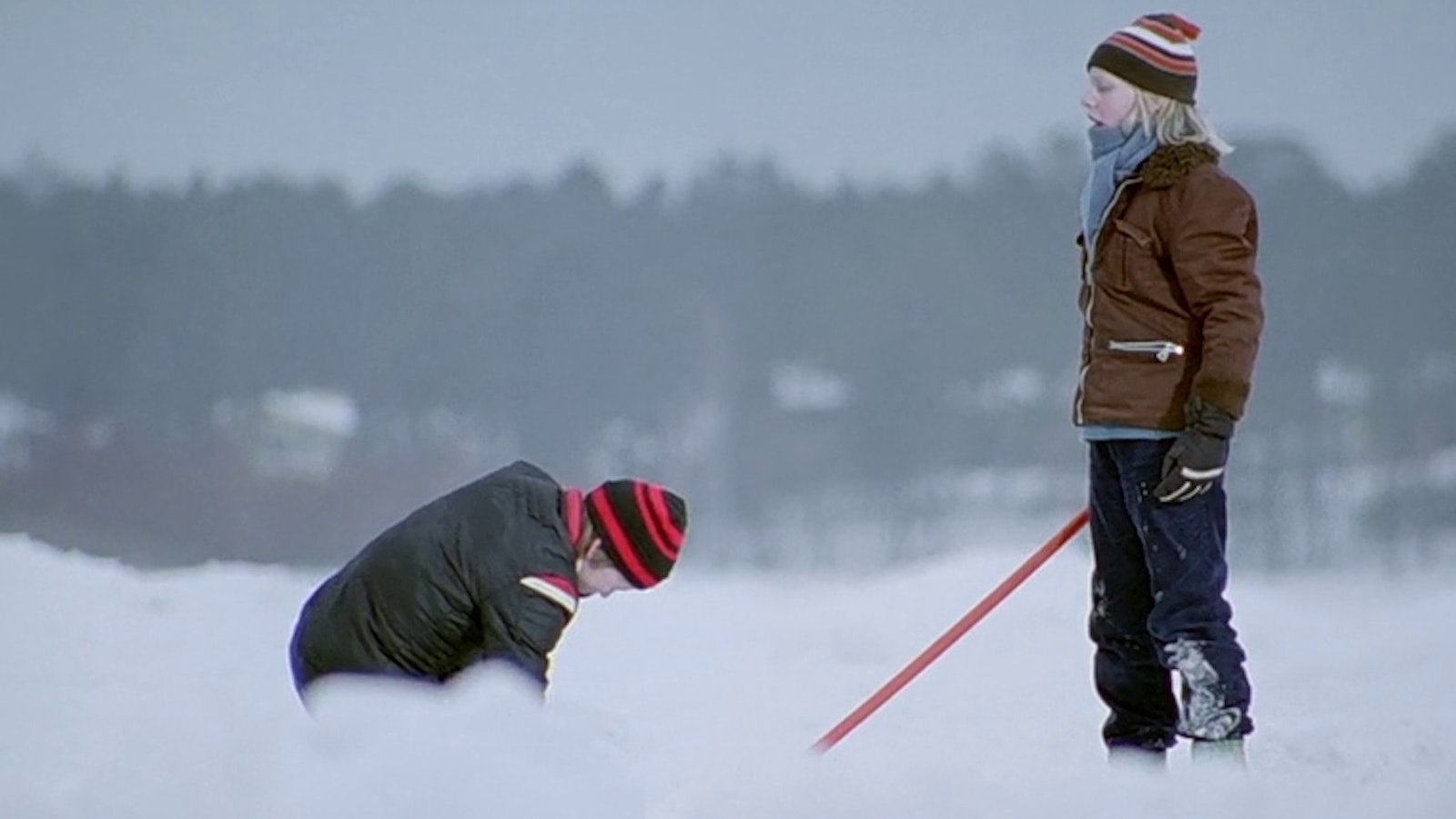
Eli is a creation of nature, a completely wild and unpredictable being, independent of the human world. And yet she continually penetrates that world, whether to accompany Oskar or to satisfy her own needs. She exists in a cage of dependency, powerfully suggested by the place where she sleeps—a bathtub barricaded with locks and cardboard. Oskar, meanwhile, although he lives in the human world, like Eli cannot cope with it at all. He helps her exist in his world, while she introduces him to the mystical world of nature. This is vividly shown at the moment when Oskar finally rebels against his school tormentor and mutilates his ear-it takes place in a snowy wasteland during a school trip.
In every aspect of the film, the creators strive to maintain a balance between these two worlds: between wild, untamed nature, in which humans discover their true selves, and the human world, in which everything seems predictable. In this way, Alfredson and Lindqvist create a complete metaphor that, together with the perfectly chosen original title, refuses to let go of the viewer’s thoughts. Interpreting the title, on a basic level it refers to a motif rooted in legends, which requires a vampire always to ask whether they may cross the threshold of a home.
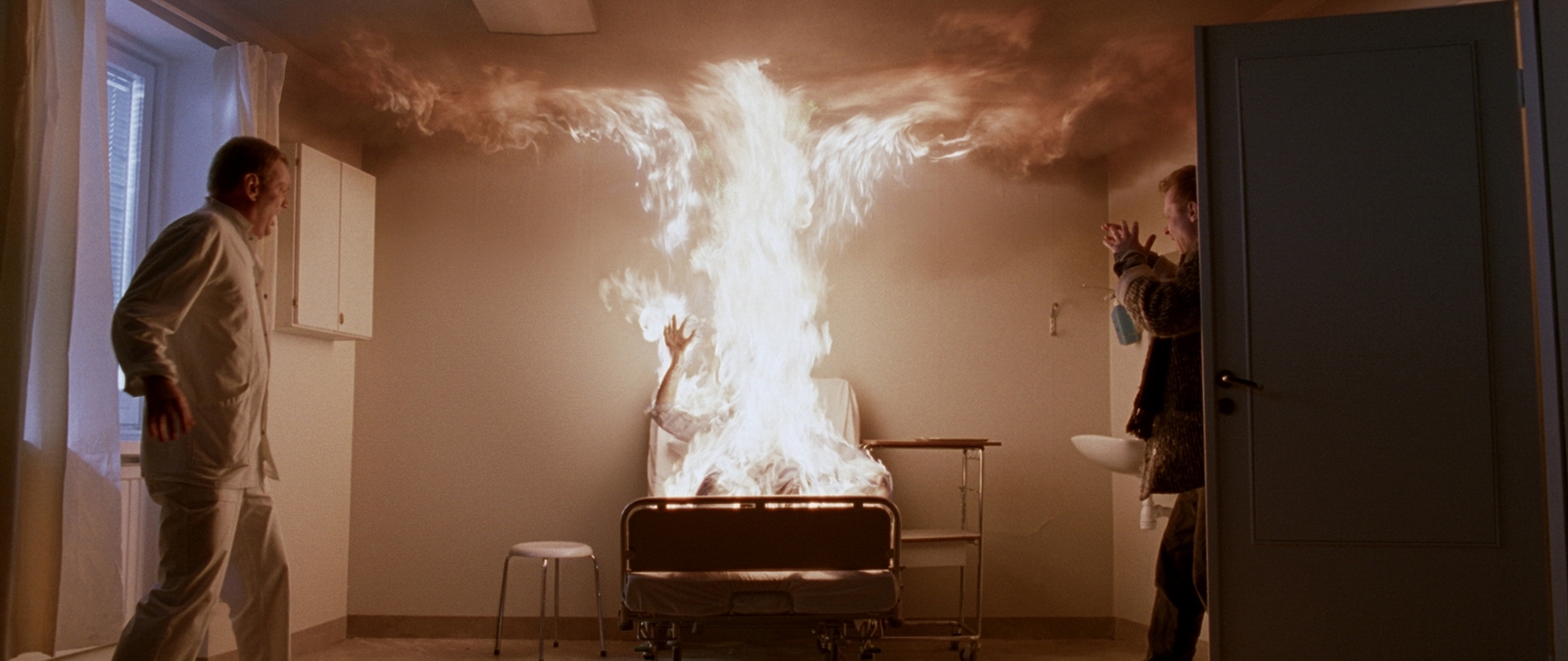
If they do not, their body begins to bleed (and may even die, though here one would have to delve into the nuances of vampire cinema, which is not the aim of this text). On a higher level, it is a metaphor for decision. The old guardian knows what awaits him at the moment he opens the hospital window for the girl—he agrees to death, almost with joy, because for some time now (since the opening frames of the film) he has felt that his time has come. Oskar, on the other hand, does not know what he is doing; he banters with Eli, provoking her to enter his apartment without permission—resulting in the girl turning into a walking geyser of blood.

It is a metaphor of innocence and unawareness of life, which until a certain moment protect a young person like a cocoon, so that later a transformation can occur—a symbolic tearing away from the world of childish naivety and carefreeness. Eli is, in this sense, not a bearer of death but of nature itself—this unpredictable and undefined force that governs human existence. On this level, she becomes a metaphor for the decisions a person makes throughout life, decisions both existential and mundane: whether it is worth loving, whether it is worth having friends, whether it is worth trying.
The Swedish film is an extraordinary work that encourages one to pause for a moment over what has been seen, to change one’s way of perceiving film aesthetics, to shift onto a different track of thinking. It is a cinematic experience that soothes and calms. A beautifully shot and thoughtfully constructed film, in which the multiplicity of interpretations does not get in the way but captivates, because it shows that not everything needs to be fully defined.