
Article
Why ALIEN: EARTH Gets Under Your Skin So Effectively
In one scene of the series Alien: Earth, a line is spoken saying that in a corporation you always say “yes,” because “no” means a lack of growth.


There are only two ways for a person to understand what evil is: through observation or through personal experience. The former is usually embodied by monsters—external, tangible symbols of fear. The latter reveals itself when we ourselves become monsters. And then the most sensitive, yet also the most honest, critics of our actions turn out to be… children. In one scene of the series Alien: Earth, a line is spoken saying that in a corporation you always say “yes,” because “no” means a lack of growth. This neat summary of the philosophy of all future engineers turns out to be just as accurate when applied to the Alien franchise itself.
The creators had to tell themselves a decisive “yes” in order to pick up their pens and create the first series set in this universe. Whatever else can be said about the project, one thing is certain—it does not lack courage.

For years, silence reigned in the world of Alien instead of a creative outcry, settling in after the premiere of the extravagant Alien Resurrection in 1997, the last installment featuring Sigourney Weaver. Many felt that Jean-Pierre Jeunet had exhausted the supply of ideas and that the producers lost their nerve for a long time. The silence lasted until 2012, when Ridley Scott returned with Prometheus, inspired by Däniken, and Covenant, drawing on Paradise Lost. Both films said “yes,” but fear increasingly gave way to existentialism.
Noah Hawley, the creator of Alien: Earth, received a vote of confidence from Disney and chose to take a risk. The latest iteration, balancing between homage and reinterpretation, surprises above all by replacing claustrophobia with space and fresh air. This is precisely what sets it sharply apart from the recent Romulus—a safe production built from the franchise’s best practices—because Earth goes in the opposite direction: wider and against convention.

Alien: Earth is an installment that plays very skillfully with sound, imagery, and stylistic detail. The series abandons slow-building tension in favor of rapid exposition because—as Hawley notes—there is no point in escalating fear around something everyone already knows, something that has long since escaped its cage. At the same time, it does everything to make viewers feel “at home.” The music, retrofuturism, and production design function as a tribute to the franchise, creating a bridge back to Alien. A return to this “look” was inevitable, especially since the story is set a few years before the first film.
Things become more dynamic on the level of cultural references, the most important of which turns out to be Peter Pan. This tale forms the foundation of the script: the crocodile takes on traits of the Alien, and the sibling relationship moves to the foreground (as it did earlier in Romulus). At the same time, Hawley gives the monster a new purpose, redefining its symbolism. Until now, the xenomorph was a figure of sexual anxiety—its phallic shape, the confrontation of a woman with oppressive male force, Freudian nightmares rooted in the body. In Alien: Earth, erotic tension gives way to childhood—a time of freedom and carelessness—suddenly confronted with the inevitability of death. In this reading, the monster becomes less a nightmare of desire and more a brutal reminder that no innocence lasts forever.

Although assurances were given that Alien: Earth has nothing to do with David’s storyline, it is hard not to notice similarities to themes from Prometheus and Covenant. The series asks a question about identity: is it defined by the body or by consciousness? A reference to the legend of John Henry in one of the finales underscores that the clash between humanity and technology offers no simple answers—especially when machines can be more human than humans, and people more mechanical than androids. Sydney Chandler does not awaken to strength like Ripley, but matures, discovering that control is part of growing up. Olyphant and Ceesay, meanwhile, remind us that the most interesting conflict is the one between the machines themselves, just as the monsters, too, have received their own modifications.
Alien has always contained a paradox: everything best about these films is built on the encounter between humans and a mysterious being from space, yet this motif was already exhausted in the first three installments. Attempts to move away from it provoke resistance—although everyone knows the story of the ship as a dark castle, with a vampire from another planet lurking in its corridors, cannot be repeated endlessly, this is precisely what audiences expect from the franchise. The monster ceases to be a monster when we turn on the light that once fed it.
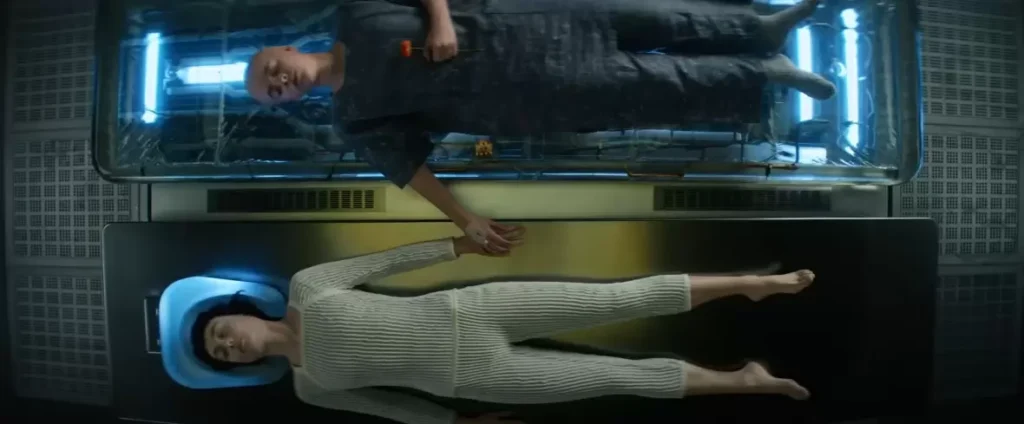
Alien: Earth changes the perspective, however—replacing enigma and nightmare with a predator in the hands of machines, turned against humans. Does that mean it is less evil? Or is evil simply part of nature? In the scene where the creature strolls through a forest, the metaphor may seem too literal, but it effectively makes us realize that evil depends on interpretation. Hawley has clearly searched for a new language for the franchise and is not helpless—he knows what he wants to say. The only question is whether audiences are ready to hear it.

