Review
WHEEL OF FORTUNE AND FANTASY. Formally Fascinating
As a result, Wheel of Fortune and Fantasy can be described as formally fascinating yet thematically underwhelming.


Although modern science is eager to frame phenomena such as emotions and human behavior within rigid formulas and clearly defined psychological or biological determinants, the question of what we actually feel toward other people remains strikingly unresolved. What shapes our emotions? To what extent are they a matter of will, and to what extent do they function as objective forces beyond our control? Ryûsuke Hamaguchi’s Wheel of Fortune and Fantasy—now viewed from the perspective of several years after its release—set out to explore precisely this uncertainty. The film examines how fragile and fluid human relationships can be, how much potential lies dormant in chance encounters, and what role imagination plays in love.
Hamaguchi structures the film as three distinct micro-narratives, each approaching the subject of love from a slightly different angle. In the opening segment, Something Less Assuring, we are introduced to a compelling love triangle that unexpectedly entangles two friends, Meiko and Gumi. The second story, Doors Wide Open, centers on Sasaki, a student deeply fascinated by her literature professor and his newly published novel. Through the book, she attempts to penetrate the professor’s seemingly impenetrable inner world. The final segment, Once Again, follows a chance reunion between two former schoolmates, during which surprising truths about their shared past come to light.

The three stories are not connected by plot, yet one may get the impression that the characters are linked in a more elusive, almost metaphysical way—as if we were watching different versions of the same individuals, placed into alternate identities and circumstances. This sensation is intensified by Hamaguchi’s subtle disruptions of realism and temporality, which lend each episode a faintly fantastical quality. The film plays with imagination and unrealized possibilities, culminating in ambiguous epilogues that undermine the reliability of the camera’s point of view and draw Wheel of Fortune and Fantasy closer to the logic of dreams than to strict realism.
This element of unreality proves to be the film’s most intriguing aspect. Hamaguchi skillfully weaves together his narrative threads while examining various shades of love—jealousy, erotic fascination, routine, longing, suppressed anxieties, and the inescapable role of fantasy. Female perspectives dominate the film; male characters are present but largely marginal, serving more as catalysts than as emotional centers. Discreet temporal shifts, an unreliable, subjective narration, and the almost magical agency of language—words that do not merely describe emotions but actively generate them on screen—combine to create a hypnotic experience. At its best, the film engages the viewer in a refined game of perspectives and perceptual possibilities.

Seen as a whole, the three segments form a cohesive statement, thematically interlocking and accumulating into a broader reflection on chance and imagination—an idea already hinted at in the film’s title.
And yet, much of this feels oddly familiar. While Hamaguchi’s observations emerge from everyday detail and aspire to universality, that universality ultimately becomes a weakness rather than a strength. Wheel of Fortune and Fantasy is layered and intellectually engaging, but it does not offer many genuinely new insights. Its intimate explorations of emotion—delivered through precisely written dialogue and delicately performed scenes—recall the socially attentive domestic cinema of Yuzo Kawashima. At the same time, the film largely avoids updating its social context, which remains confined to surface-level mise-en-scène rather than meaningful contemporary engagement.
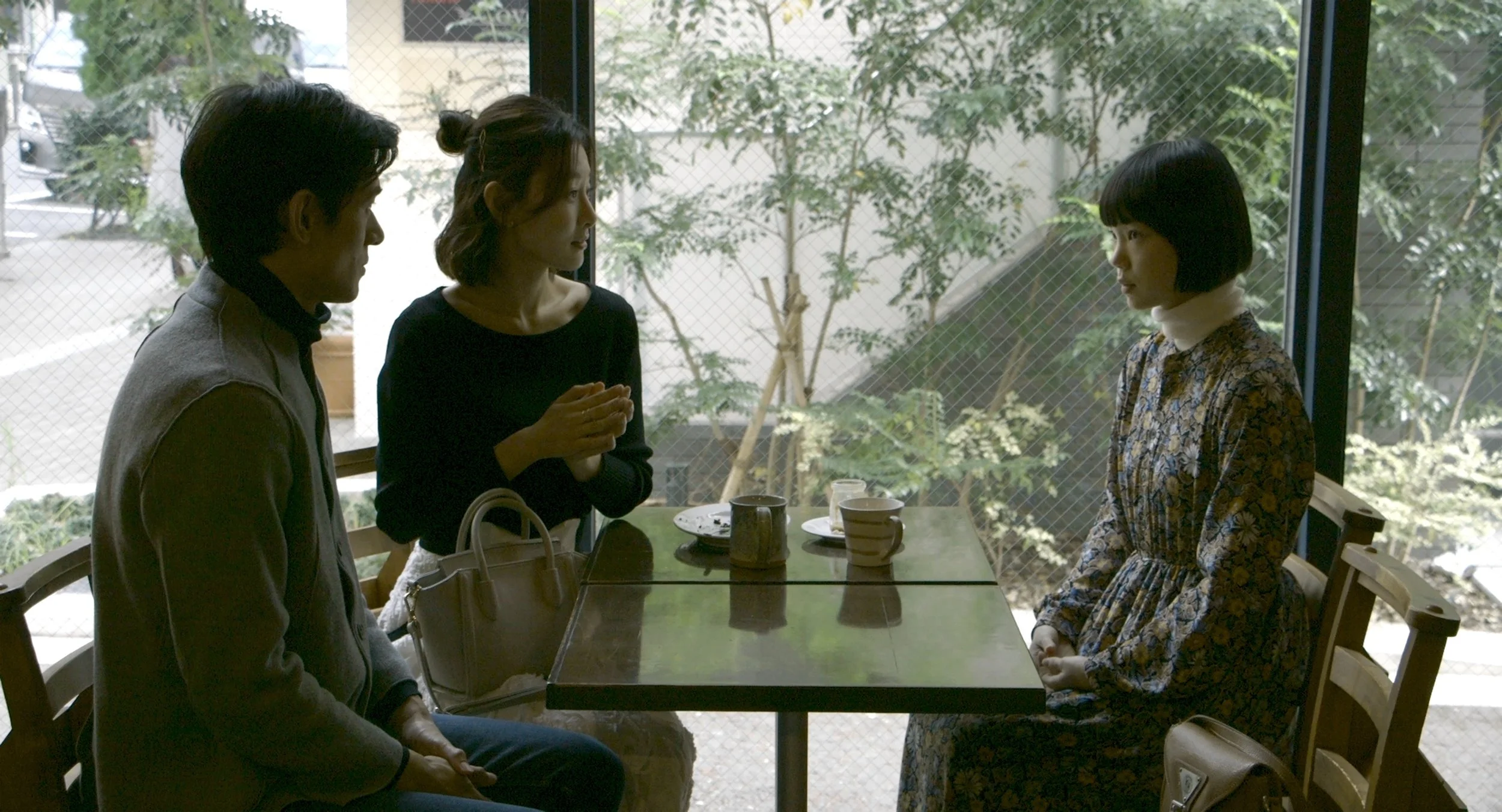
The film’s strongest kinship, however, lies with Eric Rohmer. Hamaguchi’s extended dialogue scenes, his soft formal touch, and the quiet perversity of his narrative constructions often feel directly indebted to the French New Wave master. Each of the micro-stories could almost be transplanted wholesale into a Rohmerian setting without disturbing its rhythm or meaning. While such lineage is hardly a flaw in itself, Hamaguchi’s classicist approach ultimately weakens the film by exposing its semantic repetitions. In other words, he revisits insights and emotional dynamics already articulated by earlier filmmakers, and much of his formal sophistication amounts to a careful re-enactment of modernist conventions rather than their reinvention.
As a result, Wheel of Fortune and Fantasy can be described as formally fascinating yet thematically underwhelming. Individual scenes and compositions invite close appreciation, and Hamaguchi’s play with the unstable boundary between truth and fiction is worth surrendering to. One should not, however, expect too much from the film’s ultimate conclusions. Viewed from a distance, it leaves the audience with a sense of lingering incompletion—and, paradoxically, a feeling of déjà vu.