
Review
TOLKIEN. A visual version of a Wikipedia entry
Tolkien works as a visual version of a Wikipedia entry and a starting point for deeper interest in the Hobbit creator. I won’t criticize that.


Tolkien’s biography entered cinemas preceded by the information that it had not been approved by his family. This fact didn’t particularly discourage me – the writer’s relatives passed judgment before watching the film, and their criticism focused solely on the fact that no one had asked their permission to make it. Besides, Tolkien’s family is known for harsh judgments of interpreters of his work – for example, the author’s son, Christopher, spoke unfavorably about Jackson’s The Lord of the Rings. So, undeterred, I bought a ticket, and after watching the movie, I can calmly say that the Tolkiens have no reason to distance themselves from Tolkien so categorically. No one desecrates the memory of the famous writer here; the facts are presented faithfully and reverently, without distortions or major controversies.
Public television could safely air this film during lunch. If anything could offend the writer’s family, it’s the fact that such a dull, uninspired film was made about their brilliant relative. It’s hard to define the target audience for this biopic. On the one hand, the creators wink more or less subtly at Tolkien fans – the soundtrack at times echoes Howard Shore’s unforgettable score, the main character roams through World War I trenches reminiscent of Mordor with his loyal companion Sam at his side, and the horrors of war transform in the young writer’s imagination into phantasmagoric beasts and silhouettes of knights.
On the other hand – the whole thing resembles a cheat sheet, a summary of a biography, in which fans will search in vain for unknown facts or meaningful reflection. The creators aimed to tell everything that happened in the author’s life before he achieved literary fame. With a biography as rich as Tolkien’s, this had to result in a clumsy, superficial effect. The director rushes from one event to another, not allowing them to resonate or gain weight; one jump follows another. The film ends with overly long closing credits that summarize the writer’s later life. In them, we’ll read about little-known facts such as the claim that Tolkien is now considered “one of the most important fantasy writers.
” No, dear creators, not “one of,” but the most important – everyone writing in this genre is essentially footnoting and commenting on his work.  The worst part is that in this hasty ticking off of biographical facts, the main character is lost, portrayed rather mechanically by Nicholas Hoult (Mad Max, The Favourite). Let’s be honest: serious scholars are not rock stars, and you need a concept to “sell” them compellingly.
Such withdrawn, introverted heroes who shine more inside than out are better suited to close-ups than panoramic views: just as the value of an introvert is revealed in a long, in-depth conversation rather than at a loud party. Perhaps the film should have focused on one specific time period or theme? It could have told a story of melancholy, inherited from a childhood marked by poverty and orphanhood and a youth shattered by war and the death of friends – a melancholy Tolkien tried to silence with workaholism and the creation of fantasy worlds. Or it could have shown his life through the lens of his long friendship with Lewis, told the story of that dialogue and mutual inspiration between two brilliant minds – but the creator of The Chronicles of Narnia does not appear on screen. Another major absentee in Tolkien – despite general factual accuracy – is religion. Faith was a true pillar in the writer’s life, the foundation of his work, and his support in the toughest times; but in the film, spirituality is only present through a tertiary character – the priest who takes care of the orphaned Tolkien and stands in the way of his relationship with Edith. 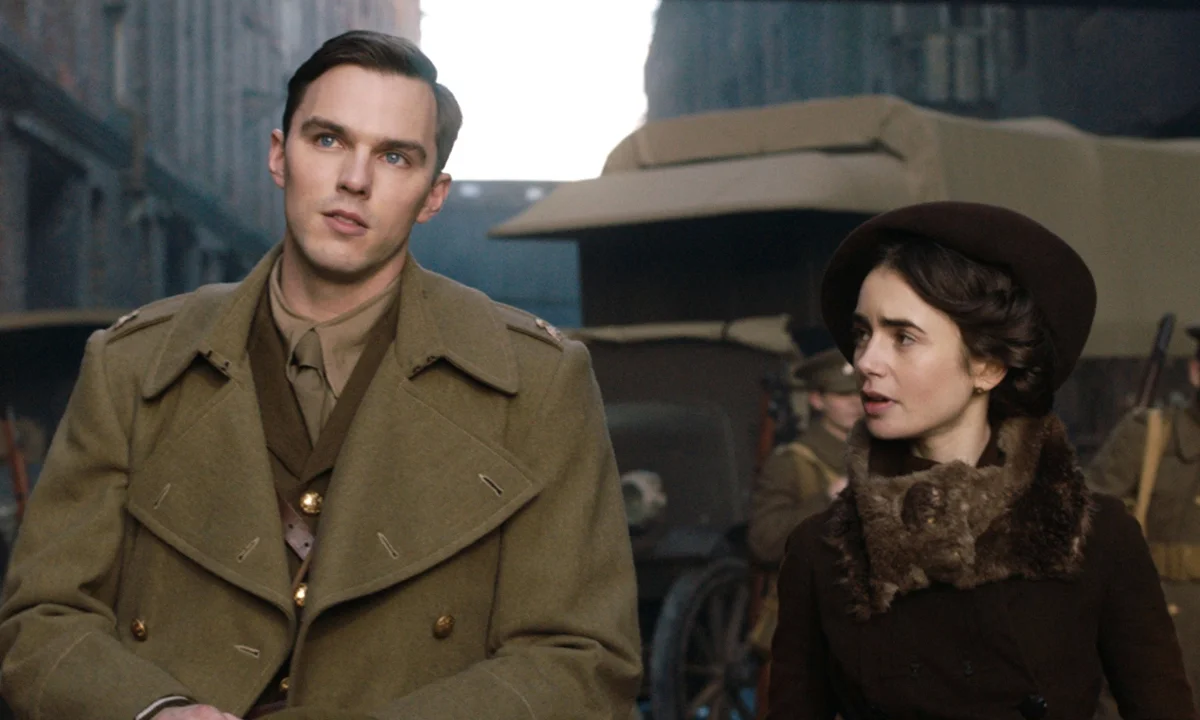 Spirit and intellect – the most interesting parts of the creator of The Silmarillion – are absent here. Unfortunately, Tolkien in Tolkien is a colorless boy tossed chaotically from place to place: we’re meant to accept his sharp intellect on faith, but his thoughts and inner life are nowhere to be found. The film’s protagonist is overshadowed by the supporting cast, especially the charming Lily Collins, who gives the only fully fleshed-out performance as Tolkien’s beloved, Edith. The romantic subplot can just about be called the main one in this story, though it’s diluted and weakened by the creators’ indecisiveness, as they seem to constantly hesitate whether to emphasize his relationships with school friends instead.
Because of this indecision, the film’s portrayal of Tolkien and Edith’s relationship loses strength – but it’s still the best-developed thread in the production, mainly thanks to Collins and the love story itself, which is genuinely romantic. Derek Jacobi is also excellent in a brief role as the slightly eccentric Professor Wright, a linguist and expert on dead languages. He appears in the only scene that gave me something like chills – a shot of enthusiastic and cheering students who have just learned that England has joined World War I. Apparently, the film’s director, Dome Karukoski, dreamed of making a Tolkien biopic since he was a child. Unfortunately, after watching his biopic, I cannot say what so fascinated him about the writer.
I don’t know what the creators wanted to tell me about him; I don’t know what kind of man he is in their eyes. Tolkien works as a visual version of a Wikipedia entry and a starting point for deeper interest in the Hobbit creator. I won’t criticize that – “informative” and popularizing films also have their place: even if they’re incapable of inspiring awe.

