
Review
THE HOUSEMAID. A Precursor of Korean Horror
For the first time, The Housemaid was shown to a wide audience in 1997 at the Busan International Film Festival.


Joon-ho Bong, the director of the acclaimed Parasite, called The Housemaid the Citizen Kane of Korean cinema. Ki-young Kim’s film is a wonderfully rediscovered gem of Korean cinematography, considered one of its most important works. Made during the so-called Golden Age of Korean cinema, this psychological drama distinguished by its unique form and style also serves as a cinematic testimony to the social transformations of South Korea in the 1960s—and as a precursor of the Korean horror genre.
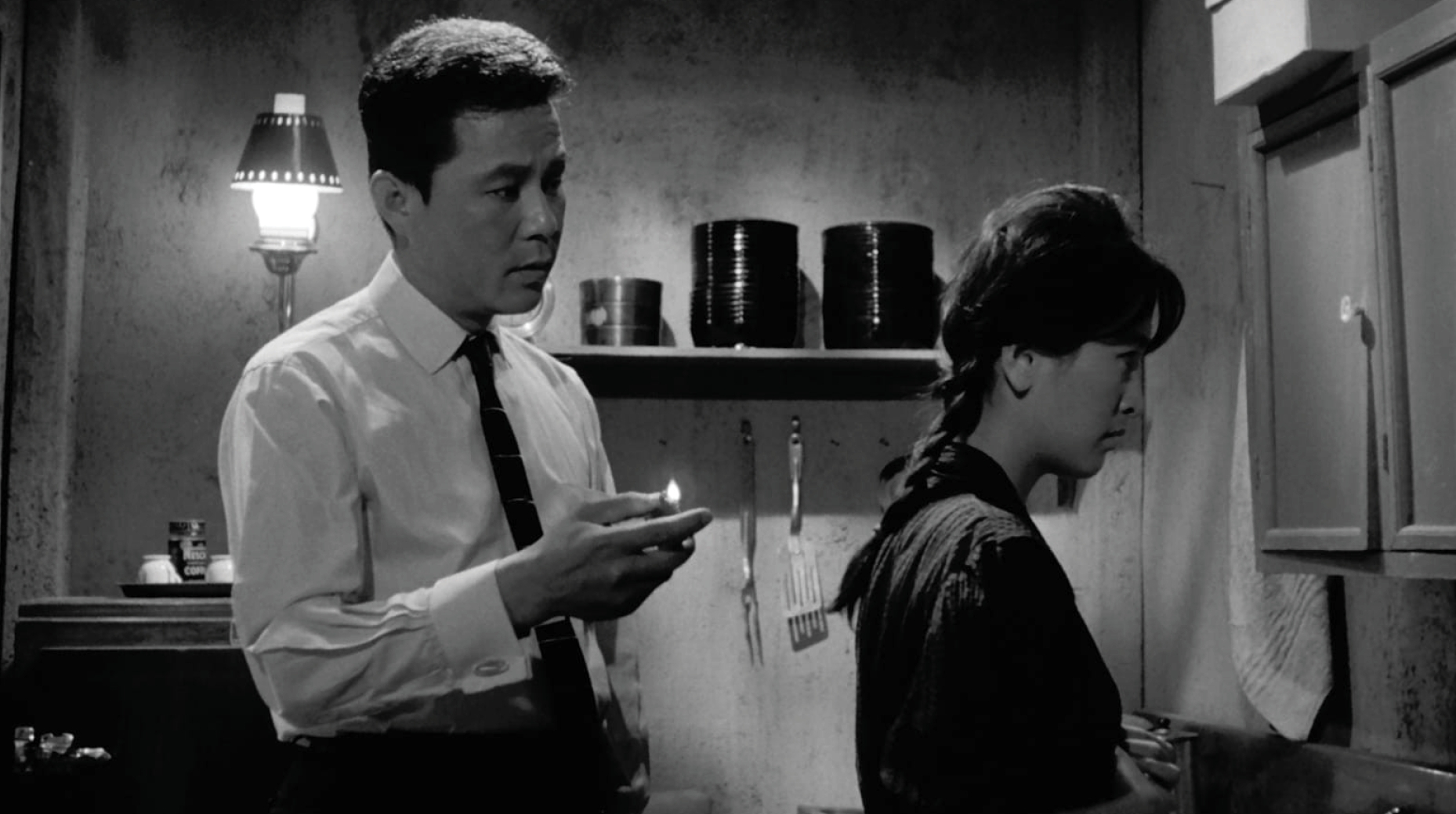
The Housemaid follows the story of the Kim family. The head of the household, Mr. Dong-sik Kim, is a music teacher who gives lessons at a school for seamstresses. His pregnant wife (interestingly, her name is never mentioned in the film—people outside the family simply refer to her as “Mrs. Kim”) earns extra money by sewing at home while taking care of their two children—daughter Ae-soon and son Chang-soon. The family’s life begins to unravel when Dong-sik receives a love letter from one of his students and hires a maid to help his wife with household chores. Myung-sook, the new housemaid, however, harbors sinister intentions and does everything she can to seduce the master of the house.

It is precisely this newly arrived servant—determined, confident, and ready to stop at nothing (literally over dead bodies)—who is the catalyst of all the ensuing chaos. From a narrative standpoint, Kim Ki-young’s film is exceptional: productions from the so-called Golden Age of Korean cinema typically told optimistic stories of love and family stability, with melodrama being the dominant genre. A notable subgenre was shinpa films (a term derived from the expressive Japanese kabuki theater), which told tragic love stories centered on female suffering in failed relationships with men—films overflowing with emotion and expressive acting.
Much of this melodramatic tradition can be found in the dark, gothic Housemaid, which adds even darker elements of its own (its plot, after all, was based on a true murder case). It is precisely from these emotions—sadness, grief, suffering, and tragedy, as well as familial and romantic turmoil—that Korean horror emerged. During the Golden Age, an increasing number of horror films followed The Housemaid’s narrative model, creating a distinctive subgenre in which the main themes were female suffering and revenge.
The protagonists of these films were often female ghosts, known in Korean tradition as wonhon—spirits seeking revenge after death for injustices suffered in life, usually as a result of family betrayal or sexual violence. In The Devil’s Stairway (1964), directed by Lee Man-hee, a doctor murders his pregnant lover and is subsequently haunted by her ghost. In A Devilish Homicide (Salinma, 1965) by Lee Yong-min, a woman murdered by her mother-in-law and cousin returns as a vengeful cat spirit.
The motif of the ghost-cat (bakeneko) is also popular in Japanese cinema—the most famous example being Kuroneko (1968) by Kaneto Shindo. (In Korean folklore and film, there were also popular female fox-spirits known as gumiho.) In A Public Cemetery Under the Moon (Wolhaui gongdongmyoji, 1967) by Gwon Cheol-hwi, a woman dies as a result of a plot by her mother-in-law and maid, and later returns from the afterlife to protect her son. Tales of wonhon and vengeful spirits—like stories of betrayal, suffering, and revenge—are a permanent element of Korean culture.

We are exceptionally lucky to be able to watch The Housemaid today in its full form—out of the 32 feature films directed by Ki-young Kim, only 22 have survived. More than 70 percent of Korean films made before 1960 have been lost or deliberately destroyed—during the difficult postwar years, celluloid film stock was sometimes repurposed to make straw hats popular among farmers. Kim Ki-young’s The Housemaid, which was a box office hit upon its release during the Golden Age of Korean cinema, was soon forgotten by Koreans themselves and remained completely unknown to the rest of the film world.
In the 1960s, South Korea tightened censorship and imposed restrictions on film studios. Western films were blocked, leading to an increase in domestic production—but only of propaganda or government-approved films. Censorship promoted politically correct works while ruthlessly suppressing any content deemed communist, unpatriotic, or obscene. As a result, Kim Ki-young’s film—dealing with themes of marital infidelity, infanticide, and murder—was completely forgotten, along with the works of other directors of the period such as Yu Hyun-mok, Han Hyung-mo, and Kang Dae-jin.

In the 1980s and 1990s, Korean cinephiles became enamored with Hollywood cinema, once the earlier trade restrictions were lifted and censorship had loosened considerably. A new generation of Korean filmmakers—Park Chan-wook, Kim Jee-woon, and Bong Joon-ho—brought new vitality to Korean cinema, popularizing it worldwide. It is thanks to them, painstakingly rediscovering their country’s cinematic heritage preserved on old VHS tapes found in second-hand shops, that the works of Kim Ki-young were brought back to light.
For the first time, The Housemaid was shown to a wide audience in 1997 at the Busan International Film Festival, after the missing film reels were recovered. In the following years, retrospectives of Kim Ki-young’s work appeared at festivals around the world. The director himself, however, died just days before he was to travel to Berlin in 1998 to attend the first international presentation of his films. The rediscovery of The Housemaid and Kim Ki-young’s oeuvre forced film historians to reassess Korean cinema, long considered deeply rooted in film realism.
The Housemaid is far from that—it thrives instead on the grotesque absurdity of its characters’ situation. It is a waking nightmare full of violence, blending melodrama, thriller, and horror, whose overall tone borders on satire. It is also a self-reflexive work—a film about filmmaking—in which the director lays bare the power of his own medium, ending with a sly wink to the audience.

