
Review
SEARCHING. Memorable Thriller Built on Strong Concept
Searching is not a film that struggles to capture online reality. Fortunately, it avoids simplistic cynicism or the tired tendency to demonize technology.


In Aneesh Chaganty’s film, you have to accept two things from the very beginning: its unconventional narrative form and the fact that John Cho — once known for playing the teenage Harold in a popular early-2000s comedy — now portrays the father of a teenager. He has, of course, also appeared three times as Sulu in Star Trek, but for a long time he risked being remembered primarily as the marijuana-loving Harold. That perception has clearly shifted, because in Searching he delivers a performance as a desperate father that makes him one of the strongest elements of the film. Surprisingly, the format itself — following an entire investigation through phone recordings, laptops and messaging platforms — proves equally compelling.
David Kim’s 16-year-old daughter Margot disappears without a trace. The father, who raises his child alone, entrusts the case to a private detective but continues investigating on his own. For now, all he can do is rebuild an image of his daughter through her digital footprint — conversations on Messenger, FaceTime, Skype and various chat apps. It soon becomes clear that she was living a double life. Throughout the search, we observe everything from David’s perspective as he navigates his computer and smartphone. The questions keep piling up, and time is running out. The camera never leaves the screens, app windows or browser tabs, and the storytelling is entirely shaped by what Kim is doing at any given moment. It may sound gimmicky — but it works.

Searching is not a film that struggles to capture online reality. Fortunately, it avoids simplistic cynicism or the tired tendency to demonize technology as something incomprehensible to older generations. In fact, the events unfold so intuitively that they almost feel like a practical guide to navigating everyday digital problems — even something as basic as recovering access to an email account. In one scene, David has to do exactly that, and the frustration feels familiar to anyone who has ever been locked out of an important account.
More tech-savvy viewers will also recognize elements such as cryptocurrency transactions on the dark web, Reddit-based investigations, 4chan conspiracy theories, stolen stock images and other online traces that populate the digital landscape.
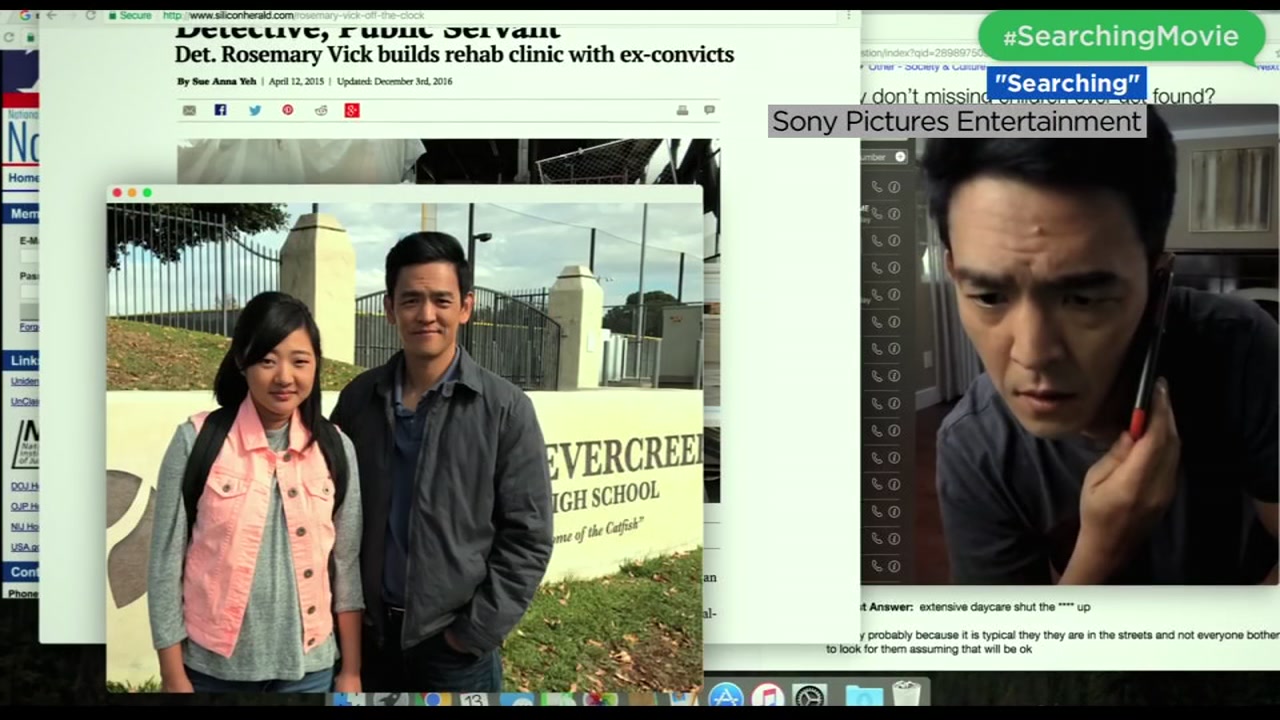
The film’s strength lies in translating classic crime-thriller conventions into cyberspace through clear and accessible storytelling tools. The idea that the internet, much like real life, is full of people who try to erase their tracks is not especially original — but the writers deserve credit for keeping the concept grounded. With such a distinctive approach, it would have been easy to drift into technological jargon or overcomplication.
Watching the film with members of an older generation can also spark interesting conversations about the role of messaging apps in modern relationships. In a world where people often choose texting over simply calling each other, technology does not automatically weaken connections. In fact, David gradually discovers the positive side of digital communication; through his online search, he learns more about who his daughter truly was and what she experienced after the loss of her mother.

Although the film functions largely as a one-person show — centered on the tearful, frustrated yet determined father — everything feels carefully constructed and rooted in the logic of a classic crime story. Some tension arises in the third act, when the filmmakers push a little too hard to surprise the audience. Even so, despite occasional missteps, Searching remains a strong and memorable thriller built on a bold concept.

