
Review
MR. JONES. Politically charged film by Agnieszka Holland
Mr. Jones is another strong entry in Holland’s filmography, demonstrating her ability to tell difficult stories while maintaining high artistic standards.

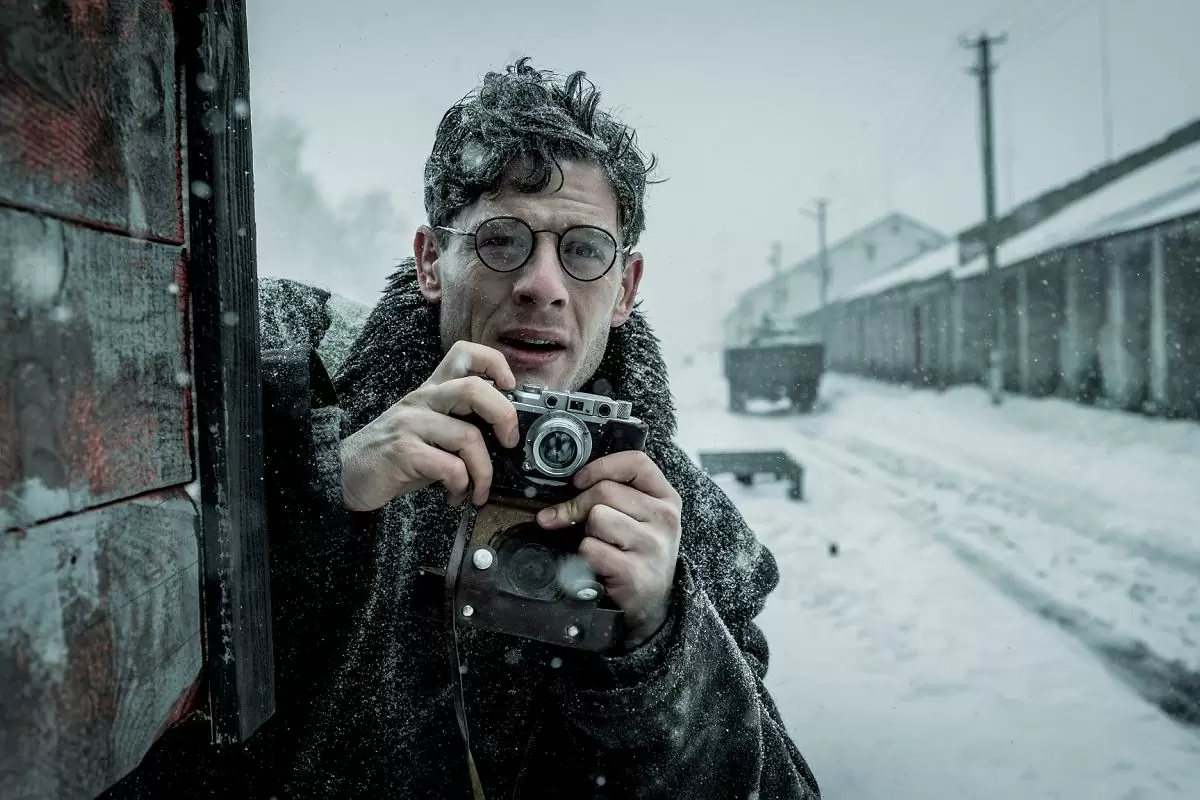
Mr. Jones is yet another politically charged film by the Polish filmmaker Agnieszka Holland, this time focusing on the Holodomor — the man-made famine in Ukraine in the 1930s — and the figure of Gareth Jones, the Welsh journalist who brought this atrocity to global attention. The titular Mr. Jones was an advisor on foreign affairs to Minister George Lloyd in the British government, as well as a journalist with a sharp political instinct. At the dawn of the Nazi regime in Germany, he interviewed Adolf Hitler and warned the British government about his ambitions.
Fluent in Russian, Jones had deep insight into Soviet matters. In 1933, he ventured into the USSR on his own, aiming to uncover the real state of the Soviet economy. During his visit — in defiance of Soviet authorities’ plans — he witnessed the suffering and death of millions of Ukrainians, starved by Joseph Stalin’s exploitative policies. After returning safely to the UK, Jones decided to publish what he had seen, despite having agreed to terms with Minister Litvinov. For this, he was publicly discredited by pro-Moscow circles and later assassinated by the KGB in 1935. His reports were the first to expose the truth about the Holodomor and the true nature of the Bolshevik regime. His encounter with Orwell is thought to have inspired Animal Farm, a connection Holland cleverly incorporates into her film.
 The screenplay for Mr. Jones was written by debut screenwriter Andrea Chalupa, driven by a sense of mission to commemorate the victims of the Ukrainian genocide and Jones himself. She managed to capture Holland’s interest, resulting in a film showcased at the Berlin Film Festival. For Holland, it marks another historical drama that confronts the traumas of the 20th century. One could say that the director of Europa, Europa and In Darkness has become something of an expert in portraying the war-torn traumas of Central and Eastern Europe — and this film confirms it once again.
Mr. Jones stands out especially because, unlike most war-themed films focusing on the Holocaust and Nazi atrocities, it belongs to a less explored narrative stream — that of remembering the terror inflicted by communist Russia. It is also Holland’s first English-language theatrical feature in thirteen years, which gives the film greater international accessibility. Although Holland’s age might suggest a stylistically conservative approach, Mr. Jones is, in fact, yet another film in which she boldly experiments with narrative form. Informally divided into three parts — provisionally titled “The Road to Moscow,” “Ukraine,” and “The Return” — the film seeks to capture the mood of each stage through visual means.
When Jones is navigating elite salons, engaging in rhetorical sparring and tracing subtleties, Holland and cinematographer Tomasz Naumiuk employ close-ups and sharp edits to reflect the claustrophobic nature of his environment. These segments occasionally verge on visual extravagance, aligning with the narrative complexity and overlapping themes. By contrast, during the film’s most powerful sequence — Jones’s journey through dying Ukrainian villages — the cinematography becomes calmer, the storytelling colder and more stripped down, focusing on the understated yet haunting imagery of suffering.
Naumiuk also subtly alters the color palette of each section, giving them distinct tonalities. While the visual approach isn’t always convincing — the abundance of close-ups and handheld shots can become tiring, and the narrative sometimes lacks fluidity — the filmmakers should be credited for avoiding the typical, costume-drama stiffness. Instead, we’re offered a compelling story that borders on a spy thriller and an intense political drama, centered around an unimaginable tragedy.  Unsurprisingly, the sequences set in Ukraine are the most impactful.
Their inclusion and contrast with the rest of the narrative elevate the film significantly. Holland succeeds in being direct without indulging in gratuitous dramatization. Unlike In Darkness, Mr. Jones avoids emotional blackmail, and unlike Spoor, it steers clear of excessive stylization. What matters most here is the commemoration of memory and a strong ethical stance. At times, the film leans too heavily into obvious political commentary (there are obligatory ideological debates about communism and Hitler/Stalin comparisons), and some characters are portrayed too simplistically. However, Mr. Jones remains a powerful statement about Soviet crimes, as well as a moving manifesto about the value of truth and the courage to speak it.
Several scenes are absolute gems — even more impactful when seen in the context of the whole film. The film manages to combine a delirious hedonistic party scene, a chilling portrayal of empty villages, and almost metaphysical moments bordering on the protagonist’s hallucinations — giving it a unique, auteur touch that sets it apart from conventional war cinema. Following the successful casting of relatively unknown Agnieszka Mandat in Spoor, Holland once again avoids big names and familiar faces to excellent effect. The most recognizable actor at the timie was likely Peter Sarsgaard (Jackie, The Magnificent Seven), who plays the sinister Walter Duranty — the kingpin of Moscow’s foreign press corps, manipulating journalists and obscuring the truth in the name of personal gain cloaked in revolutionary ideals.
Duranty emerges as the film’s most vivid antagonist, with his ambiguous ethics conveyed through every gesture — an embodiment of quiet menace and unchecked power. Gareth Jones is portrayed by James Norton, known for smaller roles in productions such as Grantchester and War & Peace. With his earnest, boyish charm, Norton perfectly captures a somewhat naïve yet morally resolute and politically astute Jones, adding a human dimension to a character clearly idealized by the script. Norton, Sarsgaard, and Vanessa Kirby (as Moscow-based journalist Ada Brooks) lead a well-chosen and well-directed cast that enhances the story without overpowering it with flashy performances or star power.
Mr. Jones is another strong entry in Agnieszka Holland’s filmography, demonstrating her ability to tell difficult stories while maintaining high artistic standards. Ideological messaging and narrative suspense go hand in hand here, and despite the filmmakers’ clear stance against the Soviet regime and the horror it inflicted, the film never feels preachy or exaggerated. Even the slightly showy addition of George Orwell as a narrative frame fits surprisingly well, offering meta-commentary on how Jones’s story was received — or ignored — by a West sympathetic to communist ideals. Mr. Jones is a film that fits perfectly with the political spirit of the Berlin Film Festival while also delivering solid, cinematic craftsmanship.
Holland may have her missteps, but she remains a world-class director capable of delivering powerful films on important subjects.

