
Review
MID90S. Saturated with nostalgia for lost youth
The problem with Mid90s is that Hill has made a narrative film in which he places far greater emphasis on visual atmosphere than on storytelling.


Longing for the past is a powerful driving force of culture, cinema included. We can clearly see this in the huge wave of nostalgia for the 1990s, which, together with a similar sentiment toward the previous decade, largely defines the horizon of today’s pop-cultural mainstream. So when a star born in 1983 (and thus experiencing their teenage years in the final decade of the 20th century) makes a film about youth titled Mid90s, can we really expect anything other than a sentiment-fueled trip to the world of skateboards, the Spice Girls, and colorful baggy clothes?
The star in question is Jonah Hill, for whom Mid90s was a directorial debut.
For quite some time now, Hill has seemed intent on fighting the label of a stock comedy actor—changing his appearance as well as venturing into other kinds of roles (Maniac, Don’t Worry, He Won’t Get Far on Foot, for instance). Directing a feature film based on his own script could be seen as another step in this career trajectory. Mid90s may be read as Hill’s pursuit of artistic recognition separate from the popularity of his earlier roles, especially considering that he does not appear in the film himself. That would have been difficult anyway, since the protagonists of Mid90s are a group of teenagers, with thirteen-year-old Sunny Suljic (known from Yorgos Lanthimos’s The Killing of a Sacred Deer) at the center. It is around Suljic that Hill builds his film, which indeed turns out to be a bittersweet journey into the past.
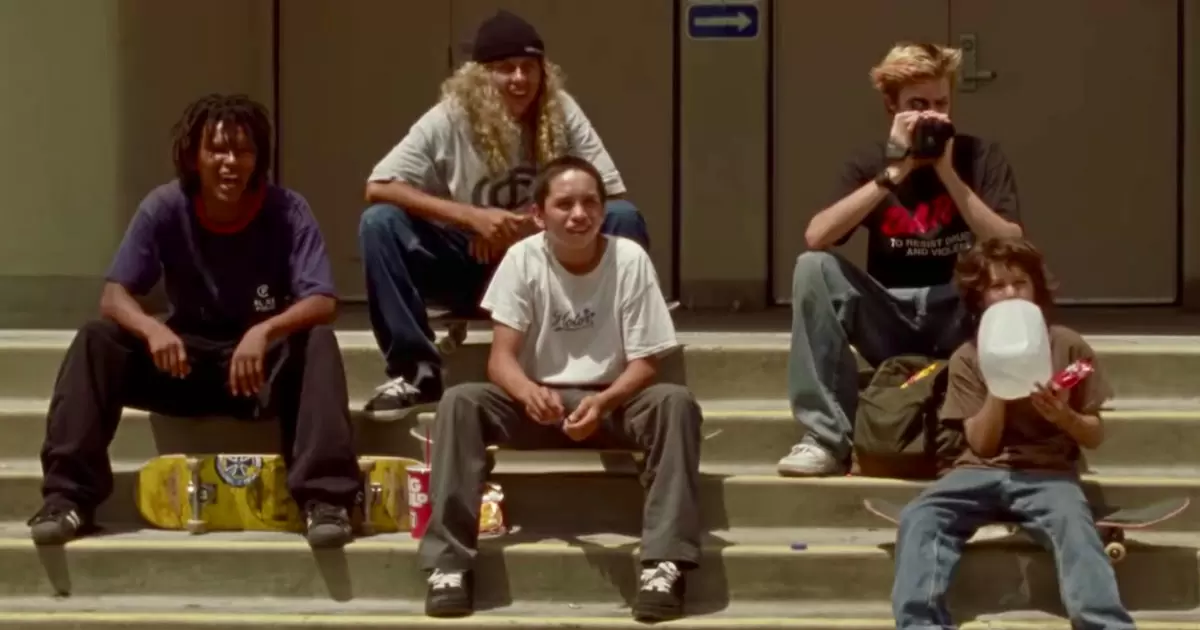
The main character is Stevie, who lives with his single mother and an abusive older brother (played by Lucas Hedges).
The timid, withdrawn boy becomes fascinated by a group of older teens who hang out at a skate shop. This ethnically diverse crew—Ray, “Fuckshit,” Ruben, and “Fourth Grade”—attract Stevie with their tricks and rebellious ease, which appear to him as an irresistible path out of his domestic hell. Stevie buys a skateboard off his brother and sets out to join the gang, quickly succeeding. Yet the new friendship comes with an ambivalent flavor. Trying to keep up with the boys he idolizes, Stevie is forced to sacrifice part of his childhood innocence, leapfrogging several steps in the process of growing up—risking both his family relationships and his own well-being.
Mid90s develops according to the textbook model of a coming-of-age movie: the protagonist’s fascination with his new friends and the skateboarding subculture is underpinned by a search for identity, a desire to taste another world, and an education in life.
Stevie revels in newfound freedom, but he also discovers the value of friendship and gains the chance to find his own place. Gradually, he also learns more about his companions, realizing that they too have problems. Every fall comes with a lesson, every success with a cost. And all of this is bathed in the warm summer glow of the late 20th century. Hill’s film comfortably fits into the tradition of American teenage portraits, telling an unpretentious story that life itself could have—and has—written many times.

From a technical standpoint, this is a film that is hard to fault, yet it offers nothing truly new or memorable.
Its greatest added value is the outstanding performance of young Sunny Suljic, who convincingly inhabits a character suspended between childhood innocence, the rush toward adulthood, and the desperate need for acceptance. Hill directs with a steady hand, avoiding overstatement or unnecessary breaks in the film’s restrained style. Only the ending feels forced, as if the filmmaker wanted to cut the story with a stronger accent, which results in a rather middling effect. Otherwise, everything falls neatly into place within a proven composition, discreetly charming with indie cinema aesthetics, making Mid90s feel warm and familiar.
Weaker, however, is the construction of the story itself—highly schematic and predictable, as already mentioned, but also fairly shallow. At under 90 minutes, Hill seems to shy away from developing certain threads in depth, at times losing narrative coherence. Episodes follow one another sometimes without clear cause-and-effect logic, and very few events in Mid90s carry consequences beyond a few remarks or heated arguments that abruptly cut off and are seemingly forgotten. As a result, the film barely grazes the central problem of adolescence and the search for acceptance, moving from one “checkpoint” to the next, ultimately leaving us with a collection of images that do not quite add up to a coherent story.
The problem with Mid90s is that Hill has made a narrative film in which he places far greater emphasis on visual atmosphere and the mood conveyed through his frames than on storytelling. And although this weakens the overall quality, it must be admitted that evoking the spirit of the 1990s and the energy of youthful friendship is something he does well. It isn’t enough to create a fully convincing work, but it does reveal the heart Hill put into making Mid90s. Saturated with nostalgia for lost youth, his film ends up in a kind of limbo between extremes—it works on the technical and conceptual level, but falters somewhat as an artistic statement. Still, on balance, Mid90s offers more cinematic merit than reasons to complain.

