
Horror Movies
JU-ON: ORIGINS – A Six-Episode Chronicle of Death
Ju-On: Origins, three-hour chronicle of death lacks shock value and solid scares, but for a 20-year-old series, it is not bad.


At the beginning of 2020, we had seen The Grudge in cinemas, a remake of the American version of Ju-On, and then Netflix released the six-episode Ju-On: Origins, a sort of prequel to the original Japanese films. I write sort of because, although the series does indeed take place before the events shown in the original, which marks its 25th anniversary this year, it also presents a completely different origin for the curse from which there is no escape. Thus, knowledge of the original, let alone any of the later twelve (!) films (including the American versions and the spin-off – Sadako vs. Kayako), is not required – Netflix’s series draws on selected elements from the first Ju-On films by Takashi Shimizu but reworks them according to its own vision. Therefore, the term reboot fits better than prequel, which should not be surprising if one recalls what these films are about.
Anyone who crosses the threshold of a certain haunted house in Japan will die. The entire cycle is based on this simple idea, which from the outset determines the fate of the characters and from which there is virtually never any deviation.
The characters are thus replaced by others in each film, because it is the curse that is at the center of the story, and it is the curse that governs the narrative. The creators of the series seem to follow this lead – although we have leading characters for the entire season, in each episode new tenants or random visitors to the ill-fated house die.

It is hard to become attached to anyone, perhaps except for a paranormal researcher who publishes books on various strange cases but does not know himself where his penchant for such things comes from.
But, surprisingly, the horror in Ju-On: Origins this time focuses less on the supernatural layer and more on the consequences of encounters with apparitions. Their unexpected and murderous manifestations are replaced by brutal attacks from people whose actions are echoes of the original crime that gave birth to the curse.
Over the course of six half-hour episodes, it is easier to notice this repetitiveness, though it rules out the randomness of victims, which was the strength of the original. In the series, the only such case seems to be a teenage schoolgirl, lured to the house under false pretenses in the first episode, where her peers commit disgraceful acts against her.
But hers is also the storyline that best shows how easily a victim can become a perpetrator and a perpetrator a victim, only for the cycle of the curse to be fulfilled. The action of the series spans from 1988 to 1997, which makes the effects of supernatural forces all the more devastating due to their persistence over time – the longer the curse works, the more shocking its result becomes.

Instead of frightening with a meowing, pale-faced child or a long-haired ghoul, as in the original (though new versions of these characters do appear on screen), we watch the slow but constant descent of the characters into their own despair, fear, and anger.
We can blame the haunted house for this, but the creators of the series wisely do not explain what is actually the result of the ghosts’ actions and what is the work of humans. Perhaps the scariest thing of all is that the worst deeds cannot be attributed to the apparitions.
The episodic structure and temporal span also bring to mind Netflix’s The Haunting of Hill House, although Mike Flanagan’s series, itself a variation on another classic work, also drew on the original Ju-On, especially in terms of surreal horror. The new production successfully evokes the atmosphere of the original, its structure creating the impression of a criminal puzzle, but it focuses too much on horrors that are purely human, neglecting the supernatural ornamentation. The grotesqueness of Shimizu’s first films, with their terrifying sounds and visual attractions that made one’s hair stand on end, was key to the success of the entire series, and in Origins this is clearly lacking.
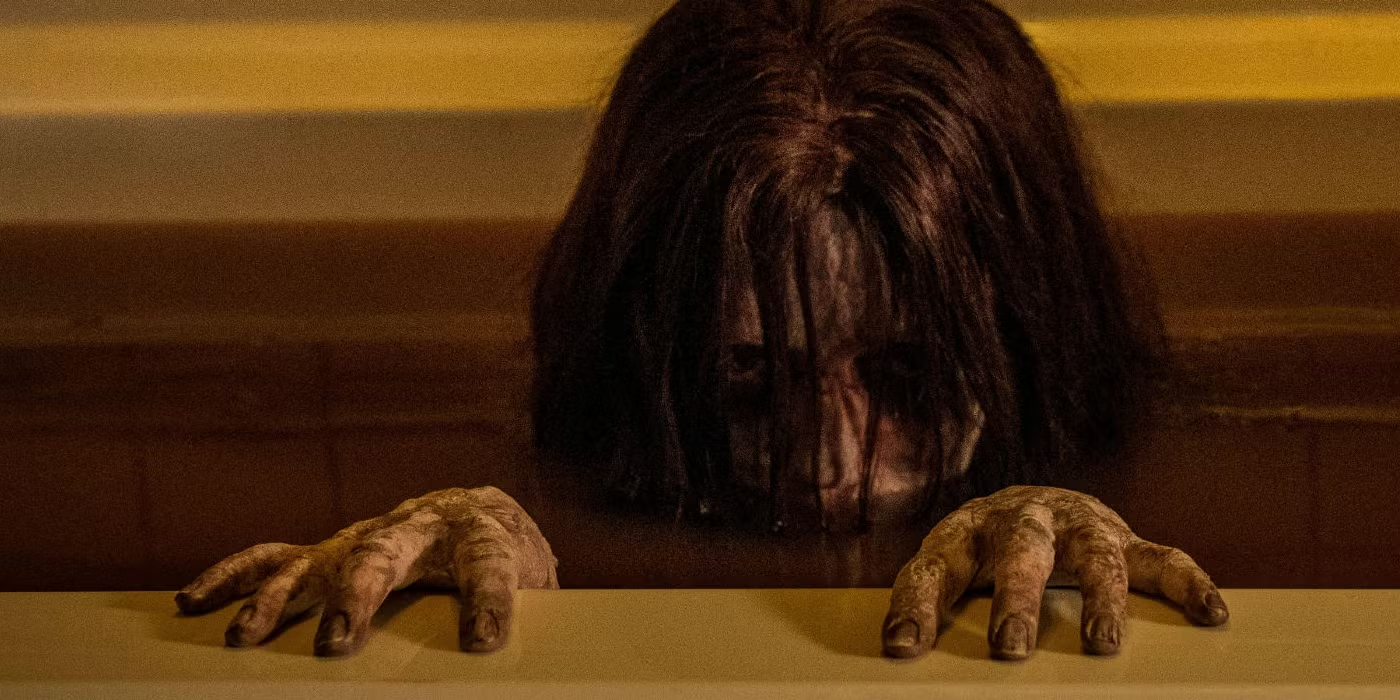
This may not be solely a matter of the toned-down sensibility or lack of imagination of director Sho Miyake and screenwriters Hiroshi Takahashi and Takashige Ichise – one only has to recall this year’s American remake, which was also devoid of bolder stylization.
Perhaps it is a sign of our times that the new Curse should be more down-to-earth; on the other hand, the series does not shy away from ideas and execution straight out of late David Lynch (especially the disappearance of one character’s father, which brings to mind the 3rd season of Twin Peaks).
When the story ends in 1997, we do not feel as though we have learned everything about the curse. The origin seems incomplete, still lacking certain elements, and it introduces things that are not entirely clear, such as media reports of various high-profile disasters (Chernobyl, sarin gas attacks). Could it be that the curse is also spreading according to the butterfly effect, resulting in much more serious tragedies than local ones?

I suspect that answers to this and other questions will appear in the second season. I have no reason to think it will not be made – Ju-On: Origins can appeal both to fans of the cycle and to those who have never encountered it before. Fear has been replaced by a sense of the impossibility of turning back time, the desire to go back to the moment before crossing the threshold of the haunted house.
The tragedy of those who haunt is nothing compared to the torment of their victims, who helplessly repeat the same pattern.
Ironically, the creators of each new version seem to do the same thing. I wrote about this at the premiere of the latest American installment – the whole thing is so heavily codified that it is hard to create anything new within it. In the case of The Grudge, this was an obstacle; for Origins, quite the opposite, as the authors consciously make the impossibility of stepping outside the formula the subject of the series. This three-hour chronicle of death lacks shock value and solid scares, but for a 20-year-old series, it is not bad.


