
Review
ELIO. A Helping Hand from Space
If during the screening you feel—as I did—that Elio is a “fractured” film,, the roots of that impression lie primarily in its complicated production history.

In 1977, the Americans launched two spacecraft into space as part of the Voyager program. However, astronauts were not aboard them—instead, they carried the famous gold-plated records with recordings intended for representatives of alien civilizations. The records were conceived as a multimedia business card of our civilization: they included greetings in 56 languages, popular works by Bach, Mozart, and Beethoven, as well as photographs depicting Earth and its inhabitants. These unique messages-in-a-bottle will drift through the cosmic ocean until someone eventually finds them. As Carl Sagan, the project’s originator, stated: the very act of sending them “says something optimistic about life on our planet.
” Deep down, we hope we are not alone in the universe. Hungry for contact with the Other, we wait for our messages to be received and deciphered. And probably no one on Earth is waiting for that moment as eagerly as 10-year-old Elio.
For a brief moment, the world disappears—along with all the worries tied to it. Tears start streaming from the boy’s eyes. On one hand, a deep passion for the cosmos is born within him; on the other, a belief—that there’s something more out there, that he might one day escape the reality where he feels lonely and abandoned. And although his sensible aunt brings him back down to Earth, Elio will never look at the starry sky the same way again—he will always see in it the hope for a better tomorrow.  Once, Lilo also looked at the sky this way, praying to a “falling star” to send her a true friend.
The starting point here is virtually identical to that of the classic Disney animation, now enjoying renewed popularity thanks to a fairly successful live-action remake: a child, after the traumatic loss of their parents, feels lost and out of place. They are regularly bullied by peers and respond to taunts with aggression. The caring relative—though doing her best and acting with sincere intentions—cannot manage the situation. A helping hand arrives from a rather unexpected place: space. That’s where the protagonist finds acceptance, closeness, and the unconditional friendship they so desperately needed. The only difference is that Elio actually goes to space—his greatest dream comes true when he is “abducted”—while in Lilo’s case, space comes to her in the form of the iconic blue creature.
Any qualitative comparison between Elio and the original Lilo & Stitch must ultimately favor the film by Chris Sanders and Dean DeBlois. Both animations essentially tell the same story (about family, the need for connection, and social acceptance), but Lilo & Stitch is simply a better-written and more skillfully executed narrative. At its heart lies the relationship between the titular characters—a thoroughly satisfying bond that is carefully developed from beginning to end.
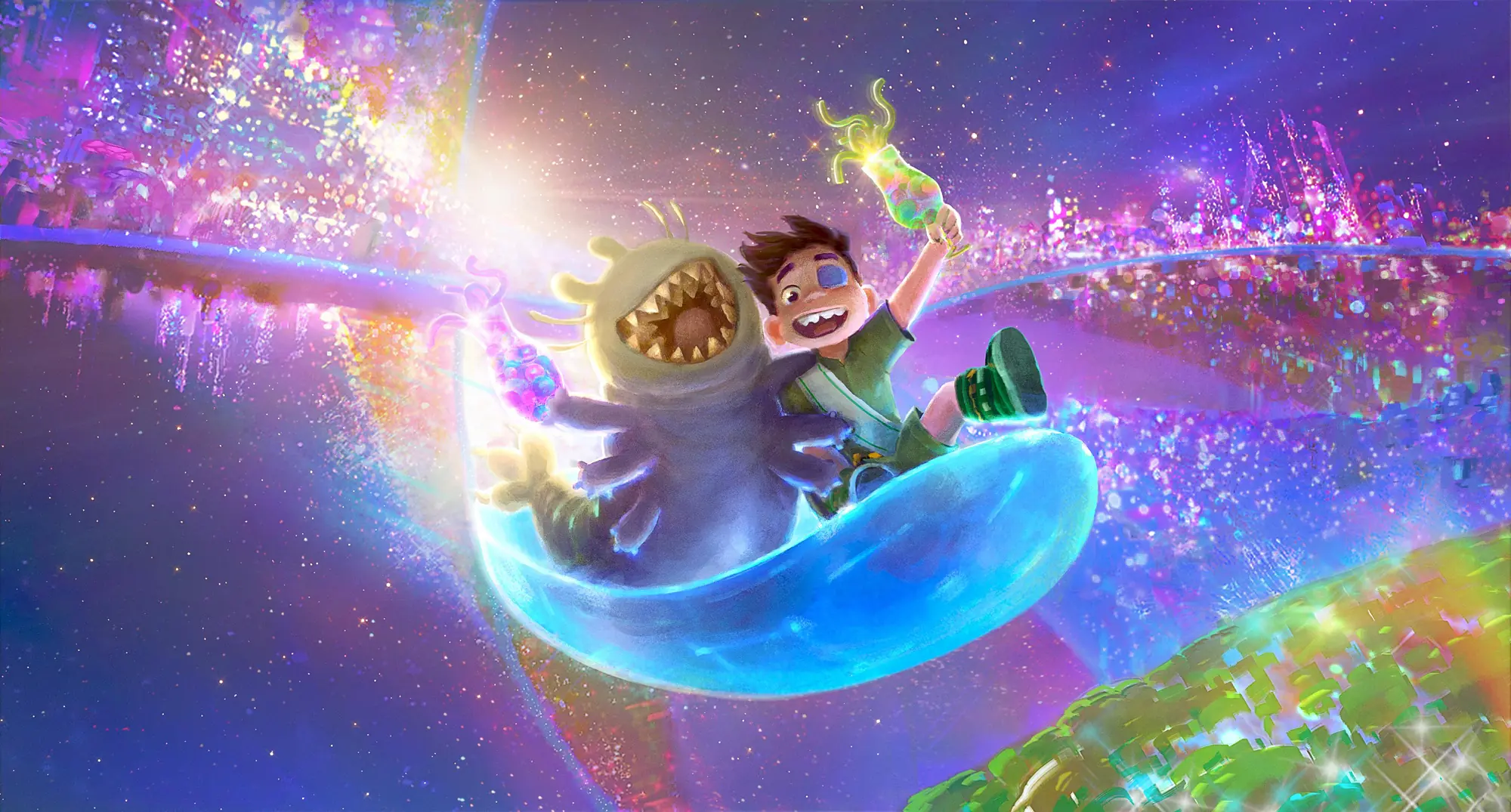
Elio could have followed suit—but the protagonist meets his cosmic soulmate, the incredibly charming Glordon, only halfway through the film. The Earth-based exposition lasts far too long, though it ends up being more engaging than the space adventures of the boy, who is assigned a rather unexciting task by a galactic version of the UN: to conduct peace talks with the bloodthirsty Lord Grigon. If during the screening you feel—as I did—that Elio is a “fractured” film, not fully coherent in terms of content, the roots of that impression lie primarily in its complicated production history.
Initially, the film was to be directed by Adrian Molina, co-creator of Coco. In its early stages, the project had a clear personal tone: like Elio, Molina grew up on a military base, grappling daily with feelings of isolation and unfulfillment. However, after several years of work, the director left the project to focus on the Coco sequel. In June 2024, it was announced that the baton had been passed to Domee Shi, director of Turning Red. If we compare the first teaser for Elio—released by Pixar more than two years ago, when Molina was still at the helm—with the final product, we’ll see two completely different films.
Ultimately, the release was delayed by a year, and the finished animation was credited to three people: Molina, Shi, and Madeline Sharafian, who was brought on in the meantime and had previously worked on both Coco and Turning Red.  The large number of rapid changes made in a short span of time inevitably had a negative impact on the film’s quality—and indeed, that’s exactly what happened. Still, Elio has moments that remind us this is a Pixar-branded animation.
Elio’s relationship with Glordon, though introduced fairly late, runs like a well-oiled machine—it entertains when it should and moves the viewer when it’s supposed to. The film also makes good use of Pixar’s typical dual-layered storytelling—seasoned viewers will easily spot several clever intertextual nods to sci-fi classics, including E.T., Alien, Close Encounters of the Third Kind, and The Thing. So, it’s not all bad—but is it good? One of Elio’s biggest curses—besides the chaos caused by its production turbulence—turns out to be the legacy of the studio behind it. Pixar, now in rather average form, has simply spoiled us with better films in the past.

