
Review
COCO. An Almost Flawless Pixar Film [REVIEW]
Coco is crowned with a heart-wrenching finale—surely one of Pixar’s most moving conclusions. It’s the kind of film that’s hard to remain indifferent to.


Pixar knows how to emotionally overwhelm the viewer. I still haven’t recovered from the unexpected goodbye to Bing Bong in Inside Out. My hands haven’t stopped trembling since Toy Story 3. The scene where Woody, Buzz, and their group of friends end up in the trash incinerator and hold hands is a harrowing experience—every single time. Pixar has a unique ability to strike a chord in the human soul with complete sincerity and without a hint of falsehood. Coco is undoubtedly another example of this. Its creators once again manage to rise to the highest artistic level. However, the intense emotions characteristic of the aforementioned films are replaced here by lyricism and a melancholic atmosphere.
In tone, Coco is perhaps closest to the poignant opening of Up. And for many, there could be no higher recommendation.
He loves music, has a natural talent for it, and dreams of pursuing it. He even hides a guitar in a corner of his room.  But in the eyes of the Riveras, this isn’t an innocent hobby—it’s practically a crime. And that’s due to a tragic event in the family’s past, which led to a strict, unbreakable ban on any musical activity.
So, Miguel defies two core family principles: he rejects their values and reaches for the forbidden fruit. The story is set during Día de Muertos—the Mexican Day of the Dead celebration. During this time, Miguel will cross into the world of his ancestors, where he’ll have the chance to fight for his future and significantly shape his own destiny. In Coco, Pixar once again creates a multilayered, richly detailed world. On one side, we have the vibrant, colorful town of Santa Cecilia—decorated with skulls, lanterns, and paper cutouts strung between rooftops. The town’s inhabitants aren’t just anonymous extras but carefully crafted characters. The attention given to their psychological portrayal is matched by the meticulous design of every location.
This includes the cramped room of great-grandmother Coco, where sunlight filters dimly through curtains, dust hangs gently in the air, and you can almost feel the weight of time itself. It’s a place where time has stopped. On the other side is the land of the dead—lit by the glow of cemetery candles, sometimes shrouded in mist, full of narrow alleys and cascading staircases. Thanks to Miguel’s journey, we dive into the structure of this city—architecturally opulent yet socially diverse. Some interiors, with their stained glass, marble walls, and gilded railings, seem straight out of Baz Luhrmann’s The Great Gatsby, while the open city spaces filled with iron-and-glass buildings evoke the nostalgic world of Scorsese’s Hugo.
In contrast, the slums consist of decaying wooden shacks. The creators present the city from sweeping wide shots to intimate close-ups, making it feel both real and suffused with mysticism and magic.  We meet the homeless, vagabonds, modest clerks, the settled middle class, and indulgent celebrities—all of them skeletons. But with gentle personalities and non-threatening appearances. Director Lee Unkrich isn’t interested in the horror potential of this story. While thematically fitting, a horror aesthetic would’ve been too obvious and inconsistent with the filmmakers’ ambition to avoid genre clichés. Though the film includes darkness and a muted color palette, Coco still functions fully as a family film. Even the youngest viewers will feel safe throughout. Coco ends with a tear-jerking finale—arguably one of Pixar’s most tender endings to date. Of course, meticulous textures and masterful use of light aren’t enough for Pixar. In Coco, it’s the people—and the bonds that rekindle between them—that matter most. Unkrich constructs fascinating connections between the worlds of the living and the dead. Together, they form a cohesive and interdependent universe. From the very first scenes, a delicate thread ties the entire family together, gradually gaining strength—this growth forms the film’s emotional core. Memories and reinterpreted past events carry deep importance, giving weight to the characters’ decisions. Coco isn’t an adventurous romp—it’s not just a boy’s innocent journey through a fantasy land. Miguel is pressed for time and must fulfill a mission.
At first, his motivation is personal, but over time, he realizes he can accomplish something far greater. And before our eyes, a true hero is born. 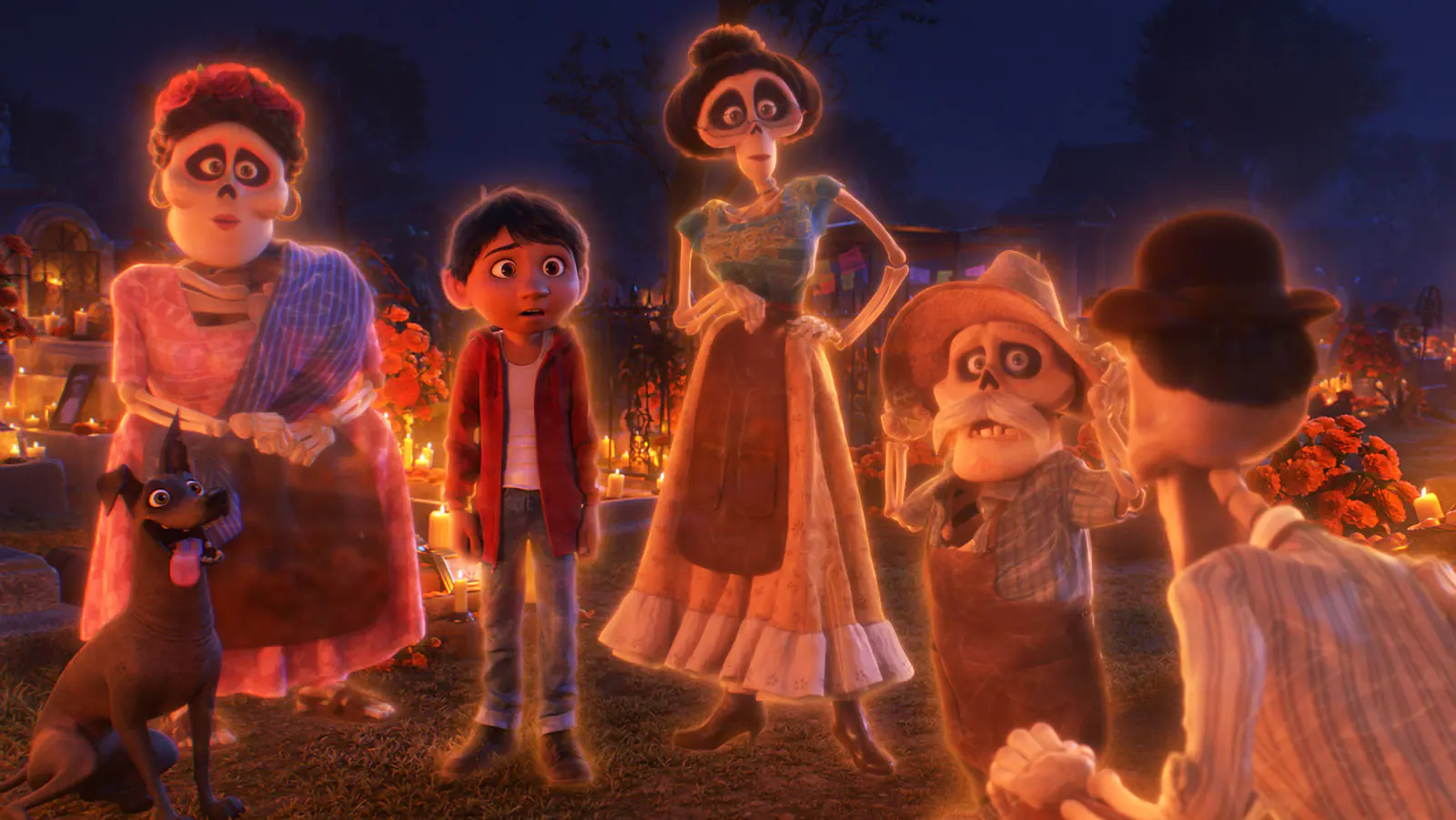 Coco often borders on being a masterpiece, though it’s not flawless. Some of the characters’ thoughts and emotions might have made a stronger impact if they hadn’t been spoken out loud so directly—especially since the emotional cues are already so vividly felt. It’s as if Pixar forgot for a moment that sometimes silence speaks volumes. I’m also not entirely convinced by the film’s antagonist, who is drawn a bit too bluntly.
He’s given a lot of screen time, but his arc is unfortunately quite predictable. Pixar usually avoids such sharply defined villains. Still, Coco remains a film of artistic fulfillment. With a layered narrative and brimming with inventive set pieces, it’s a production marked by visual splendor and exceptional visual artistry. Pixar’s animation here carries a serious, at times majestic tone, while still leaving space for quiet reflection. The filmmakers ask the ultimate questions—what happens after death, and what are intergenerational bonds made of? These are universal themes that touch everyone.
Coco is crowned with a heart-wrenching finale—surely one of Pixar’s most sensitive and moving conclusions. It’s the kind of film that’s hard to remain indifferent to.

