
Review
EDDINGTON: Checking the Pulse of Modern American Democracy
One might ask whether we still need to revisit the pandemic crises and rehash the ideological war of Trump’s America.


Eddington is the Sodom and Gomorrah of 21st-century America. The bloodstream of the titular town in New Mexico is stimulated by mutual hatred and the desire to rule over the polarized local community, perhaps even symbolizing a bit too literally the essence of the United States’ ailments over the past decade. Strong political divisions, visible especially at the very beginning of the COVID chaos—at the heart of which Ari Aster places his latest work—represent a period that none of us has truly reckoned with yet. And who else could tackle such an electrifying subject if not one of the most unhinged directors of the 21st century?
In Eddington, apart from verbal skirmishes between supporters and opponents of masks and social distancing, the main focus falls on the issue of guns available on nearly every street corner and the small-town struggle for power, fueled by a razor-sharp campaign of slander between the anti-COVID, conspiracy-theory-believing sheriff and the liberal mayor running for re-election.

The town of Eddington, in this exceptional pandemic moment for the whole world, stands on the brink of an epochal revolution: the war between Ted Garcia (Pedro Pascal, brilliant in his unfortunately too-short-lived role) and Joe Cross (Joaquin Phoenix, crossing yet another artistic Rubicon in his career), which began years earlier as a duel for the heart of young Louise (Emma Stone), becomes a choice between the new and old order—liberal America, eager for change, and the iron-fisted rule of an eccentric fanatic.
Sound familiar? Aster is unafraid to ridicule the absurdities of his homeland, showing in a distorted mirror the ethnic, racial, political, and ideological conflicts of the USA. The main problem of his film, brimming with references to Donald Trump’s anti-immigration policies, lies in its excessive thematic sprawl and the genre-blending second half, whose rushed transformations and surprising jumps from political satire to bloody western leave the viewer breathless in the wrong way.

Joe Cross (Joaquin Phoenix) is one of the most frustrated people in town. Constantly rejected by his weary wife Louise (Emma Stone), who finds comfort in the online conspiracy guru Vernon Jefferson Peak (Austin Butler), Joe—desperate to fulfill his American dream—decides to channel all his anger and determination toward his lifelong enemy: the beloved mayor Ted Garcia (Pedro Pascal). When the embittered sheriff decides to challenge him for the county’s highest office, he does not hesitate to resort to the most perfidious political tricks, soothing his wounded ego and clumsily piecing together the fragments of a heart shattered by his wife’s betrayal.
The tragic explosion of long-suppressed internal turmoil is, for the uncompromising Joe, only a matter of time. When the last thread holding his sanity snaps, what began as a promising political, libertarian, anti-racist manifesto turns into a bloody slaughter and a modernized version of High Noon, one that clashes completely with the narrative consistency built up until that point.

The action accelerates at a pace fatal to the film’s initial message, burying the enormous potential of Pascal’s role (too quickly wiped from the screen), Stone’s (whose motivations remain a mystery until the end), and Butler’s, who, blending his past incarnations from Once Upon a Time in… Hollywood and The Bikeriders, impresses only in a few minor scenes.
The initially controlled but increasingly chaotic play with form, along with the addition of grotesque side plots, progressively undermines Eddington’s artistic vision, defying straightforward genre classification. For the first time, Aster ventures into such a “realistic” terrain—devoid of the horror of Hereditary or Midsommar—and seems unsure where to take his characters, while we, faced with every increasingly absurd and comical twist in the third act, get lost in this thoughtless narrative fog.
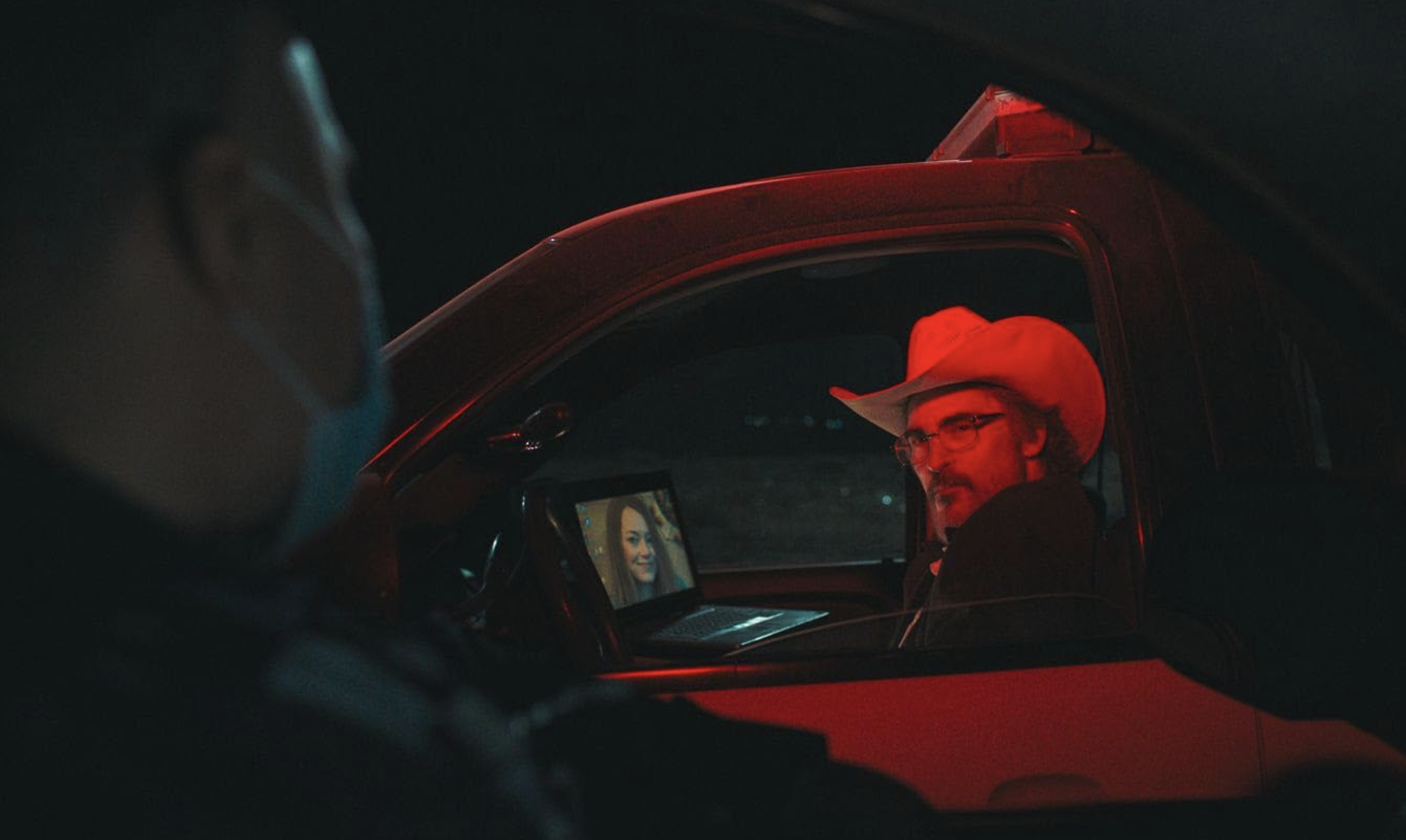
The internal chaos that drives Joe to madness quickly seeps into the quality of the film’s second half, which, apart from an action sequence featuring Phoenix demolishing everything in sight in a fit of unrestrained rage, has practically nothing left to offer.
Eddington marks a clear decline in form for the visionary creator of Beau Is Afraid and Midsommar, who here forgets the psychological depth of his characters—so crucial in his earlier works. Particularly disappointing is the objectified treatment of the heroine played by Emma Stone, who herself seems to be a ghost within her own film. Nevertheless, Aster still dares to push both narrative and emotional boundaries for his cast, giving the most space to the ever-reliable Joaquin Phoenix. His satire of pandemic panic and the mechanisms governing social media occasionally hits the mark, especially when he awakens the audience with a well-timed burst of dark humor.

The lack of consistency in the film’s central thesis, however, kills the director’s monumental potential, placing Eddingtonin the less impressive half of his filmography. The actors proudly speaking about the film’s pro-peace message refer to fragments of a work that—had Aster chosen bolder narrative paths—could have become the dark horse of this year’s Cannes lineup.
One might ask whether we still need to revisit the pandemic crises and rehash the ideological war of Trump’s America. Aster proves that confronting these burning issues remains essential in today’s cinema. If only for that reason, despite its genre disarray, I believe Eddington will, years from now, serve as a valuable point of reference—and a way of “checking the pulse” of modern American democracy. No matter who happens to steer this vast, sin-soaked metropolis next.

