
Review
DEAD MAIL. Out of Love for Horror and Synthesizers
Dead Mail is a study of loneliness, obsession, and mental illness, while also touching on racial, social, and homoerotic themes.

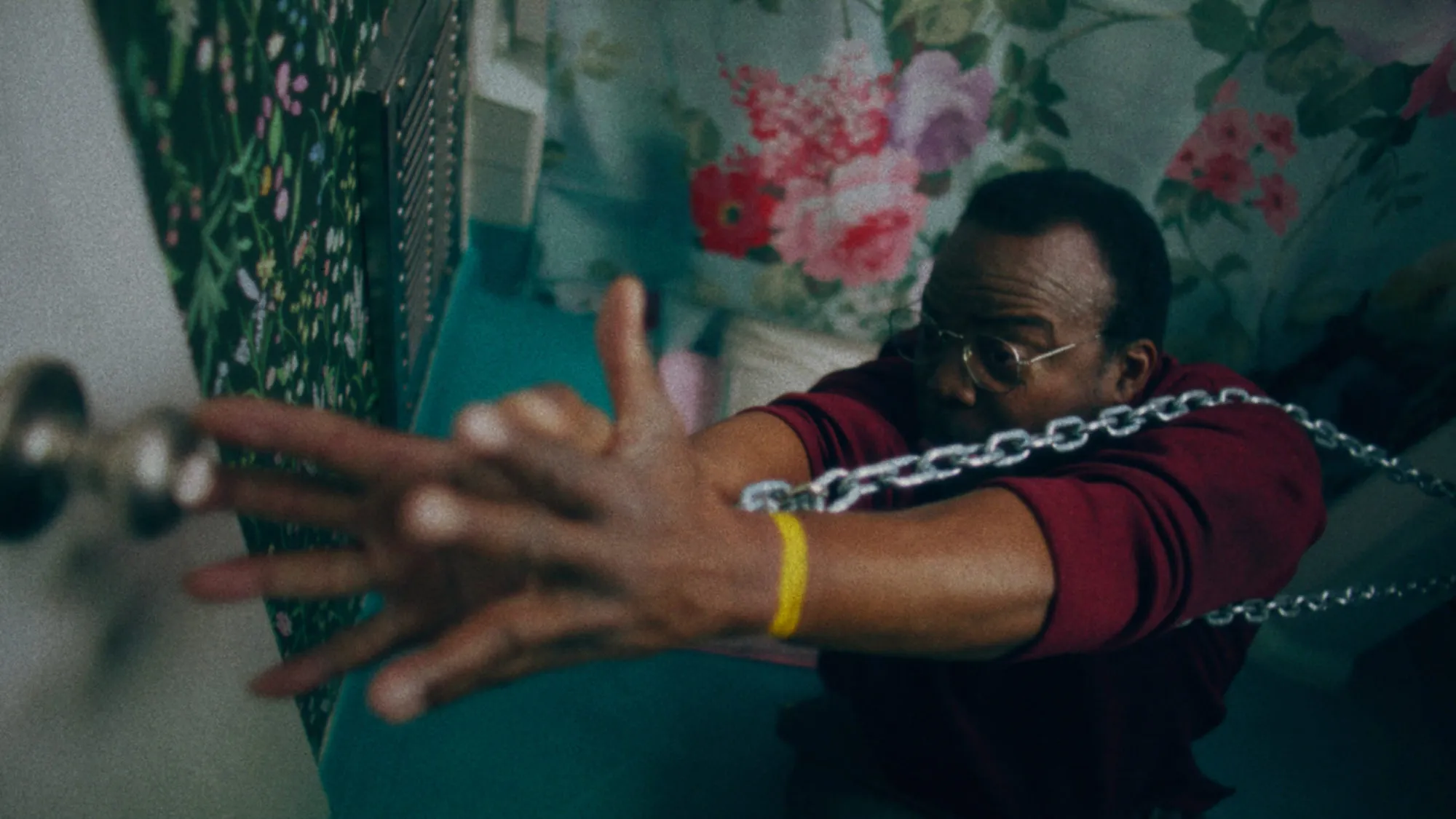
Dead Mail is an unusual study of loneliness, obsession, and madness.
A bound man escapes from a remote house and crawls toward a mailbox, into which he drops a bloodstained letter—only to be attacked by an unknown assailant. The letter ends up at a post office in a small town and catches the attention of Jasper, the head of the department dealing with undelivered, lost, or illegibly addressed mail. With the help of a hacker friend, Jasper attempts to trace the origin of the mysterious plea for help. Its story is eventually revealed through a series of flashbacks: some time earlier, during a presentation of keyboard instruments, engineer Josh met music enthusiast Trent, who offered to finance the construction of a new synthesizer.
Work progressed smoothly, but when Josh abandoned it to take a job with a Japanese corporation, Trent flew into a rage. The sponsor then locked the engineer in the basement of his house and forced him to finish the project.

The first joint film by screenwriters and directors Kyle McConaghy and Joe DeBoer was BAB (2020) – a low-budget but skillfully made, unsettling dystopia about a provincial town ruled by a brutal despot. When the artists learned that the United States Postal Service has a special section handling problematic mail, they decided to build the plot of their next film around it. They also drew inspiration from the landscapes of the American Midwest, where both filmmakers grew up, as well as from their fondness for music created on analog synthesizers (particularly the work of Wendy Carlos), VHS aesthetics, street photography, and films of the 1970s and ’80s, such as Francis Ford Coppola’s The Conversation (1974), Martin Scorsese’s Taxi Driver (1976), David Cronenberg’s The Brood (1979), and William Friedkin’s Cruising (1980). Appropriately, the action of Dead Mail is set in that era.
The film was shot over six weeks, mostly with a handheld camera (operated by McConaghy, who also edited the film) and natural lighting. The cast includes a handful of little-known actors. The soundtrack features works by obscure Scottish composer Janet Beat, as well as pieces created by McConaghy and DeBoer on a Yamaha SK20 synthesizer.
When funds ran out near the end of shooting, one of the producers had to step in as sound technician, holding the boom mic himself. Against all odds—and despite the limited budget and makeshift conditions—the result is a film that carries all the hallmarks of a professional production. Grainy visuals, claustrophobic spaces, and unusual camera angles give Dead Mail a foreboding atmosphere reminiscent of the Coen brothers’ Blood Simple (1984), Panos Cosmatos’ Beyond the Black Rainbow (2010), and Prano Bailey-Bond’s Censor (2021).
The plot, meanwhile, may call to mind Rob Reiner’s Misery (1990), another story of a tormented artist held captive by a fanatical admirer. Much like that excellent adaptation of Stephen King’s novel, Dead Mail is a study of loneliness, obsession, and mental illness, while also touching on racial, social, and homoerotic themes. The wealthy white Trent is clearly fascinated by the poorer, Black Josh; from fragments of the tormentor’s memories emerges the story of a past relationship (an unrequited love? an undeveloped friendship? an unfulfilled sexual fascination?) with a college classmate.
Yet this is presented subtly, between the lines, without any heavy-handed ideology. The relationship between captor and victim is not used as a pretext for agitation, but as the backbone of a gripping psychological thriller. It is clear that Dead Mail was made out of love for old thrillers and horror films. And for synthesizers.

