
Review
THE LORAX. A Gem of Contemporary Animation
The Lorax is, at its core, rooted in the formula of an anti-utopia. Thneedville is a settlement isolated from the rest of the world by a wall.

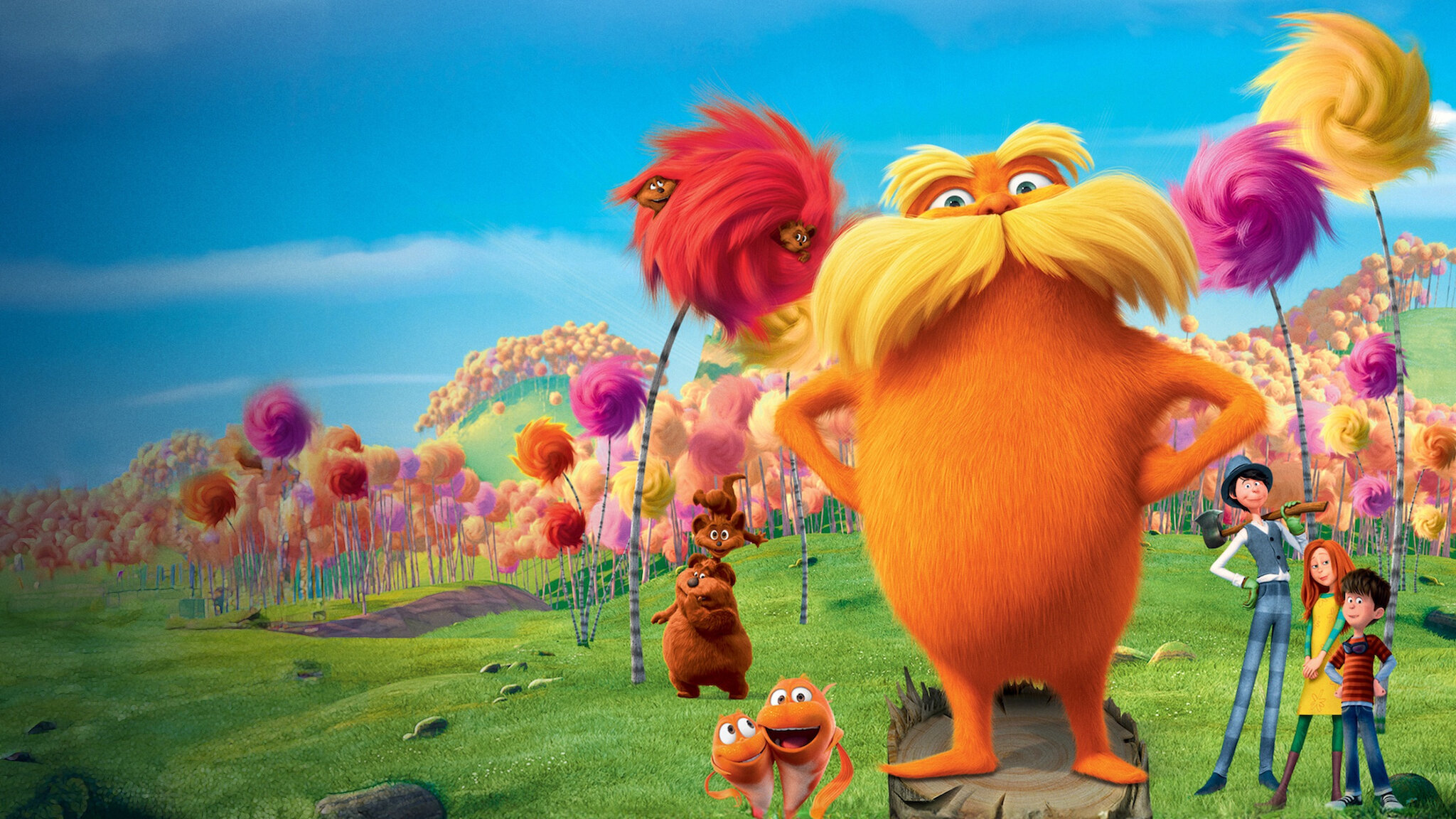
The Lorax is, at its core, rooted in the formula of an anti-utopia. Thneedville is a settlement isolated from the rest of the world by a wall. Within the city limits, all greenery has vanished. There are no trees, no grass, no shrubs—there isn’t even soil in which anything could grow. The natural environment has been replaced by plastic replicas. Instead of vegetables, the people of Thneedville put gummy candies shaped like cauliflower and carrots on their plates. Everything is synthetic; everything is artificial. The saddest part, however, is that the inhabitants live in blissful ignorance. They have no idea how manipulated their reality is, and they feel no need to change anything.
Nothing arouses their suspicion. The opening musical sequence, drenched in an aggressively upbeat tone, makes it clear that the people of Thneedville are happy and fulfilled. For a while. The absence of trees can, of course, be turned into a gold mine. Aloysius O’Hare, the city’s mayor and owner of O’Hare Air, sells bottled clean air to the residents. After all, its natural source has been thoroughly eliminated. The film’s main protagonist, meanwhile, is the teenage Ted. The boy is in love with Audrey, a slightly older neighbor who paints real trees on the back wall of her house. Wanting to impress her, he decides to sneak beyond the city walls and present his crush with a surprising gift. As it turns out, the landscape outside is a grim sight, littered with tree trunks cut down to the ground.

That is also where the shack of the Once-ler stands—a former inventor who long ago befriended, and later betrayed, the Lorax: a friendly orange creature who appoints himself the protector and advocate of the trees.
The Once-ler’s retrospective tale forms a second, equally important narrative axis of the film and a counterpoint to Ted’s storyline. After a long journey in search of business inspiration, the Once-ler stops in a beautiful forest. He invents a product certain to attract customers: a multifunctional towel–scarf–blanket that also doubles as a costume. To produce it, however, he needs specific leaves that adorn the treetops. Mass deforestation becomes an unavoidable necessity.

The Lorax is a film that explores not only the structure of its fictional world, but also delves into the motivations and rapidly evolving needs of its characters. The most compelling relationship is that between the Once-ler and the Lorax. They are neither quite friends nor outright rivals. A clear conflict of interest divides them, as do their temperaments. Aggression is replaced by half-spoken words; what they most often express toward one another is disappointment, disillusionment, and fear. In Ted’s case, a youthful desire to impress a girl transforms into rebellion against the irrational order of the world in which he is being raised.
What truly interests the filmmakers is what constitutes a person—where behavioral models come from and which stimuli people are most sensitive to. In the cases of Ted and the Once-ler, family is the fundamental building block of their temperaments. For the former, his moral authority is his grandmother, who still remembers a time when trees existed and supports her grandson in his secret excursions beyond the city. The latter cannot oppose his domineering mother, whose advice contributes on the one hand to his financial success, but on the other leads to an environmental catastrophe. This irreversible disaster causes the Once-ler, in old age, to hide away in his shack in the middle of nowhere, boarding up all the windows. Guilt and shame give him no peace.

At first glance, The Lorax may seem like an ecological manifesto. It is easy to interpret the Illumination Entertainment production through that lens. To me, however, it is a film with a much broader scope. The Lorax is above all a story about people living in bubbles. The film by Chris Renaud (the director of Despicable Me and The Secret Life of Pets) is a paean to curiosity and courage—the qualities that allow us to look beyond a narrow horizon and see what lies beneath the surface. The filmmakers encourage a more attentive look at the surrounding reality. Even if it may bring disappointment, even if curiosity can get you hurt. The Lorax is also a bittersweet story about family—about how younger generations repair the mistakes of their grandparents and parents. These threads reach far beyond a committed ecological appeal; for the creators, it is merely a starting point for far more universal stories.
In The Lorax, we can hear echoes of Pixar’s WALL·E, and in terms of world-building—layered and anything but obvious—it may bring to mind The Truman Show. Renaud, adapting a children’s book by Dr. Seuss, is interested in the tools of social control, manipulation, and oppression. What ultimately comes to the fore, however, is the way successive barriers are broken—both physical and mental. In the finale, it turns out that deep down every resident of Thneedville wanted—truly wanted—to look beyond the wall surrounding the city. The Lorax is a gem of contemporary animation. Just give it a chance.


Looking back at DEAD SNOW: A Blizzard of Nazi Gore Fun

DEAD SUSHI: Exotic, Spicy, and Wildly Entertaining

Revisiting ALICE, SWEET ALICE: Dread and Religious Symbolism

PUPPET MASTER: LITTLEST REICH – Achtung! It’s Good!
