
Review
MARTY SUPREME. Ambition That Accompanies Youth
Like a ball rolling down a steep slope, Marty Supreme steadily picks up speed until it can stop in only one way—through a spectacular crash.


Before I start the review of Marty Supreme, I’ll write this: When someone from abroad decides to learn Polish, sooner or later they stumble upon the wildly popular word “kombinować.” As often emphasized, it’s a typically Polish verb, one that has no perfect equivalents in other languages. Although it derives from the Latin combinare (to connect, combine, assemble into a whole), most Poles understand it more as an intense search for a solution—often involving methods that are not entirely honest, or at least not straightforward. Who knows, perhaps we really are a nation of schemers, given how prominent this word has become.
If that’s truly the case, then the protagonists of Josh Safdie’s films are Poles at heart—the greatest hustlers and sly operators of contemporary cinema. People who, when barred from entering through the door, jump through the window without a second thought, painfully cutting themselves on shards of glass in the process. To Connie Nikas from Good Time and Howard Ratner from Uncut Gems, Marty Mauser has now joined their ranks—the title character of Marty Supreme. On one hand, arguably the biggest jerk of the trio; on the other, the only one not entirely devoid of hope for change and a better tomorrow.

Safdie introduces Marty at a pivotal moment. The young man works in his uncle’s shoe store. Selling shoes, however, is far from the pinnacle of his dreams—his mind is at the ping-pong table, playing in the final of the prestigious British Open. As soon as the opportunity arises, Marty steals $700 from the till, buys a plane ticket, and flies off to take part in the tournament. In the meantime, he impregnates his friend–neighbor–lover (it’s complicated), embarks on an affair with a faded movie star, and racks up a $1,500 bill at the Ritz. Above all, though, he schemes. Constantly, every second of his life. How to get money, how to satisfy his urges, how to fulfill every athlete’s greatest dream—to win the World Championship final and permanently inscribe his name in the history of the sport.
It is impossible to summarize Marty Supreme faithfully. Too much happens in too short a time. Josh Safdie and his longtime co-writer (and co-editor) Ronald Bronstein have no idea what a “moment to breathe” means—they strap the viewer onto a carousel of events from the very first scene, capped with a striking visualization of a sperm race set to the hit “Forever Young.” The dramaturgy of Safdie’s films, which he created in tandem with his brother Benny Safdie up until Uncut Gems, is often compared to a “snowball,” and the comparison is both apt and still valid. Like a ball rolling down a steep slope, Marty Supreme steadily picks up speed until it can stop in only one way—through a spectacular crash that releases the enormous tension built up in the audience.
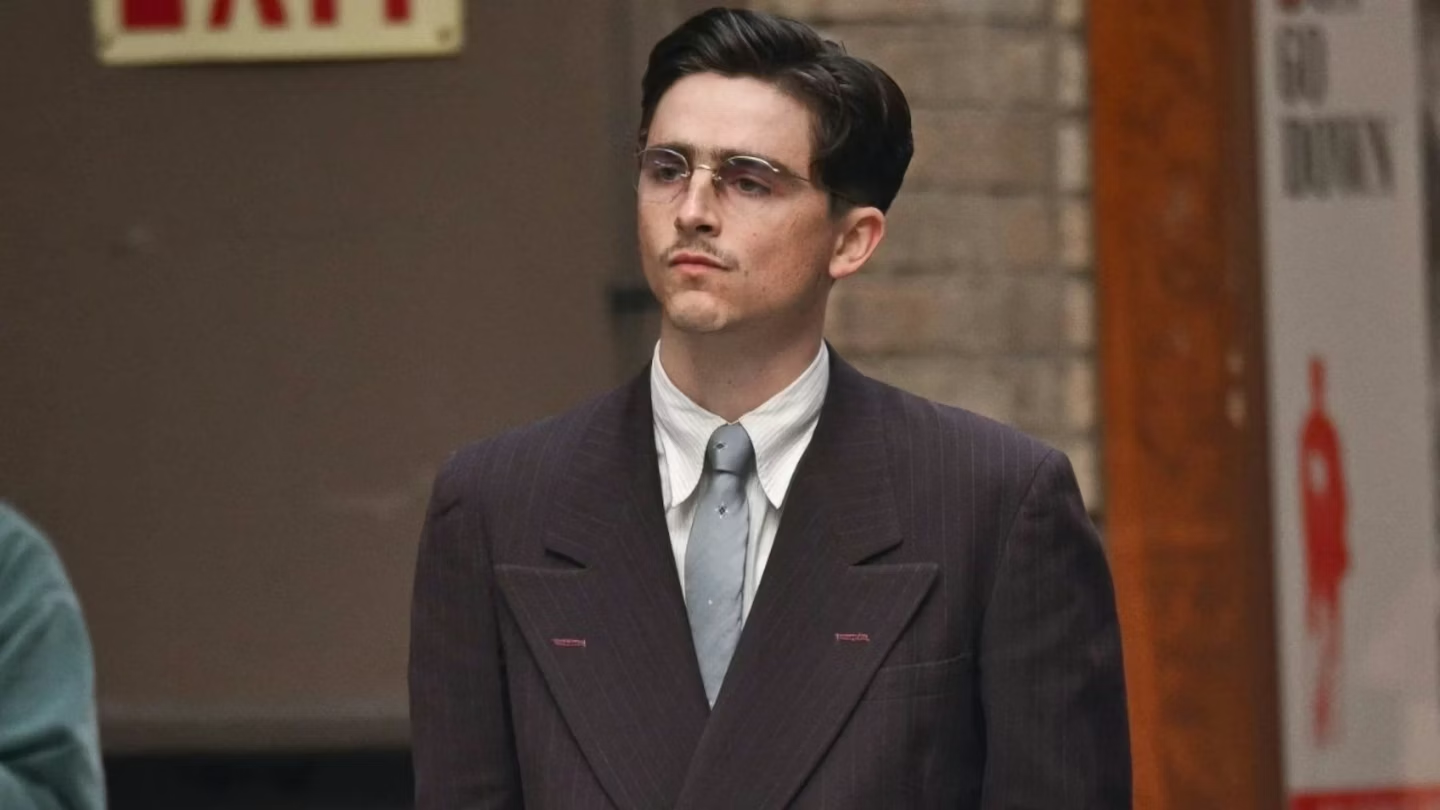
Thankfully, amid all this momentum, the protagonist is not lost. Safdie never takes his eyes off him, even though there are moments when the camera of Darius Khondji can barely keep up with Marty Mauser. The twenty-three-year-old table tennis player is a volcano of energy—he runs more than he walks, shouts more than he speaks, is everywhere at once, especially where he shouldn’t be. His sharp tongue earns him as many admirers as enemies—it repeatedly opens doors for him that would never even crack open for others, only to slam them shut again with a bang.
On a macro level, Marty Supreme turns out to be a film about unrefined youth bursting through every framework it’s forced into, and about the ambition that accompanies that youth—a painfully American belief that no limitations exist and that success requires only a mix of talent and self-confidence.

It is precisely this specific mix that makes it hard to imagine a better casting choice for Marty than Timothée Chalamet, an actor who seems to personify both values: youth and ambition. His speech at last year’s Screen Actors Guild Awards went viral online. Chalamet declared to the world that his dream is for people to mention him in the future in the same sentence as the greatest—Marlon Brando, Michael Phelps, or Michael Jordan. So at this point it’s not just about good acting—it’s about being absolutely the best in one’s field. The speech was met with mixed reactions. Some praised him for his honesty and, yes, ambition. Others stressed that such a declaration smacks of arrogance and a staggering lack of humility.
Either way, Chalamet makes excellent use of this supposed lack of modesty—he pours natural charisma into his character, fills him with his own ambitions and frustrations, this time hidden behind the safe mask of fiction. You may dislike him as a person, you may find him hard to stomach as an actor, but denying his talent—especially after watching Marty Supreme—is impossible.
Of course, Chalamet doesn’t make the film on his own. Safdie’s casting prowess becomes even more apparent when one looks at the supporting cast, largely filled with people who either had no prior acting experience or are returning to the screen after a long hiatus. Who don’t we find there? A prominent businessman from Shark Tank, a popular American rapper, a legendary director of New York gangster cinema (not Martin Scorsese!), an actress pulled from Hollywood oblivion, and finally a guy who gained fame thanks to a short interview recorded after a New York Knicks game (luckily, it turned out Safdie is a fan of the same team). Each of these people is cast perfectly—that is, in a role that corresponds in some way to their public image. Their unfamiliar faces constitute a collective added value—it is also thanks to them that Marty Supreme feels so fresh and exciting.
Perhaps every film about youth must also be a film about its end. Marty Supreme is no exception. In a moving finale, the protagonist finally sees more than the tip of his own nose and takes responsibility for someone else’s life. It is hard to imagine a more mature gesture—one that simultaneously signals entry into adulthood. Safdie is, of course, no naïf: he does not dispel our doubts, leaving open questions about the authenticity and, above all, the durability of this gesture.

Watching Chalamet fall apart before our eyes, however, it’s hard not to feel that something in his character has changed. Marty had to hit rock bottom to understand that he is not the center of the universe and that the end does not always justify the means. As a reward, fate grants him a second chance—something the protagonists of Safdie’s previous films could only dream of. Let’s hope that this time he won’t over-scheme it in Marty Supreme.


