
Review
CHURCHILL. Brian Cox Excels in Underwhelming Biopic
This version of Churchill is primarily a deeply exhausted man—worn down first and foremost by the war and its associated stress, but seemingly also by himself.

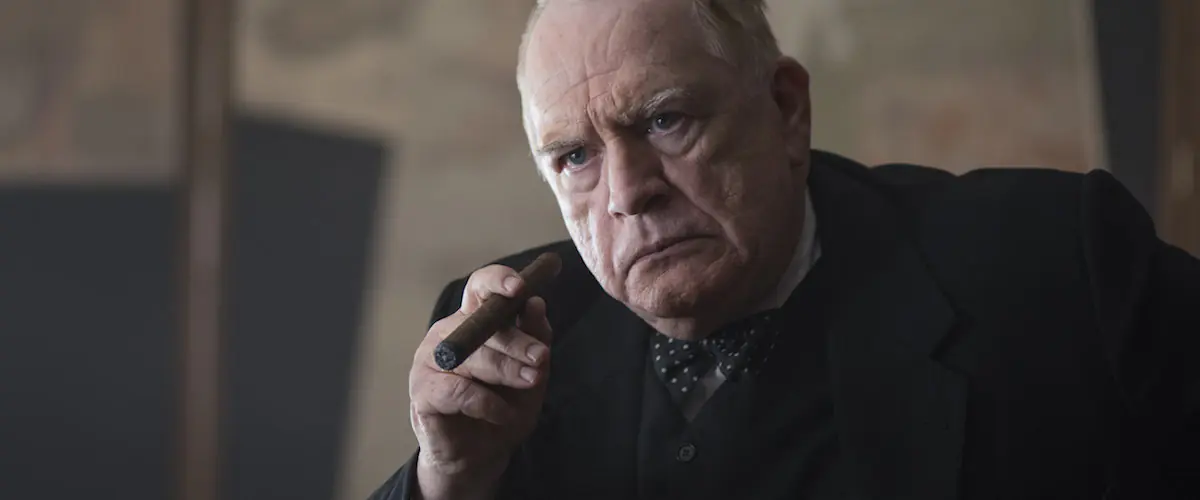
More than eighty years have passed since Winston Churchill first appeared in the world of cinema. Since then, he has featured in over fifty film and television productions, stage plays, and even video games. In 2017, two new cinematic incarnations of Churchill hit the screens. Unfortunately, one of them—simply titled Churchill—is far from perfect. It’s early June 1944. The Allies are preparing to liberate France—a move that could prove pivotal in securing victory in World War II in Europe. In just a few days, Operation Overlord, led by General Eisenhower, is set to begin, starting with the Allied landing on the beaches of Normandy.
Opposing the American strategy is Winston Churchill, who attempts to halt the launch of the entire operation. Here, Churchill is portrayed as a man burdened by difficult memories from the past and somewhat stuck in what once was. It’s repeatedly implied that his strategic thinking is outdated and that modern warfare has left him behind—along with his methods and mindset. No one denies his past accomplishments or contributions, of course, but even respect doesn’t prevent him from becoming an irritant to the American officers, with nearly every conversation between Churchill and the commanders ending in a heated argument. 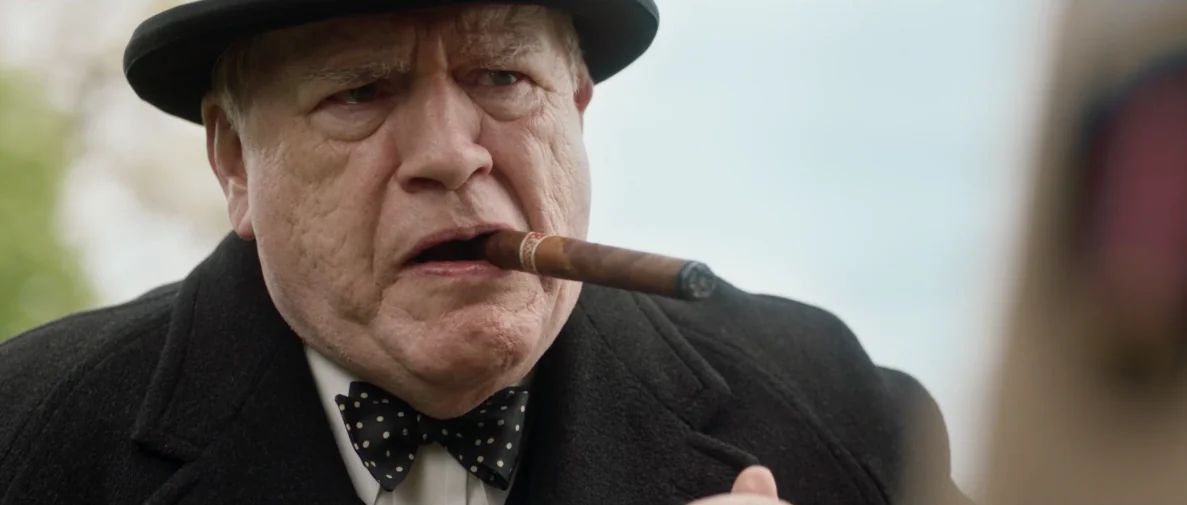 This version of Churchill is primarily a deeply exhausted man—worn down first and foremost by the war and its associated stress, but seemingly also by himself. He slips into depressive moods, turns to alcohol, lashes out at colleagues, and distances himself from his wife. Certainly, in negotiations with the military, he proposes honorable and altruistic solutions and repeatedly expresses a desire to save lives that are sure to become necessary casualties. Yet, his overall demeanor is so saturated with negative emotion that it becomes hard to root for him in this mission—eliciting, at most, a sense of pity.
Brian Cox’s performance is by far the film’s brightest spot. This is in no way the fault of Brian Cox, who plays Churchill; his performance is undoubtedly the film’s standout element. It’s his portrayal that keeps the viewer engaged. Cox masterfully conveys the full spectrum of emotions—from sorrow to rage to disappointment—and when he listens to his assistant’s story and gives her a comforting smile, he instantly radiates a fatherly warmth. It’s one of those roles where the actor fully inhabits the character. It’s also a performance that deserved a better script—because the screenplay is the film’s biggest weakness.
The central plot—detailing the behind-the-scenes lead-up to the famous D-Day invasion—is unquestionably a compelling topic, not only for history buffs but also for fans of war films, especially those built on a well-crafted script. Sadly, that is nowhere to be found in Churchill—the pacing is slow, and the dialogue is painfully clunky. Churchill himself, a man famed for his wit and sharp tongue, is reduced here to a loop of fretting and repeating how many young men will die in the landing (if I took a shot every time he says “so many young men,” I might not make it to the end of the film). Cox’s performance helps redeem this interpretation somewhat, but as a character, Churchill comes across as too one-dimensional.
The potential to show a brilliant strategist grappling with outdated methods in a new era of warfare is entirely wasted—Churchill is confronted with a fait accompli from the outset, after which he simply walks around complaining. There’s much talk of his greatness and the respect he commands—but based solely on the film, it’s hard to believe this is such a noble figure, rather than just a shadow of his former self.  The plot, in its current form, is not very engaging. This interpretation is dropped into a narrative that, according to Churchill’s biographer Andrew Roberts, diverges from the truth in many significant ways. The irony here is that the screenplay was written by Alex von Tunzelmann—a historian by profession. Leaving historical accuracy aside, the story as presented in Churchill simply fails to captivate. As a viewer, I wanted to feel the emotional weight of Eisenhower’s decision—to sacrifice thousands of soldiers in the name of victory. I wanted to be moved, to find myself pondering what order I would have given in the general’s place.
Instead, Churchill just repeats the same conversations over and over. Occasionally someone shouts. Occasionally someone stares into space. Cardboard cutouts, that’s all. Although the supporting cast tries their best, it’s difficult to get invested when the characters are written so poorly. The film does, thankfully, redeem itself somewhat on a visual level. For a modest drama set mostly indoors, there are many beautiful shots (enhanced by excellent music!), and the period-accurate cars and equipment are always pleasing to the eye. Still, it’s not enough to make up for the stiff dialogue and sluggish pacing. It’s always nice to have something to look at, of course. In this case, a dull portrait of a fascinating man has been wrapped in attractive packaging.
The film ends with talk of the Allied victory—but on a cinematic level, the biggest winner here is Cox: a breath of fresh air in a film clouded by a haze of mediocrity, drifting across the screen like the cigar smoke from Churchill’s lips.

