
Review
CHILD 44. Bad Film Starring Tom Hardy [REVIEW]
Child 44 veers toward an overblown comic book aesthetic—irritatingly loud, operating on radical hypotheses and banality.


Child 44 is a bad film. It stars Tom Hardy and is supposedly set in the USSR during Stalin’s era. Gary Oldman appears in a supporting role. What we get, however, is not the real postwar Russia, but a grotesque American fantasy of the country. The film includes the murder of innocent children and a criminal investigation—first conducted officially, then pursued privately. Child 44 is filled with all the weaknesses of American cinema, in its most unbearable form: crammed with kitsch and empty spectacle, narrative shortcuts, illogic, and bombast. Added to this are forced sentimentality, schematic plotting, and stereotypical characterizations.
These elements are all mashed together in Espinosa’s film (surprisingly, Espinosa is Swedish). I can’t recall another movie where I encountered such a concentration of all these flaws at once. Usually they attack individually, not collectively. Most often, only one piece of the puzzle doesn’t fit, causing the whole construction to collapse.

With Child 44, from the very beginning I’m looking at a battlefield—a mess that no one ever had under control. From fundraising to the final tweaks on the editing table. I dislike the portrayal of the USSR. It’s based on extreme, utterly banal clichés, seemingly lifted straight from an American propaganda leaflet. Over the course of the two-hour runtime, images so typical and derivative parade across the screen that I start to truly believe the filmmakers never consulted any other sources. Generals and officials are nasty, vindictive bastards. You wouldn’t shake their hands or look them in the eye.
They are soaked in the same poison as their leader. Moscow’s residents are, without exception, informers, traitors, and spies. Rank-and-file soldiers are degenerates. In this company, the protagonist is free to roam and privately fight for justice—without means of subsistence, without contacts, without weapons. He’s a hero from another planet.

This is an extreme and implausible world that, for reasons unknown, still tries to maintain the appearance of credibility. Child 44 veers toward an overblown comic book aesthetic—irritatingly loud, operating on radical hypotheses and banality.
Paradoxically, it very much does not want to be that. The filmmakers harbor ambitions to tell a story about a real, pathological state that once existed. But apparently only in the imagination of the unaware creators of Child 44, who measure the USSR by the conventions of a brutal western. I don’t believe in this vision. It strikes me as stupid and naive, trivializing and distorting a real social tragedy. In terms of substance, a coloring book has more to offer.

I can’t justify why the action of Child 44 is set at that particular time and place. It doesn’t meaningfully determine phenomena specific to that era. Of course, there is poverty, exploitation, crime, disease, oppressive власти, ubiquitous corruption, and a restrictive justice system—but these are not exclusive to that regime. The historical context doesn’t serve the story; it’s an unjustified decoration. The USSR was chosen solely to reassure Americans in their false conviction that we were the good guys and they were barbarians. During the Cold War, Child 44 would have fulfilled its role—it would have been politically useful to one side of the conflict. In the 21st century, it resembles an archaic relic, a useless museum exhibit.
Daniel Espinosa does not paint a portrait of Russia of that time. He doesn’t know it. The director can only throw random images of misery from the USSR at the screen.
He knows it was hard, brutal, and bad. To convey that, he transplants the rules of gangster cinema into this world. He also borrows from the aesthetics of the western—unfortunately on entirely unsuitable territory. One thing is suggested by the action, another by the setting. These two conventions clash violently. More than once I doubted what the director was trying to sell me, or whether he even knew what he had on offer. I don’t understand his intentions. Whenever he wants, he breaks the rules and lets his characters live.
Child 44 also fails as a crime film. For large stretches, the investigation goes nowhere. There are no clues that would push the plot forward or enrich the portrait of the killer with motivations. The most interesting trait of this character seems to be that he limps—probably on his left leg. I won’t be returning to the film to verify that. The murderer is merely a madman who, near the end, clumsily confesses who he is and delivers a speech about his own monstrosity. Horrifying. Espinosa handles this thread ineptly. Ultimately, I don’t know why he pursued it at all if he was going to dismiss it so ostentatiously.
The Russian accent adopted by the English-speaking actors is unintentionally amusing. Some emphasize it heavily; others seem to forget about it entirely. This creates chaos and confusion. Are they pretending to be Russians, or are we supposed to believe they merely possess some vague “Russianness”? Let’s imagine an analogous situation: Poles travel to the United States to make a film about native-born Americans. All dialogue is recorded in Polish, and the director asks the cast to imitate a Yankee accent. That’s a strategy more associated with parody. In Child 44, this effect appears disastrously. The film sounds unbearable—another nail in its coffin, driven in slowly and relentlessly throughout the runtime.
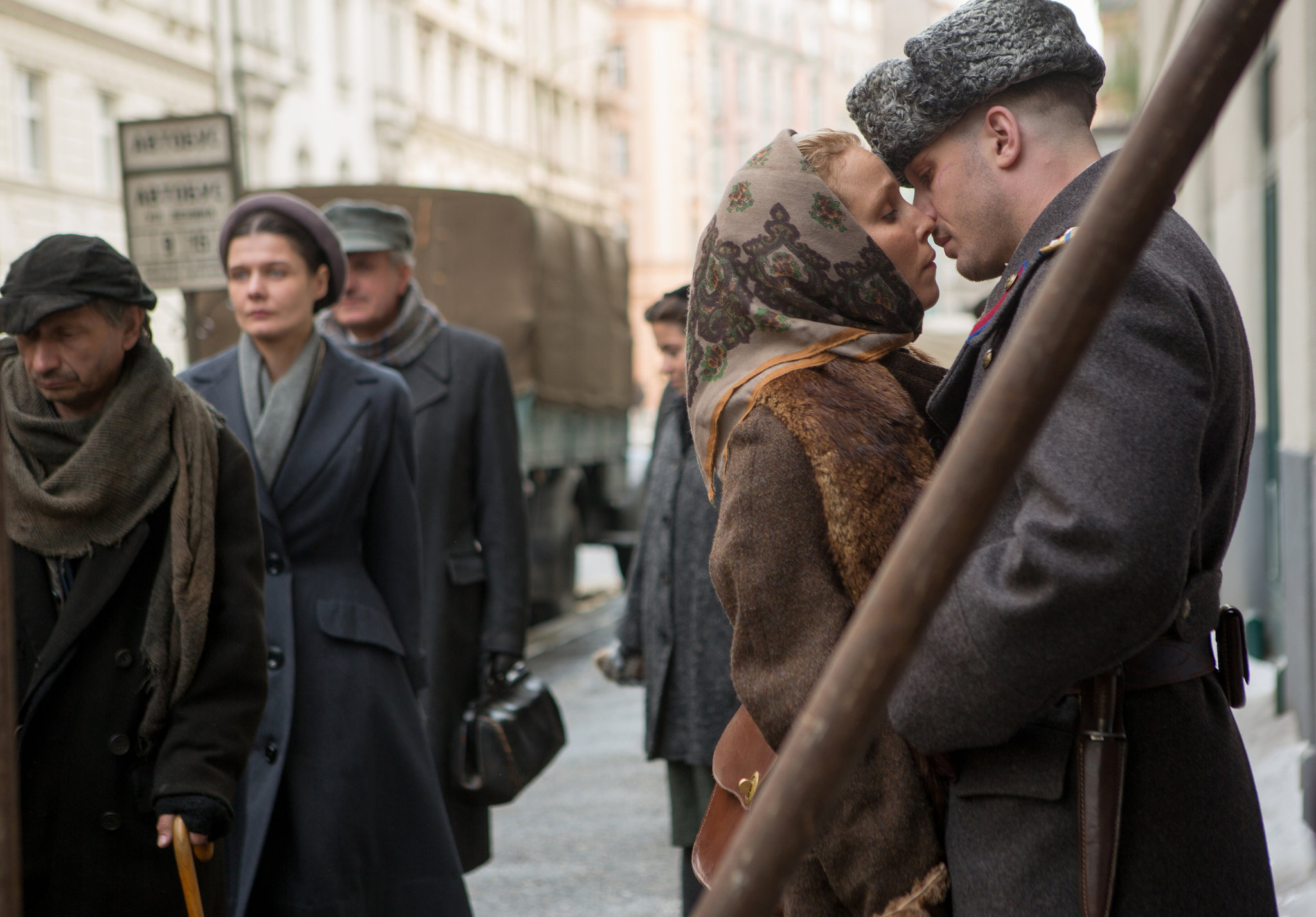
From a production standpoint, Espinosa’s film also feels outdated. It reminds me of a phenomenon common in some Polish productions—the “single wall.” This results either from a low budget or from a lack of ideas about how to present space on screen. It happens when filmmakers can’t find a suitably old-looking street or even an entire building and are left with just a fragment of a façade. They shoot the scene solely against that background, without changing perspectives or using wide shots. Child 44 contains a surprising number of such sequences, betraying the provisional nature of this world.
This is what cinematic Moscow looks like. Its inhabitants are no less cardboard. The shaky camera in more dynamic scenes is also exhausting (in several fistfights and in the sequence of the Russians taking the Reichstag). It’s meant to conceal the clumsiness of the staging. In making Child 44, the creators relied on half-measures and knock-offs. This film doesn’t know what it is. It pretends to be real cinema.

