
Review
CAPO. Abandon All Hope, You Who Work Here [REVIEW]


“Have you ever seen snow?” – a girl from Capo asks a group of newly met friends. “Only in the freezer,” comes the shy reply. Everyone is a little terrified, a little excited. Crammed into a silver delivery van, they try to find positives in the difficult situation they’ve found themselves in. They are immigrants from Venezuela, torn apart by internal conflict.
In Poland, they have found work that will not only allow them to get back on their feet but also help their loved ones who weren’t able to leave the country. Yet the van is taking them deep into the countryside, where their hopes quickly vanish. Instead of hotel jobs, the protagonists face 12-hour shifts in a meat factory. Instead of a proper contract – illegal off-the-books work. Instead of a monthly salary of three and a half thousand dollars – three and a half thousand zlotys. Along with the prospects of a normal life, their passports disappear too, confiscated by the employer to prevent anyone from thinking of escape. In other words: welcome to Poland.

Although Robert Kwilman’s feature debut is steeped in the muddy reality of Polish labor exploitation, the story could just as easily unfold anywhere. Anywhere, that is, where capitalism has brainwashed people into believing that the best – because most effective – way to make money quickly is to exploit another human being.
It is in these conditions that the struggle for the soul of Adrian (Daniel Jiménez) takes place. He too is an immigrant, but already fairly well assimilated. His basic command of Polish earns him the favor of the local shady businessman, who tempts him with promises of a work permit and grants him a semblance of authority over other workers. In this sense, Adrian plays a role analogous to that of a kapo in the Nazi concentration camps – both victim and oppressor. When a workplace accident with grave consequences occurs, the protagonist is forced to choose sides.

CAPO is a film of noble social realism, closely related to the works of Ken Loach or the Dardenne brothers. The kinship with the Belgian duo is apparent at first glance, also in the formal layer. Cinematographer Kacper Lasek shoots everything handheld: he keeps the camera close to the characters, filming in long takes, in a quasi-documentary style. Like the Dardennes, Kwilman eagerly casts non-professional actors.
Daniel Jiménez, who plays Adrian, works as a casting director in his daily life and had never appeared on screen as an actor before. Initially, he only helped assemble the cast, but eventually was persuaded to take the lead role himself. His lack of experience and acting polish turned out to be an advantage here – the sparse, mechanical delivery of lines does not sound artificial or forced. Instead, it feels like part of a deliberate artistic strategy – a side effect of Adrian’s emotional numbness, the cynical attitude he must adopt every morning just to survive another day in hell.
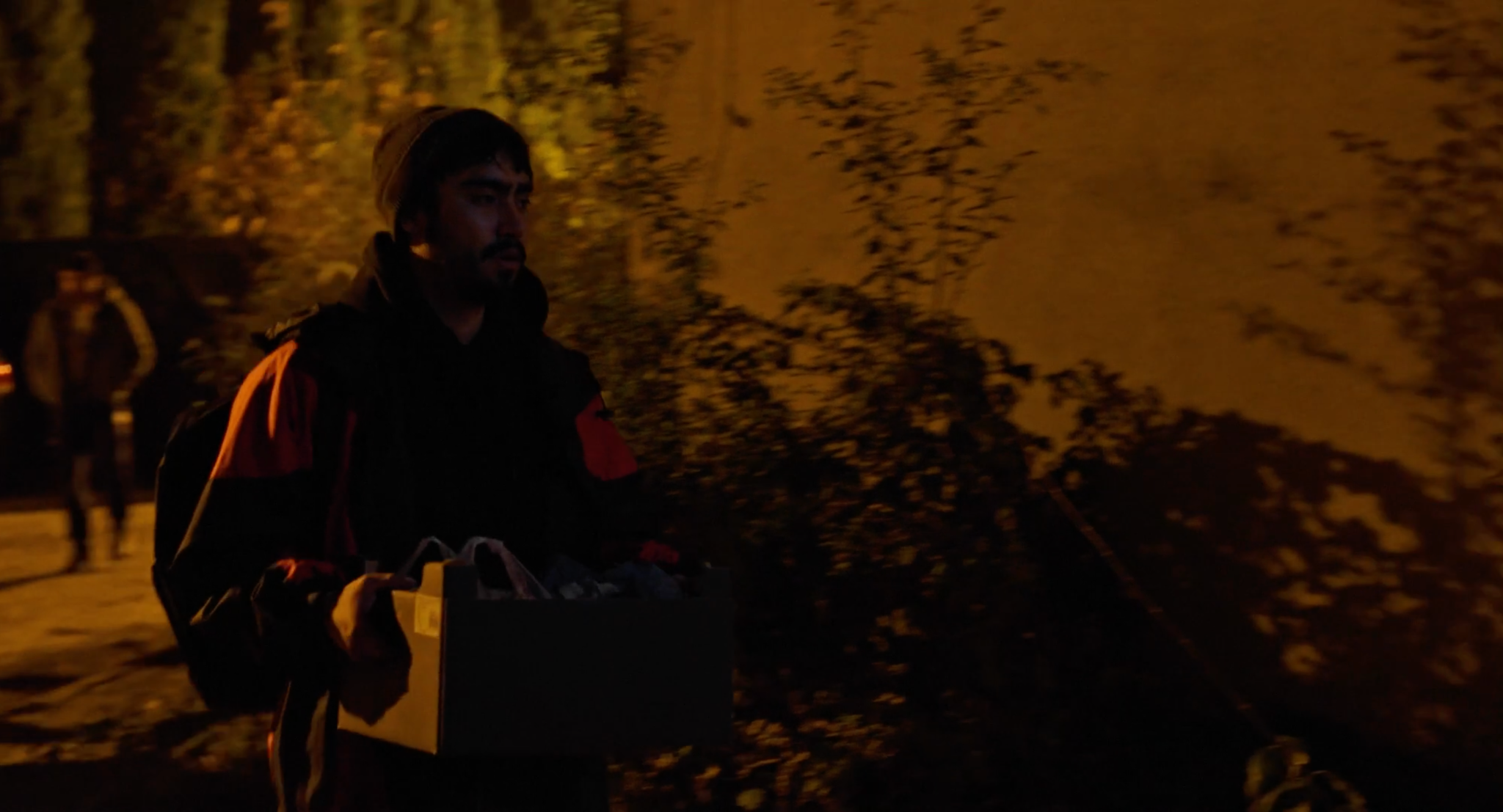
The most recognizable actor in CAPO is Sebastian Stankiewicz, cast against his usual comedic type. In Kwilman’s film, he becomes a slimy entrepreneur – a cunning manipulator who controls his subordinates with a mix of carrot and stick. When needed, he can throw them some cash and make solemn promises, even if his words are empty. At the same time, he knows how to instill fear, threatening to notify the authorities and arrange immediate deportation. Yet even in such a man, Kwilman and his co-writers, Malwina Górecka and Kirk Kjeldsen, manage to find a spark of humanity.
We glimpse it in short scenes at his family home – carefree play with his children, affectionate smiles toward them. How is it possible to be so human and inhuman at once? The answer is simpler than it seems: all it takes is to accept the belief that our world is divided into better and worse, winners and losers, exploiters and exploited. Either you become an alpha male, a ruthless king of the jungle, or you get devoured by those faster and stronger.
And what about social justice and empathy? Well, Mr. Areczek, the former simply doesn’t exist – the only justice is the victor’s justice – and the latter is reserved for family and friends. As for you, a 12-hour shift awaits, plus a few dozen minutes in the locked cold storage room if an inspector happens to show up.
It would be a cliché to say that CAPO is a necessary film – but the truth is, we simply lack this kind of cinema in Poland. Labor market pathologies, against which only one political party in Poland meaningfully fights, have until now been explored mainly in short films and almost exclusively in the context of Eastern European immigrants (60 Kilos of Nothing by Piotr Domalewski, Masza by Krzysztof Chodorowski). Kwilman picked up the gauntlet, confronted one of the most pressing problems of our times, and emerged victorious.

