
Review
BAD EDUCATION. Hugh Jackman is Fantastic
In retrospect, Bad Education stands out as one of those festival discoveries that quietly grow in stature over time.


Film festivals have a way of surprising you at every turn. The productions you anticipate the most — the ones that draw long lines and generate the loudest buzz — often turn out to be disappointingly average. And then there are the unexpected gems: films meant to fill a gap in the schedule that linger in your mind long after the screening. Bad Education, starring Hugh Jackman, was very much the latter. Shown quietly, outside the main competition circuit and without much distribution fanfare at the time, it ended up being one of the most memorable discoveries of that festival season for me.
I only learned from the end credits that the story had actually happened. And perhaps that was for the best. The less you know going in, the better. The twists and the gradual shifts in our perception of the main characters make the film riveting. What initially seems like a straightforward story about a respected school superintendent facing a moral dilemma unfolds into something far more layered.

Writing about a film that benefits from secrecy is never easy. Screenwriter Mike Makowsky based the script on a scandal that erupted at his own high school while he was a student there. In short, it involved the embezzlement of millions of dollars by school administrators — funds meant for the education of students in Roslyn were instead spent on summer homes, cosmetic surgery, and lavish travel. Yet paradoxically, the very people who stole from the students also appeared deeply committed to improving academic standards. That moral contradiction lies at the heart of the film.
Don’t expect a conventional investigative thriller. Yes, an exposé plays a role — but it is written by a teenage reporter for the school newspaper. Nor is this a straightforward social commentary dissecting the American public education system. Director Cory Finley blends genres, incorporating elements of satire and dark comedy. Such mixtures can be uneven, but here the balance is remarkably successful. For much of the runtime, I wasn’t entirely sure what kind of film I was watching — and that uncertainty made each scene more compelling. Nothing is quite what it first appears to be.
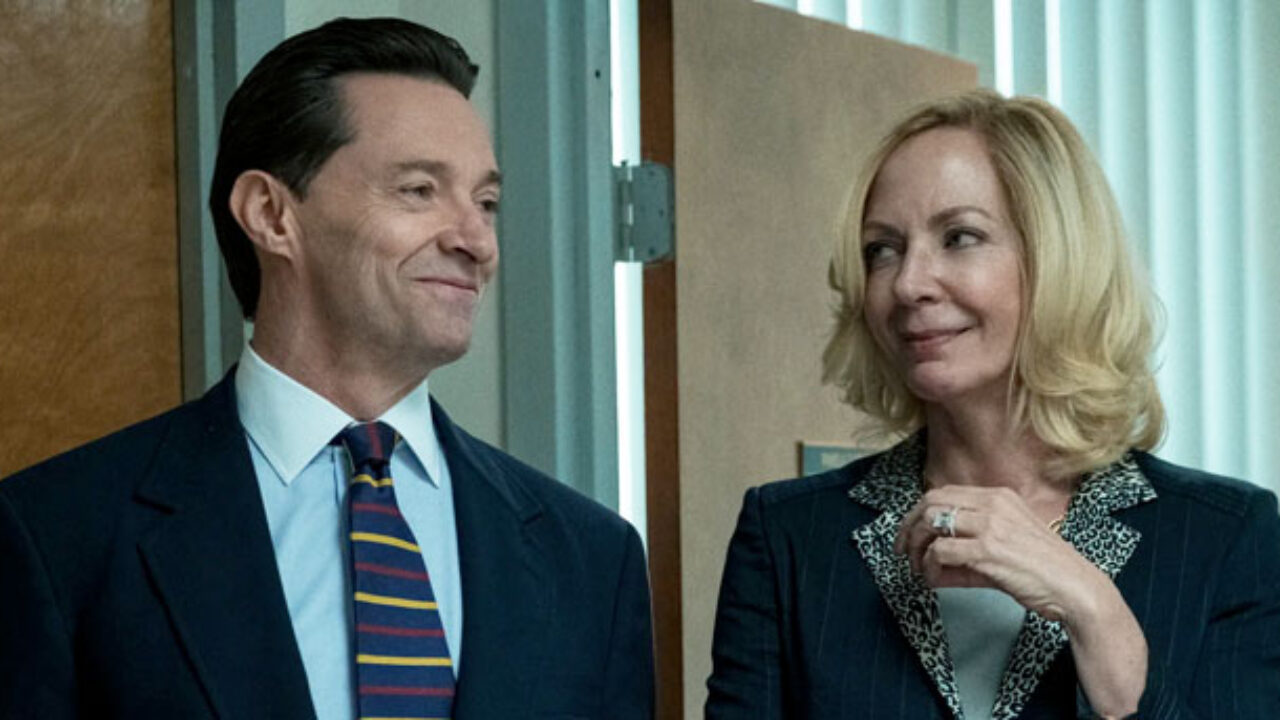
The story drew me in completely. Although much of it is presented as a black comedy, there is a strong sense of realism and credibility throughout. The narrative feels authentic, and it genuinely engages the viewer. Much of that impact comes from the performances, led by Jackman. I haven’t seen every role in his filmography, but I had never seen him better. His Frank Tassone evokes sympathy, admiration, pity, anger, and disgust — often all at once — without a single false note. And he achieves this in just over ninety minutes. It’s a demanding, deeply layered performance.
It is arguably even harder to portray such complexity within a lighter, satirical framework than in a traditional drama. While I have always appreciated Jackman, I would not have predicted a performance of this caliber from him. In a different distribution landscape, with a traditional theatrical run and a strong awards campaign, it is easy to imagine his work becoming a major contender during awards season.

The film’s strength lies in its entire cast. Ray Romano delivers a memorable supporting turn, and Geraldine Viswanathan leaves a strong impression as the ambitious student journalist. Alison Janney, already an Academy Award winner for I, Tonya, has perhaps the most demanding supporting role. Long admired for both her dramatic and comedic work — whether in film or on television — she once again proves her remarkable range here.
In retrospect, Bad Education stands out as one of those festival discoveries that quietly grow in stature over time. What began as an unassuming screening has settled into memory as a sharp, intelligent, and unsettling portrait of ambition, image, and moral compromise — a film well worth seeking out.

