
Review
A WHISKER AWAY. More than just a teenage love story
A Whisker Away is not a film that will find its place in the pantheon of Japanese animation—it simply lacks that level of impact.

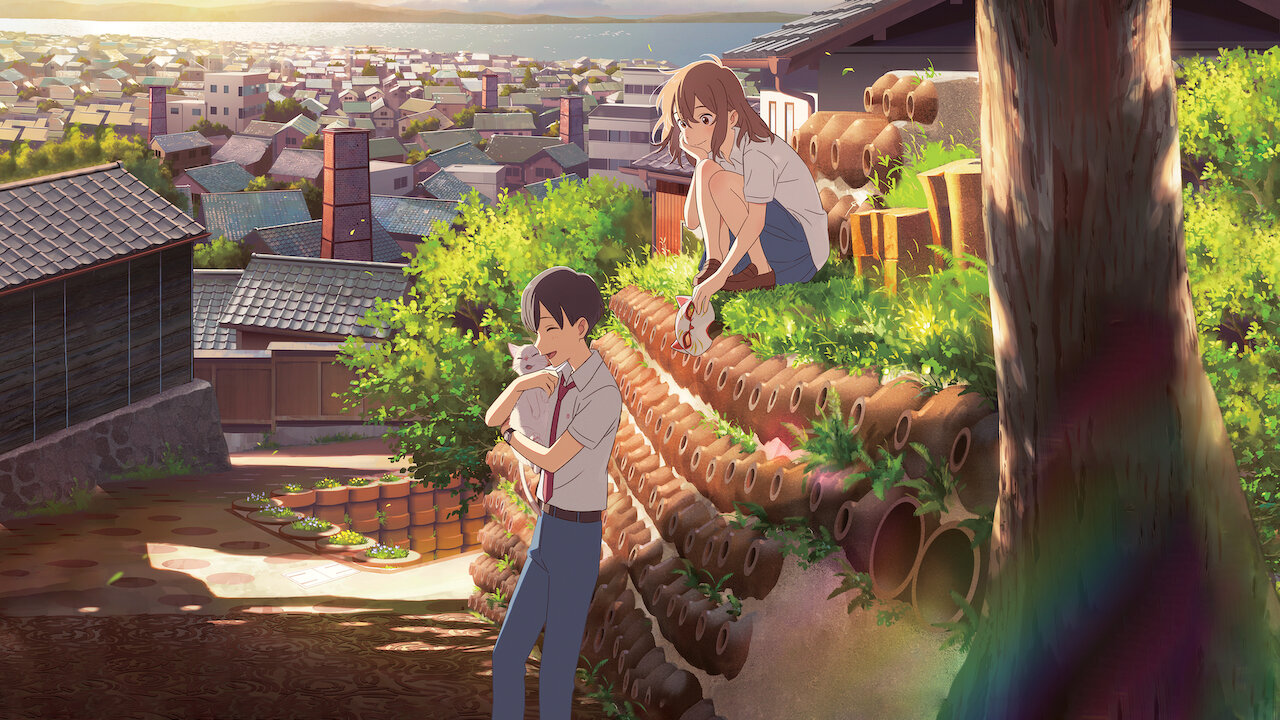
At first, I had my doubts about Netflix’s Japanese animation – I expected it to be yet another shallow, childish story about teenage love. Instead, the film quickly drew me in, winning both my engagement and sympathy. A Whisker Away hides much more than just a teenage love story intertwined with fantastical events featuring anthropomorphic cats. It is a film that reveals the complexity of human emotions, while at the same time dazzling the viewer with its visuals, its wonderfully imaginative world, and its engaging storyline. For this reason, in many places it reminded me of the legendary Studio Ghibli’s animations.
A Whisker Away tells the story of teenage Miyo. At school, she is nicknamed Muge, short for “Miss Ultra Gaga and Enigmatic,” a title given to her by classmates. To be fair, she has certainly earned that nickname. With admirable confidence, the girl tries to win the affection of her classmate Hinode. She openly bursts with feelings before the quiet, reserved boy, who coldly tries to reject her advances. Yet, to Miyo, every word Hinode utters to her becomes a veiled love confession. The girl is so blinded by love that she decides to make a pact with the devil—or more precisely, with a fat tomcat in a kimono called the Mask Seller, whom she meets in a dark alley during the Tenno festival night. When Miyo puts on the cat mask, she transforms into a charming white kitten who easily wins the affection of Hinode, who is in love with the furry creature. In cat form, she spends days and nights in her crush’s arms, learning his secrets and worries. Over time, however, the line between her human and feline form begins to blur alarmingly. Miyo must find the Mask Seller, who has stolen her true face, condemning her to live forever in a white cat’s fur.

A Whisker Away is steeped in Japanese sensitivity and folklore, which makes it especially enjoyable for fans of Japanese animation. For viewers outside this circle, it may initially be difficult to adjust to all the Japanese quirks. Nevertheless, the references to Japanese culture and beliefs serve primarily as enrichment. References to traditional Shintō religion and Japan’s colorful festivals lend the story a sense of mystery and depth—particularly in the thread about cats. Cats have a rich history in traditional Japanese beliefs: they were considered good household guardians, but also attributed with the power to transform into demons such as bakeneko or nekomata. In the film, they take on both the role of human allies and cunning adversaries. What surprised me most was the elaborate development of the cats’ world. The universal love story was thus transplanted into the realm of magic and sorcery, represented by anthropomorphic felines who live alongside humans but also have their own impressive, phantasmagorical kingdom, where they can freely drink sake or feast on fried mice. At times, this evokes imagery reminiscent of Spirited Away. Also interesting is the subplot of people who, persuaded by the Mask Seller, chose to abandon their human selves and transform forever into cats. These people fled from life’s troubles and challenges, opting instead for life on four legs. Worth noting as well is the beautiful, meticulous animation, which fully captures the magic of the feline world. It also adds subtlety and refinement to the story, making it feel lighter and more cheerful.
Director Junichi Sato humorously portrays teenage platonic love with all its exaggeration, naivety, and lack of reason. When Miyo spots Hinode’s back in a crowd, everyone else suddenly turns into meaningless scarecrows. The mere sight of or even thoughts about her beloved make her see the world through rose-colored glasses. Since the love story is built entirely on the contrast between the straightforward Miyo and the skeptical Hinode, it takes on a humorous tone, making it amusing rather than irritating. Miyo is a love-struck oddball, viewed with undisguised astonishment by everyone around her. Yet, this is the perfect picture of puppy love—unstoppable even by a battering ram, let alone common sense.

The romantic thread between Miyo and Hinode also conveys a sincere portrayal of sensitive teenagers hiding their emotions behind various masks. Bitter events come to light that explain the eccentric and enigmatic behavior of the two protagonists. Miyo comes from a broken family, harbors resentment toward her absent mother, and struggles to accept her stepmother. Hinode, on the other hand, bears the pressure of being the future head of the family, a role imposed on him by his mother. The boy has a dream, but one that does not fit into the plan set for him. Junichi Sato gradually reveals more pieces of the puzzle, creating an image of lost teenagers, afraid to speak openly about their feelings and hiding instead behind certain behaviors.
Although the love story between Miyo and Hinode appears to be the central plot around which everything revolves, it turns out to be merely a pretext for telling a deeper story. Beneath the cover of romantic dilemmas, the director portrays the complicated family situations of the two main characters. The whole adventure with the feline characters naturally ends in the two protagonists growing closer, tossing the word “love” about too carelessly, yet the more important takeaway is the lesson learned: Miyo manages to reconcile with her parents and stepmother, while Hinode opens up to his mother. Ultimately, it is at the moment when Miyo loses her human face that she more fully realizes her own humanity, which finally teaches her openness and humility.

A Whisker Away pleasantly surprised me, though it is not a perfect film. After watching it, one cannot help but feel that Japanese animations often follow the same repetitive pattern. The characters, though exaggerated and polished, seem to be yet another version of the same archetypes so common in anime. In the end, the viewer is not given something entirely original, though they still receive another authorial variation of what one has come to expect from Japanese animation. The film stands out with its unique ideas and solutions, yet it remains rooted in the soil from which many Japanese screen stories grow.
However, these remarks do not significantly affect the overall perception of Junichi Sato’s work. If anything, they may bother longtime anime fans, who could grow tired of the recurring formulas. A Whisker Away is not a film that will find its place in the pantheon of Japanese animation—it simply lacks that level of impact. Nevertheless, it remains a title worth watching. A title that will amuse, charm with its fantastical world of enchanted cats, but above all captivate with its thoughtful analysis of growing up, sensitively portraying teenage emotionality and vulnerability. It is worth confronting one’s feelings openly—even if shedding human skin in favor of feline fur seems like the most tempting solution.

