
Features
How TROPICAL HEAT aka SWEATING BULLETS Saved the World
Explore how a cheesy TV show character of Tropical Heat aka Sweating Bullets became a symbol of hope and freedom for a nation in turmoil


It was supposed to be about something entirely different, but while digging through the murky depths of my memory and rifling through the cultural relics cluttering my mind, I remembered Tropical Heat aka Sweating Bullets. On the surface, just another TV show that once delivered plenty of fun to viewers eager for the American excess. But when I started digging—wanting to know what Rob Stewart, the show’s Nick Slaughter, was up to now—a sudden twist worthy of Hitchcock tore my heart out.
It turned out that the wisecracking ponytailed detective played a significant role in toppling Serbia’s Slobodan Milošević’s regime—one of the 20th century’s most brutal dictators.

It began innocently enough. By 2008, Rob Stewart—whom I’d half my childhood mistaken for Bruce Willis and the other half convinced was a famous singer—had long passed his five minutes of fame.
Tropical Heat had been canceled in 1993 after just three seasons. No wonder: in America, crime dramas were already a mature industry, and a mash-up of Baywatch, Miami Vice, and a loose Chandler-style detective didn’t make much of a splash. But in other, especially Eastern European countries a detective piling one-liners left and right, shooting pool under palm trees, living on bullets and sea breezes, and strutting around in a garish Hawaiian shirt on hot sand embodied the dream life. The man had never heard of food rations.
Add in his one-day stubble, artfully braided ponytail, and chest as lush as a forest—and you had the total man.

Stewart’s detective days however were just a song of the past. No significant roles had appeared on his horizon for years; gray hairs began attacking the forty-something’s scalp; and he found himself… in his parents’ basement. Worse still, in Canada. That’s where his son introduced him to Facebook. Like any old-school actor, Stewart decided to see if anyone remembered him.
He stumbled upon a post titled Nick Slaughter for President, linked by a man named Ivan Jovanović. Jokingly, Stewart replied that if Jovanović wanted to secure him the post, all he had to do was ask. Jovanović then explained the story behind the slogan: Stewart was still remembered… throughout Serbia. The actor couldn’t believe how popular Tropical Heat remained there, or what cultural significance Nick Slaughter held. He quickly contacted Serbian fans and decided to go to Europe to discover the phenomenon’s roots—he had little choice, since the alternative was more basement-dwelling in rural Canada. Stewart flew to Serbia and recorded his encounter with an unexpected fame he’d never dreamed of, resulting in the documentary Slaughter Nick for President (he spent his last pennies on the project).
Watching that film is an extraordinary experience. It perfectly underscores pop culture’s immense power—how what one culture dismisses as trash can spark revolution in another.

In the former Yugoslavia, Stewart was greeted like Barack Obama, the sheriff of the free world. A gargantuan crowd welcomed him at the airport; a limousine whisked him off for further celebration; he appeared on almost every major Serbian talk show; and even starred in a bizarre commercial evoking Lost in Translation’s cultural clash. Slaughtermania had gripped the nation. It turned out that nearly everyone there knew the swashbuckling detective, who showed young people brutalized by Milošević’s 1990s rule that something called freedom actually existed. Beautiful tropics, justice always prevailing, and a funny, almost superhuman hero in a billowing shirt/cape became a beacon of hope. For many Serbians, meeting Stewart fulfilled their youthful dreams. It’s remarkable that Serbia’s heavily censored state TV even aired such American fare—who could have guessed that silly beach chases and modern-cowboy antics would move the masses?
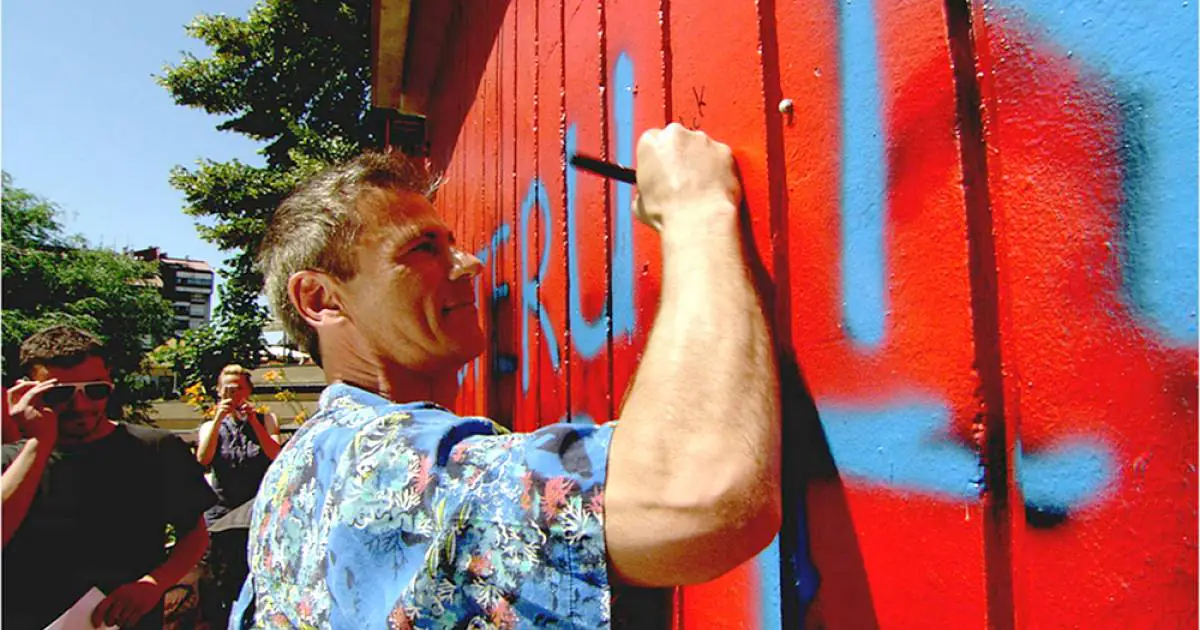
At the time, Serbia was torn between UN sanctions and Milošević’s murderous regime, where citizens were just political waste. Yet it was those citizens who peacefully overthrew the dictator in 2000, even as the nationalist monster tried every trick to extend his power. And it was Detective Nick Slaughter who served as the spiritual guide for young activists. The punk-rock band Atheist Rap—authors of the 1998 freedom anthem Slaughter Nietzsche—still inspired by the series, performed the song live with Stewart in 2008.
Even former environment minister Srđa Popović, who as a student founded the pacifist resistance movement Otpor!, appeared in Stewart’s documentary. The film’s title itself references one of the most popular protest graffiti slogans of the era (Sloter Nik za predsednika), and Slaughter even appeared as a comic-book hero in Aleksa Gajić’s strips printed during the 1996–1997 student protests.

This is an absolutely astonishing story that romantically unites a kitschy Western-forgotten TV show, one of Europe’s bloodiest conflicts, and citizens’ collective strength, driven by a shared goal and fascination.
Humanity has yet another example of how forgotten cultural artefacts can change the world. After all, we saw Anvil! The Story of Anvil—the forgotten Canadian heavy-metal band that once had a shot at stardom and impressed legends like Slash, Lemmy, and Metallica (spoiler: they never made it big, but the documentary is fantastic)—and the Oscar-nominated Searching for Sugar Man, where we learned how Sixto Rodriguez, unaware of his impact, helped fight apartheid.
Pop culture, endure forever!
P.S. In Serbia, a hairy chest is known as Nik Sloter.


Looking back at DEAD SNOW: A Blizzard of Nazi Gore Fun

DEAD SUSHI: Exotic, Spicy, and Wildly Entertaining

Revisiting ALICE, SWEET ALICE: Dread and Religious Symbolism

PUPPET MASTER: LITTLEST REICH – Achtung! It’s Good!
