
Movies Explained
Revisiting FEAR AND LOATHING IN LAS VEGAS: Pure Madness!
Fear and Loathing in Las Vegas is today a cult film — cult in the original meaning of that word.


I would like it to be regarded as one of the best and one of the most hated films of all time. Terry Gilliam on Fear and Loathing in Las Vegas
He succeeded. The amplitude in public opinion regarding the eighth film of the former Monty Python member is as extraordinary as the things depicted in it. One cannot be surprised by this, considering that Gilliam and Hunter S. Thompson joined forces on this shared project. Indeed, some films are destined for controversy from the very beginning, and the 1998 feature is one of them.

Thompson’s book itself — bearing the same title as the film — is the most acclaimed example of his work. Expectations toward the adaptation were therefore significant, and they were raised even higher by Gilliam’s previous two films, namely The Fisher King (1991) and 12 Monkeys (1995). Interestingly enough, the creator of Brazil was not the first director attached to the project. That was Alex Cox (Sid and Nancy, 1986). In the end, however, the Brit had to step aside, and it was the equally mad genius from America who faced the opus magnum of the wild prose writer.
America itself, or rather the United States and their spiritual condition, are the main subject around which the film’s “plot” and book revolve. The book says as much in its subtitle: Fear and Loathing in Las Vegas: A Savage Journey to the Heart of the American Dream. Yet it must be noted that Thompson’s work is not the easiest material to transfer onto the big screen. It is one of those books in the vein of William S. Burroughs’ Naked Lunch or Thomas Pynchon’s Inherent Vice, which — when applied to film stock — provoke a wide range of reactions and require multiple viewings for a better grasp.
Fear and Loathing in Las Vegas is precisely such a production, and with each subsequent viewing, many things become more noticeable — though still open to various interpretations. And that’s fine. What matters is that Gilliam does not move toward the mainstream, that he believes in the viewer’s intelligence, that he creates a film which not only refuses to flatter the audience, but even — more than that — is intentionally unpleasant in its approach. This naturally entails many qualities that do not make the film easy to like, but it must be acknowledged that the creators were driven by considerable artistic courage.
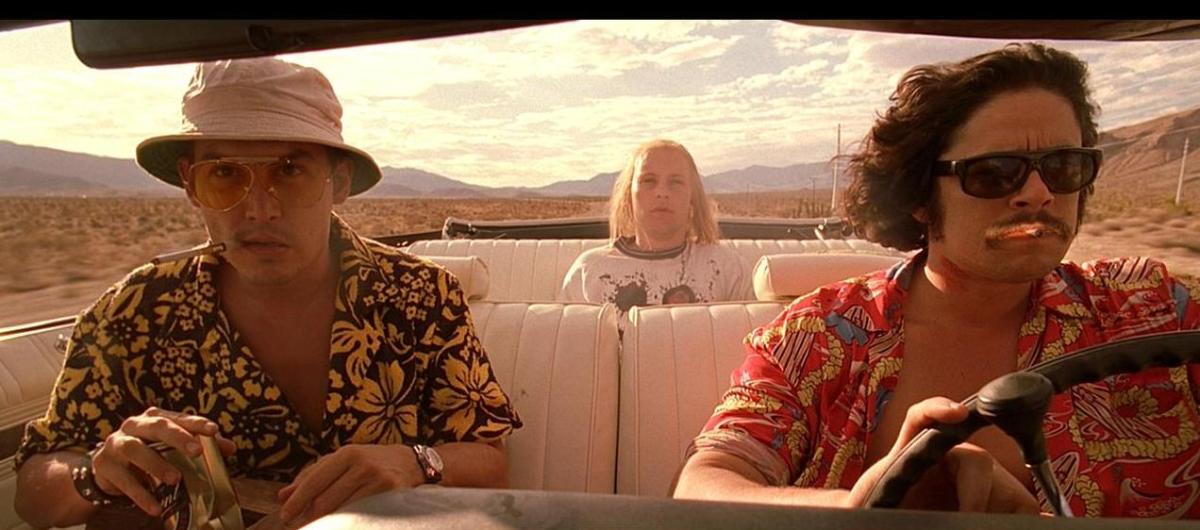
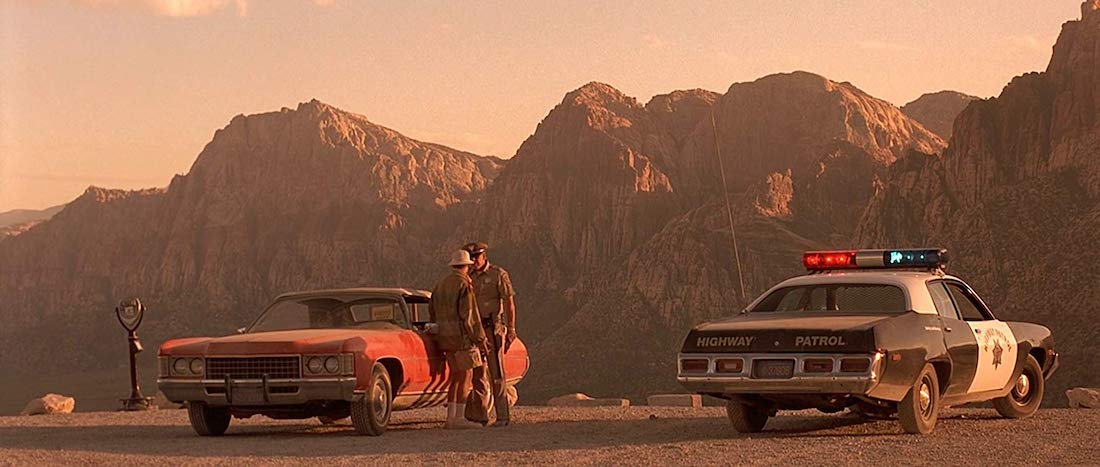
Fear and Loathing in Las Vegas takes no prisoners. Either you’re with the film, or you’re outside it. There is no middle ground. The year is 1971. The Manson murders have already occurred. The story begins as if from the middle. Two men are speeding through the deserts of Nevada in a Cadillac. They are Raoul Duke (Johnny Depp), Thompson’s alter ego, and his attorney — Dr. Gonzo (Benicio Del Toro). Where are they going? For what purpose? We do not learn this immediately.
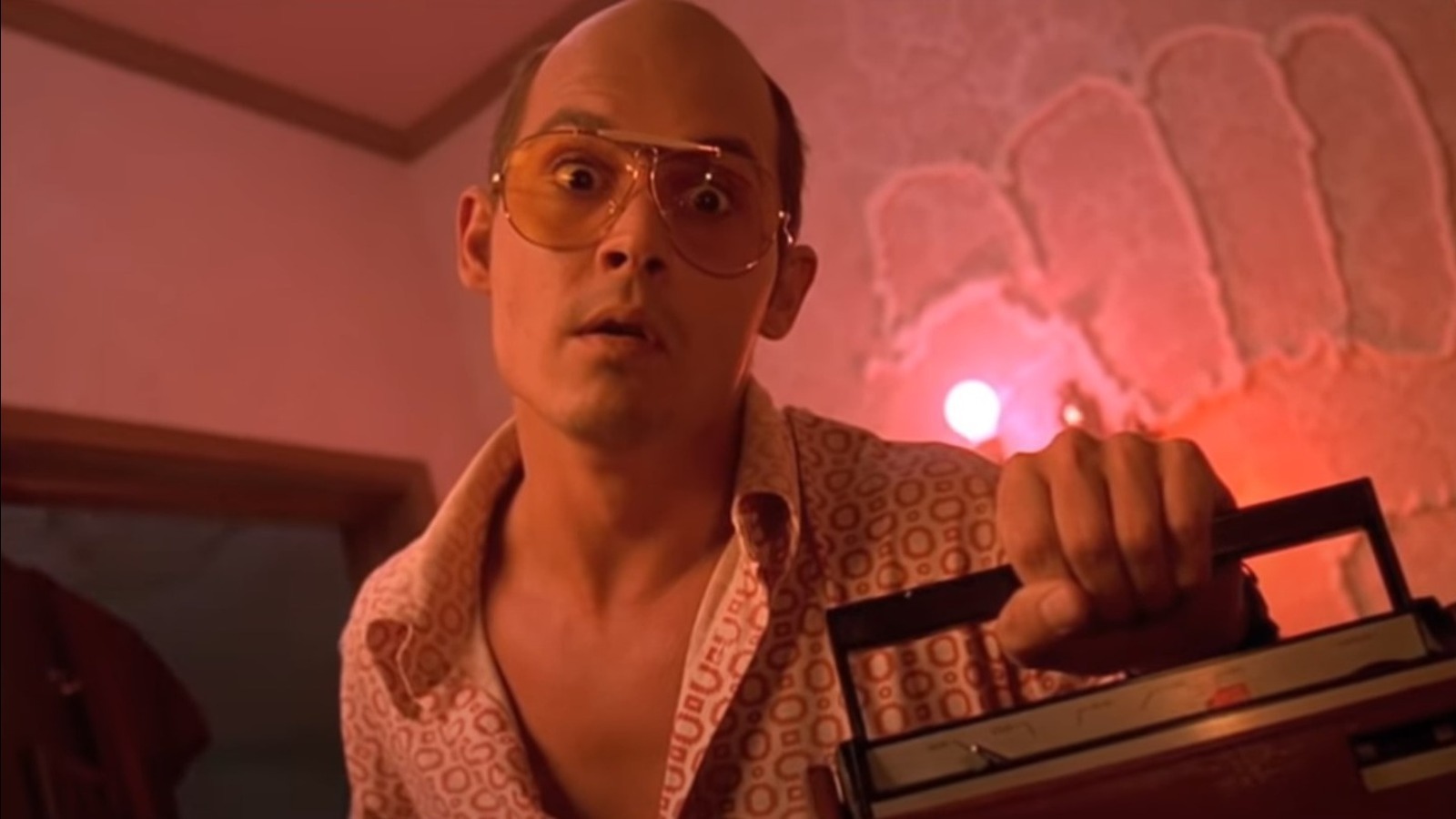
Instead, Gilliam, in his familiar manner, through various shots and dialogues lifted directly from the book, gives us a signal: the destination of the journey is irrelevant — the journey itself matters. Only after some time do we learn that the characters are rushing to Las Vegas to write coverage of a motorcycle event known as the Mint 400. Yet the event functions merely as a pretext — a pretext for taking drugs.
The opening text of the film reads: He who makes a beast of himself gets rid of the pain of being a man. Raoul Duke is an intelligent journalist who cannot remain sober for long. He prefers to abandon his humanity rather than continue suffering. Essential to the film is the scene in which, during one of his narcotic trips, he returns to San Francisco, to the year 1965. He nostalgically recalls the lost time, which appears to him as a unique place that had already reached its peak. He compares this period to a wave that surged, broke, and receded — failing to reach the next level.
The ’60s were for him a kind of unfulfilled promise that from that moment onward everyone would become liberals. But that did not happen. The ’70s came, and people fell into desire and greed. As a society, America did not follow the right path.
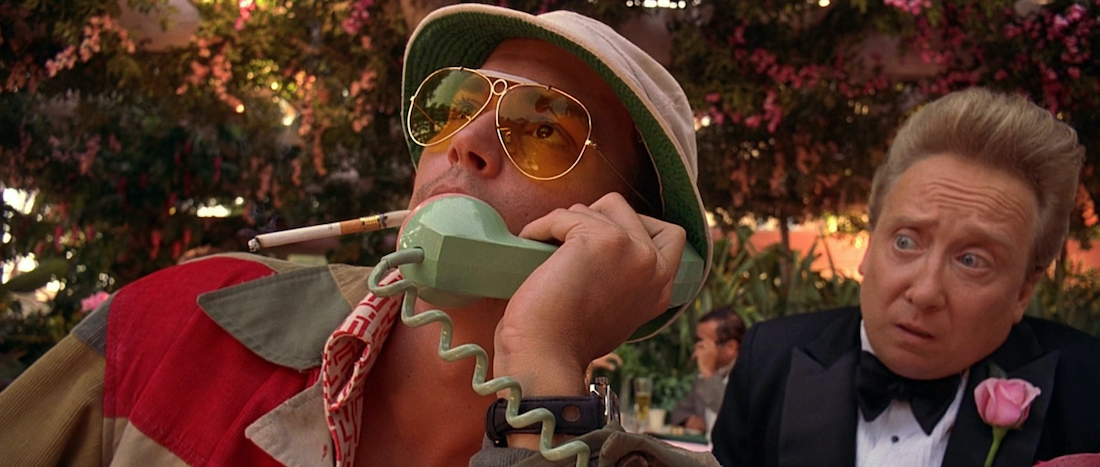
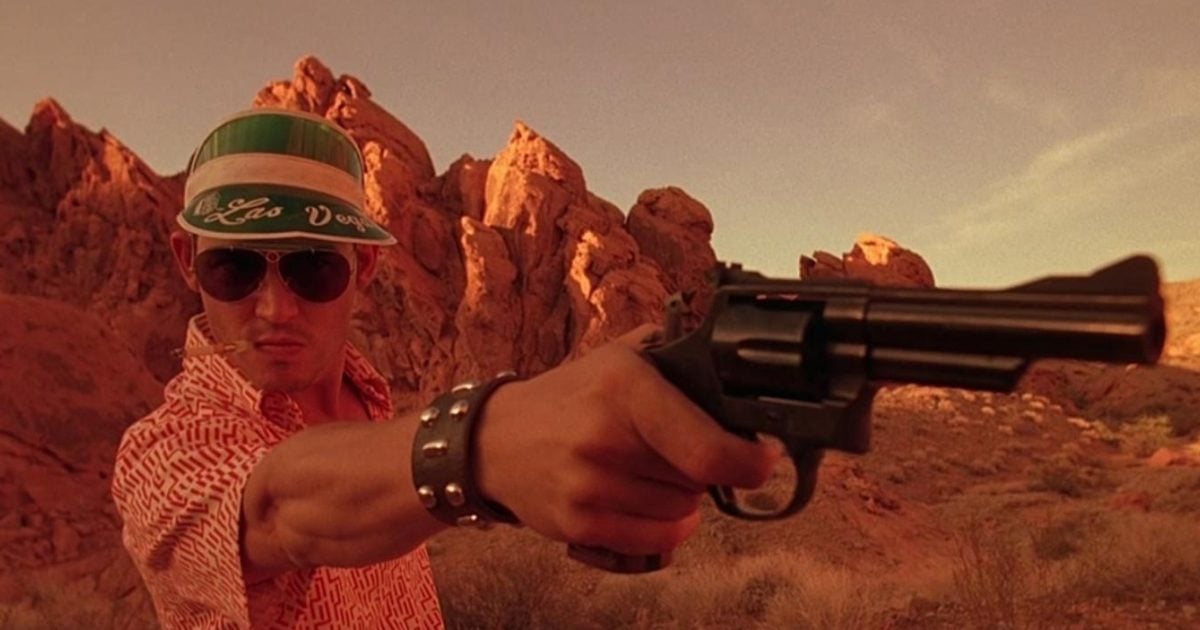
Gilliam’s film focuses on mocking this society. It is a satire on reality, on the American dream, it is a dark comedy. The creator of Time Bandits (1981) constructed a burlesque in which he portrays the real world through two wildly intoxicated men. Through this device, a second, imaginary image of life is created simultaneously — one that nevertheless harmonizes with the real one. Luxurious Las Vegas is a perfect place for this. Casinos, circuses, the inherently psychedelic neon lights illuminating the city at night — they are real, they exist. Yet they perfectly blend into the bizarre visions experienced by the protagonists, which appear from the very beginning of Fear and Loathing in Las Vegas.
Gilliam, however, does not only mock the characters’ surroundings — he also mocks the characters themselves. We see this, for example, in the scene where the heavily tripping Dr. Gonzo attempts to get off a carousel at a bar in one of the Las Vegas venues. Slapstick in the good old style. The success of the film is also determined by the actors. Both Depp and Del Toro are excellent in their roles. And although the performance of Tim Burton’s favorite appears more expressive, caricatured (in a good sense — for caricature is the nature of the film), it does not overshadow his partner’s work.
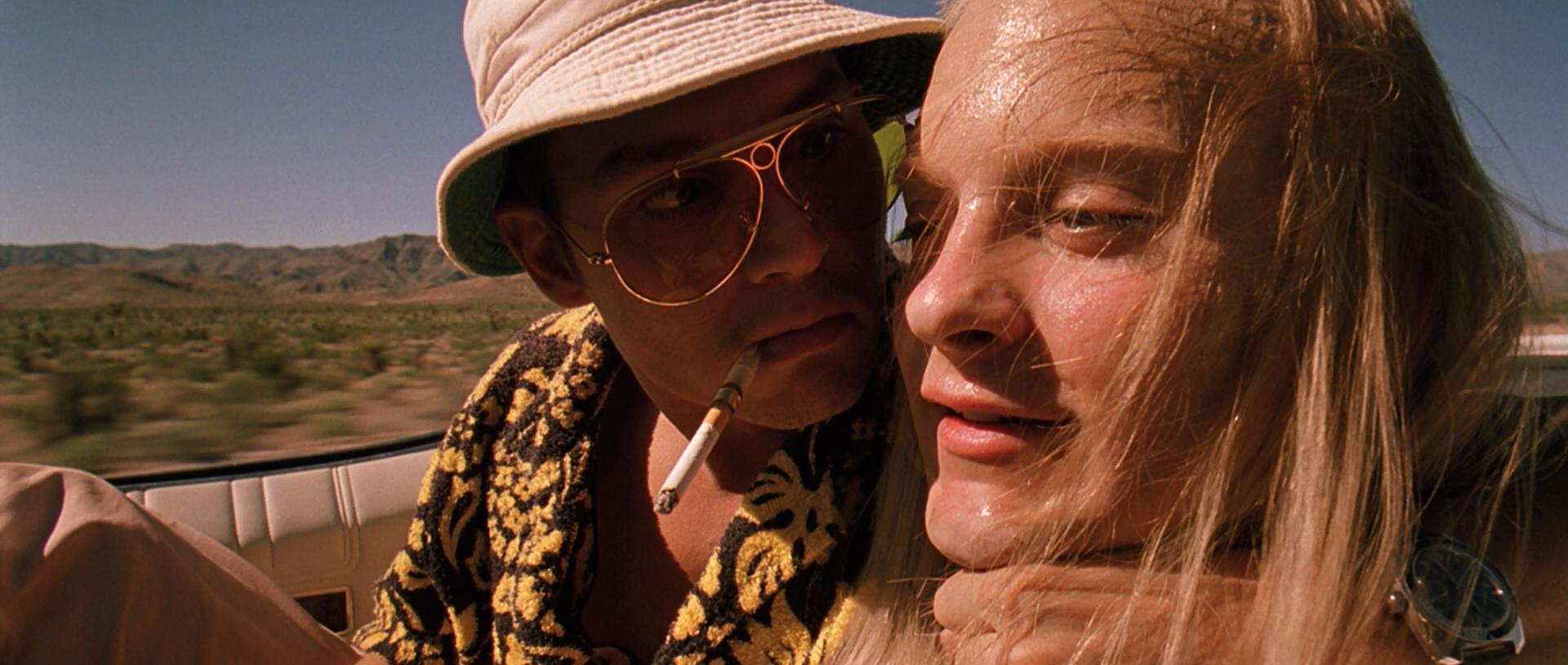
Del Toro’s corpulent figure is by no means insignificant. His character is at times rational, resourceful, yet also unpredictable, repulsive, and frightening. The camera also plays its role. Gilliam shoots the faces in extreme close-ups. These sweaty, exhausted, disoriented faces perfectly evoke the atmosphere and tone of the film, which is… unique. Gonzo and Duke are not characters one easily grows fond of. They do not undergo transformation, nor are they — needless to say — angels. Quite the opposite. Still, the voice-over helps in understanding their behavior.
Similar to Thompson’s innovative journalistic style (so-called Gonzo) in his literary work, in the film it communicates with the viewer through the mouth of Duke in a precise and bawdy manner. Yet it remains easy to understand the opinion that the film is not engaging for some, because it offers no characters with whom one can easily identify. Gilliam’s style mentioned earlier does not help in this regard either. His way of telling the story can, in a single moment, present masses of information through peculiar camera movements or rapid editing cuts.
This is, of course, an intentional effect — increasing tempo and amplifying the madness of the situation — but not making the experience easier for a lay viewer. Fear and Loathing in Las Vegas is today a cult film — cult in the original meaning of that word.
The soundtrack contributes to this as well, with which Gilliam proves his skill in pairing images with songs à la Scorsese. The reception of the film — positive or negative — seems in this case strongly tied to personal, psychological reactions to the “narcotic immensity” presented in the film. Listening or reading about drug trips is one thing — watching them is something else entirely.
It is a different matter. For those who are prepared for it — and it must be emphasized that Gilliam certainly does not promote drug use — his eighth film is worth watching not only for the first time, but also once again, even by those who initially did not like it, and for whom another viewing may appear as a kind of illumination.


Looking back at DEAD SNOW: A Blizzard of Nazi Gore Fun

DEAD SUSHI: Exotic, Spicy, and Wildly Entertaining

Revisiting ALICE, SWEET ALICE: Dread and Religious Symbolism

PUPPET MASTER: LITTLEST REICH – Achtung! It’s Good!
