
Review
THE NIGHT IS SHORT, WALK ON GIRL. Absorbing feast for the senses

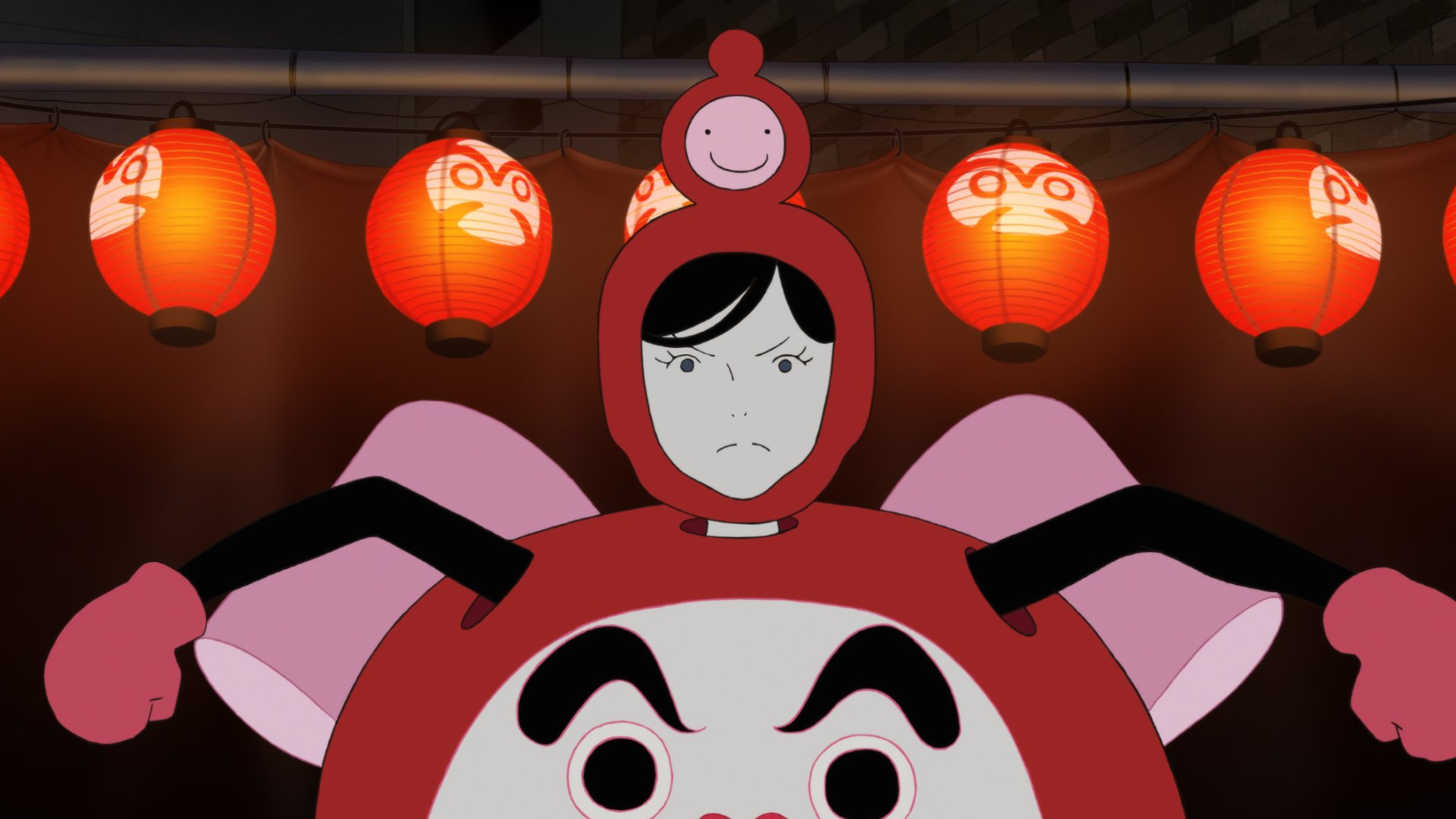
At a time when animated films are increasingly—though so far with dubious results—being remade into live-action productions, Japanese director Masaaki Yuasa can rest easy. With works like Mind Game and The Night Is Short, Walk on Girl (Yoru wa Mijikashi Arukeyo Otome), Yuasa showcases the true power and astonishing beauty of hand-drawn animation. The truth is that The Night Is Short… would lose all of its surreal and eccentric magic if adapted into a live-action film, as its essence is inseparable from Yuasa’s distinctive, light drawing style.
The Night Is Short, Walk on Girl, despite its misleading title, tells the story of an exceptionally long night brimming with extraordinary events. A young man sets out into a city buzzing with fun and pleasures, following in the footsteps of a black-haired girl. Guided by his idea of the “Strategy of Pure Coincidence,” the secretly infatuated protagonist hopes to get closer to her. But the girl’s path proves anything but simple—it leads through drunken tournaments, book fairs, street festivals, and other places born out of the still-unquenched night’s astonishing whimsy. A night that will turn out to be the longest of their lives.

Although the boy’s relationship with the girl forms the backbone of the story, the film is soon overtaken by a parade of colorful supporting characters who are Yuasa’s trademark: Don Underwear, a stern, square-jawed man who swears not to change his underwear until he reunites with his mysterious beloved; an eccentric kimono-clad collector who hoards even random clothing found in the street; members of an underground theater; and the God of the Used Book Fair. Yet the true essence of the film is the bizarre, nearly indescribable journey through the crowded, intoxicated city.
Yuasa’s film bursts with visual eccentricities: a mix of contrasting animation styles, playful manipulation of form, and vibrant color. It is like a kaleidoscope into which the viewer is suddenly and without warning thrown. Everything spins faster and faster, just like the black-haired girl after each drink she downs. Animation is the obvious backbone of this warped world, but it is not the meticulous, polished, and tidy style we know from Studio Ghibli. In The Night Is Short, Walk on Girl, it is simplified, elastic, almost childlike—as if drawn in haste. In fact, “haste” perfectly defines the film. Its plot, defying all logic, never slows for a second, leaving the viewer with no time to catch their breath. The dialogue—witty, thoughtful, and full of intriguing and humorous content—pours out of the characters’ mouths at breakneck speed. Added to this is absurd humor, highlighted not only through the eccentric behavior of numerous characters and the nonsensical construction of the world itself, but also through playful “Japaneseness”: witty reinterpretations of traditions, embellishments drawn from Japanese demonology, and even comical jabs at shunga—“spring pictures,” traditional ukiyo-e woodblock prints with strong erotic undertones—presented here in a cheekily censored form, much to the delight of the film’s eccentric perverts.

The Night Is Short, Walk on Girl is an intoxicating and absorbing feast for the senses, packed with clever references and adult-oriented humor. At the same time, it is nearly overwhelming—some viewers may find it headache-inducing. The surreal visions, abstraction, and absurdity deliver a dazzling showcase of Yuasa’s directorial and animation mastery, offering immense delight. But even the most resilient viewers may find this non-stop ride exhausting or frustrating over time. Importantly, however, Yuasa does not leave the audience with mere visual extravagance. The climactic fever dream of the flu-stricken protagonist, rich in ambiguity and metaphor, doesn’t force viewers to invent their own ending. As dawn finally arrives, the film mercifully slows its pace, allowing us to savor an inventive, long-awaited, and satisfying resolution to its central threads.
Yuasa’s animation, based on the novel of the same name by Tomihiko Morimi, unfolds like a stream of consciousness dreamt by someone delirious with fever and still floating in a narcotic haze. It is filled with vivid associations, visual metaphors, and omnipresent absurdity. And for those who, like me, find the film’s story insufficient, I recommend Yuasa’s anime series The Tatami Galaxy, which expands the eccentric world introduced in The Night Is Short, Walk on Girl.


Looking back at DEAD SNOW: A Blizzard of Nazi Gore Fun

DEAD SUSHI: Exotic, Spicy, and Wildly Entertaining

Revisiting ALICE, SWEET ALICE: Dread and Religious Symbolism

PUPPET MASTER: LITTLEST REICH – Achtung! It’s Good!
