
Review
THE GIRL WITHOUT HANDS. Visually Exquisite Work


When a single person is responsible for directing, writing, and animating an entire film, it must be called a truly auteur work. What’s especially impressive is that Sébastien Laudenbach single-handedly created an extraordinary, visually stunning piece that can easily be described as a moving painting. The Girl Without Hands is a film hard not to admire — both for its beauty and for the sheer effort behind it. The director not only creatively reworked his source material, but also personally brought to life a project that had long been considered lost.
Production on the film originally began in 2001 and lasted seven years, but serious financial difficulties caused the project to collapse. Only four years ago did Laudenbach take an interest in The Girl Without Hands. However, he did not own the rights to Olivier Py’s play on which the script was initially based, nor could he use the long-abandoned storyboards or the former production team.

The director decided to undertake the project entirely on his own, drawing inspiration directly from the Brothers Grimm fairy tale The Handless Maiden, which had also inspired Py, and animating the entire film essentially from scratch. The result of this immense effort was his feature-length debut — a work that, although it failed to secure an Oscar nomination, artistically far surpasses Academy-recognized titles such as Boss Baby or Ferdinand.
Visually, The Girl Without Hands consists of painterly images defined by loose contours and the interplay of shadows. Laudenbach uses brushstrokes and a wide color palette for a variety of effects — from giving movement a fleeting quality, to highlighting key elements within the frame, to emphasizing shifts in mood. At times, the director behaves like a true Impressionist, using diverse hues to capture changes in time of day, while gracefully blending realism and magic, or sketching the textures of clothes, hair, and bodies.

Laudenbach creates extraordinarily expressive compositions — stripped of unnecessary concreteness yet never lacking spatial depth. Fortunately, this is not art for art’s sake. The film’s distinctive visual style harmonizes perfectly with its subject, forming a dreamlike, fairy-tale atmosphere detached from reality.
Based on the Grimms’ tale, The Girl Without Hands tells a story filled with shape-shifting demons, streams of pure gold, and the kind of brutality so characteristic of German folklore. The plot follows the fate of the title character, the daughter of a poor miller. One day, her father encounters a mysterious wanderer in the forest who offers him great wealth in exchange for what lies behind the mill. Believing the man refers to the apple tree growing there, the miller agrees — unaware that he has just sold his daughter to the Devil, who happened to be sitting in its branches. After several failed attempts by the demon to claim her, the girl loses both hands and sets off into the world in search of happiness and freedom.
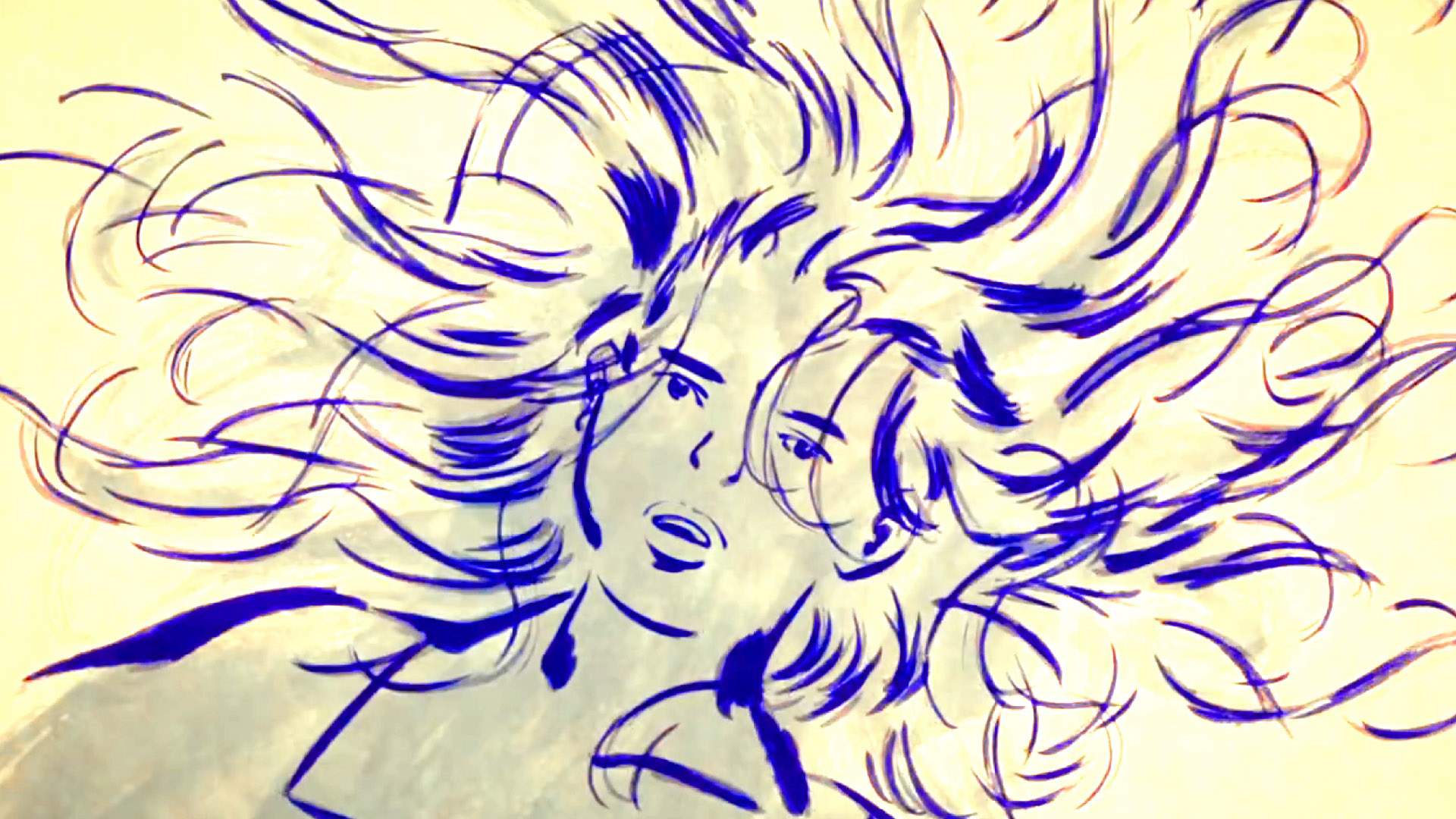
Laudenbach subtly alters the literary original — and does so brilliantly. From a story simple in structure and moral, he extracts a layer of ambiguity and depth. He also turns the title heroine into a psychologically complex, conflicted, and therefore believable character. She is not merely a vehicle for moral instruction but a free spirit who wishes only to live honestly, joyfully, and unbound. She has no need for the riches that satisfy her father. And though she remains a figure from a fairy tale, over the course of the film she gains a surprisingly human dimension — after all, how can one be fully content with life when one cannot hold a child or climb a tree?
The director avoids creating an outdated moral fable while also refusing to rely solely on the beauty of his imagery. Clinging too faithfully to the Grimms’ The Handless Maiden would have resulted in a clear but unengaging cinematic retelling.

It’s no exaggeration to say that Sébastien Laudenbach has achieved an almost perfect adaptation. He not only expanded a straightforward, one-dimensional fairy tale into a compelling and accessible cinematic story, but also wrapped it in a breathtaking artistic form. The Girl Without Hands demanded enormous labor and even greater dedication — and the result could hardly be more satisfying. The outcome is a visually exquisite work, created with the sensitivity of a painter and the intuition of a film poet.


Looking back at DEAD SNOW: A Blizzard of Nazi Gore Fun

DEAD SUSHI: Exotic, Spicy, and Wildly Entertaining

Revisiting ALICE, SWEET ALICE: Dread and Religious Symbolism

PUPPET MASTER: LITTLEST REICH – Achtung! It’s Good!
