
Review
POPEYE. Robin Williams’ First Leading Role
Popeye can be seen as one of the first superheroes of modern pop culture. It’s no surprise that he easily transitioned from one medium to another

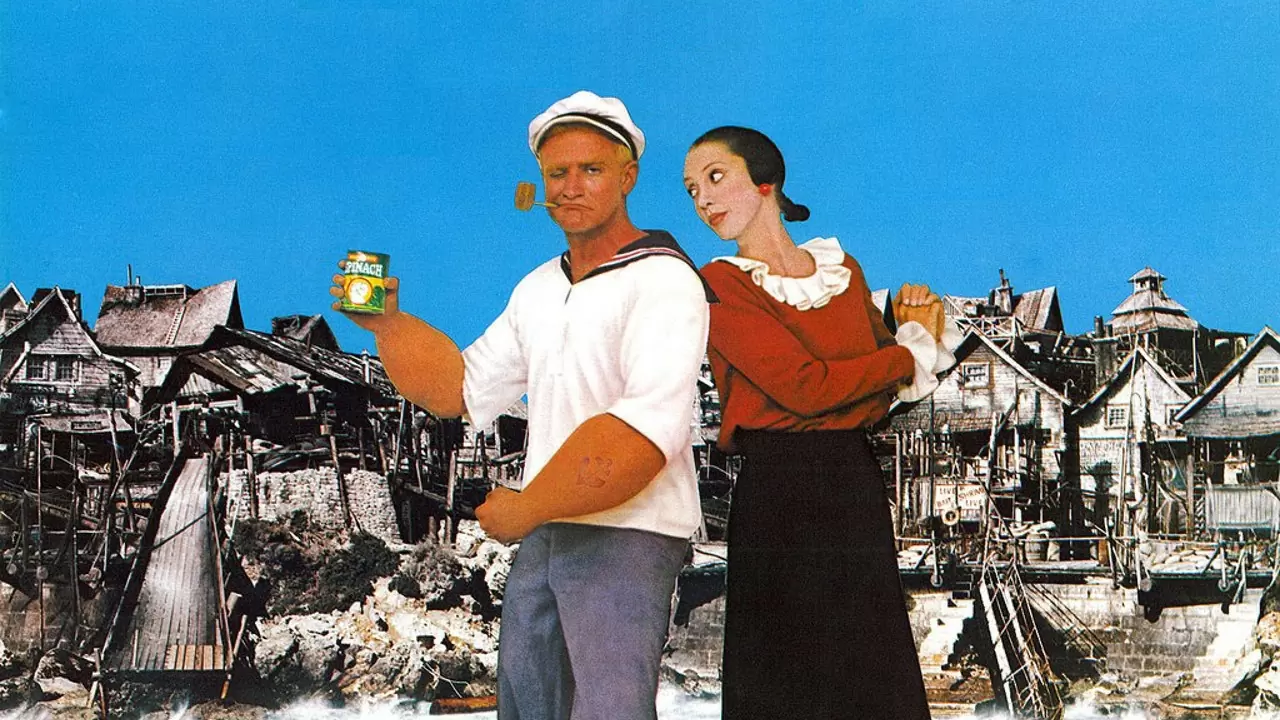
Created in 1929 by Elzie Crisler Segar, the sailor with a golden heart, hot temper, and ever-present pipe quickly became one of the most recognizable drawn characters. All thanks to his love of spinach, which gives him almost superhuman strength—and which once served as a way to persuade children to eat their greens. In his own way, Popeye can be seen as one of the first superheroes of modern pop culture. It’s no surprise, then, that he easily transitioned from one medium to another—first into cartoons, and in 1980 onto the big screen, courtesy of Paramount, Disney, and… Robert Altman.
An artificial, pooping pelican; an artificial, highly theatrical seaside town in Malta, built over more than half a year by 165 workers; artificial, balloon-like forearms for the main character that weren’t even finished by the time shooting began; and an artificial, sluggish octopus, whose completion was cut short by the lack of funds in a $20 million budget. These are just some of the “attractions” offered in the work of a director otherwise known for serious, ambitious, mosaic-like stories. This time, however, Altman filmed something that is part comedy, part adventure, part musical—a movie that at times amuses, at other times embarrasses, or simply bores.
And he did so with full blockbuster scale, giving us a colorful world of contrasts—vividly comic-book-like, delightfully exaggerated, deliberately twisted. Yet at the same time delivered without much conviction, stripped of the energy and dynamism of the animated shorts. And, despite everything, oddly poor.

It’s enough to say that Robin Williams’ mumbling is often barely intelligible (even though the dialogue had to be re-recorded in a studio, since the on-set sound proved useless). The future comedy icon—here in his first leading role—constantly mutters under his breath, leaving the audience confused, with little substance behind the rambling. Harry Nilsson’s songs, meanwhile, seem to appear out of nowhere and are delivered half-heartedly—more recited by the actors than performed with the kind of energetic flair the genre usually promises. The screen is also constantly flooded with slapstick that feels entirely disconnected from the story, nearly drowning it out and becoming a kind of competing spectacle in itself—easy to get lost in (especially thanks to “rubber-man” Bill Irwin, also making his film debut).
Amid this barrage of exaggerated gags—only some of which truly land—you can still occasionally spot the practical effects and a few familiar faces: tiny Linda Hunt (yet another debut), Donald Moffat (The Thing), and Die Hard 2’s Dennis Franz as a barroom thug. All of this amounts to nearly two hours of PG-rated projection, intended for the whole family. Still, given the year of production—before the invention of the much-maligned PG-13—it’s easy to imagine that parts of this circus would never pass through today’s Hollywood lens of self-awareness (by Toutatis! The entire cast here is white!!!).
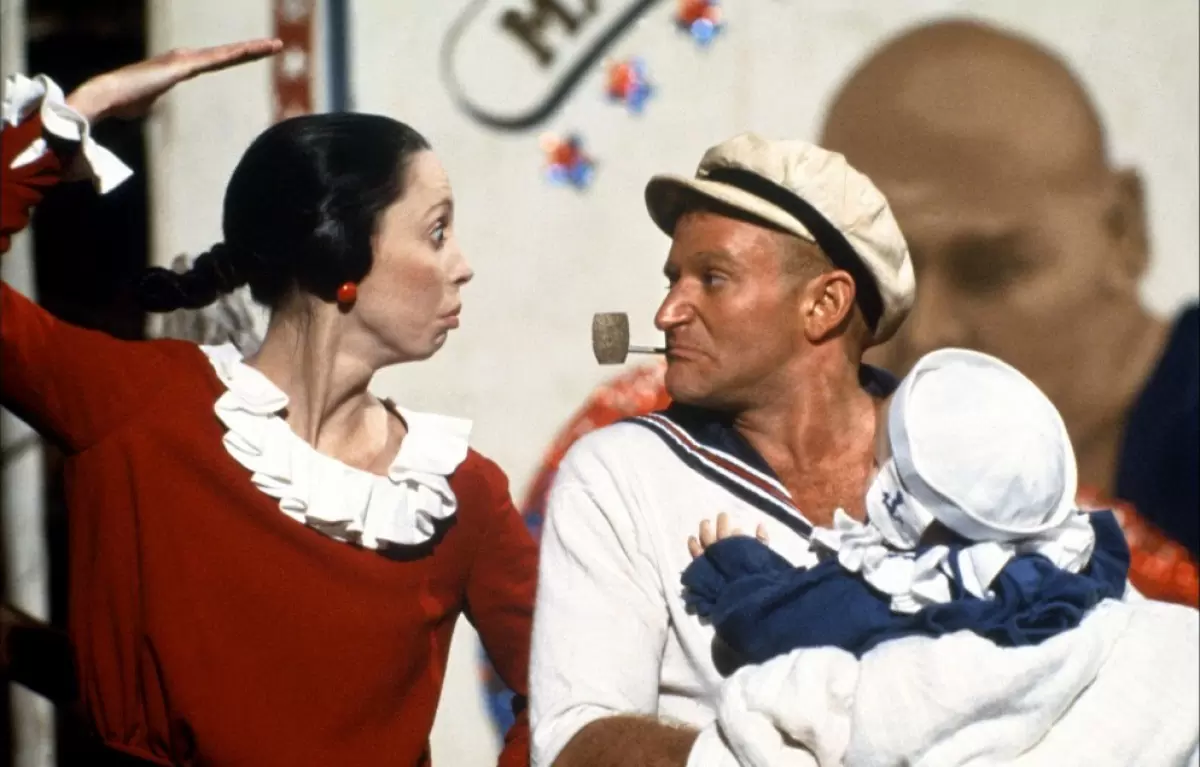
A sequence of largely disconnected musical-physical set pieces is tenuously held together by a script that’s at least coherent enough (thankfully only in the metaphorical sense). Our brave Popeye arrives in the coastal town of Sweet Haven in search of the father who abandoned him in childhood. There he encounters a gallery of bizarre characters, seemingly ripped from the nightmare of a drunken tax clerk—including Olive Oyl (Shelley Duvall, born for the role) and her impulsive boyfriend, the hulking Bluto (perfectly cast Paul L. Smith), who literally shakes the entire town. The rest… well, you can hum the tune yourself. Love and clashing male egos are thick in the air.
And it must be said: the chemistry between the three leads is what saves this farce from complete disaster.
Despite the technical shortcomings, their dynamic is palpable, and they clearly understand their characters—having fun with them in a way that stands out especially in contrast with the rest of the colorful but utterly flat and lifeless supporting cast. These are also faithful portrayals in spirit—particularly Popeye’s initial dislike of spinach, just as in the earliest comics, where his strength actually came from… rubbing a magical bird named Bernice (sic!). Thankfully, the filmmakers restrained themselves from indulging in that absurdity, and at least here Popeye doesn’t come across as too ridiculous.

Ultimately, the whole project can be compared to another cult ’80s comic adaptation released in the very same month as Popeye: Flash Gordon. In both cases, ambition is nowhere to be found, the execution leaves much to be desired (especially since the effects now look painfully clunky), and kitsch and camp overflow from every frame. But Altman—who even cast his own grandson, Wesley Ivan Hurt, as baby Swee’ Pea—staged it all with such gleeful abandon that it’s no wonder some viewers happily embrace this charming nonsense, which is almost the pure definition of a guilty pleasure: so bad it’s good.
And in fact, it was quite a hit at the time, earning back three times its budget at the box office while largely dodging the critics’ knives (Roger Ebert even gave it three and a half stars out of four!).
Though it picked up a few anti-awards, audiences generally warmed to Popeye—at least as much as possible. Proof of this can still be seen today: nearly four decades after filming ended, the movie’s seaside set in Malta’s Anchor Bay remains standing and draws crowds of tourists each year. As of January 1, 2009, the character of Popeye entered the public domain in Europe. While in the U.S. he’ll have to wait a bit longer due to legal differences, just a year later Sony announced plans for a new 3D animated feature. Since then, news has gone quiet, leaving Altman’s Popeye still one of a kind. Whatever one may think of its quality, it remains a rare example in cinema of creative extravagance, artistic chaos, and kitschy spectacle—all rolled into one.

