
Review
“Legend of the Guardians: The Owls of Ga’Hoole”. Unique


Zack Snyder focuses above all on visual impact. His films are meant to be visually overwhelming — pure spectacle cinema. They’re designed to be bombastic, lavish, and heavy. The weight of his productions doesn’t stem from refined dramaturgy but from a barrage of special effects, slow motion, and solemnly delivered grandiose monologues. Snyder channels most of his creative energy into form, leaving everything else aside with a “somehow it’ll work out” attitude. It’s a kind of cinema that’s often hard to digest and physically exhausting, giving the impression of being built through brute force rather than intellect. Legend of the Guardians: The Owls of Ga’Hoole is a unique entry in Zack Snyder’s filmography.
The director thrives in worlds crafted through computer-generated imagery. After all, most of his live-action work is overloaded with green-screen effects anyway. Animated cinema lets him remain fully immersed in a virtual space that aligns perfectly with his artistic sensibilities. Snyder knows how to tell stories using the full potential of this medium. He had already blurred the line between animation and live action in 300.

In a previous text in this series, I suggested that for Wes Anderson, Fantastic Mr. Fox offered the opportunity to exercise total control over the world he presented. The director of Moonrise Kingdom could eliminate all randomness and fully translate his vision to the screen without compromise. Of course, I don’t view Zack Snyder as a filmmaker on Anderson’s level. Snyder is a craftsman without a particularly distinctive artistic signature, but with enormous ambitions — not in the thematic sense, but in terms of scale and spectacle.
For Snyder, technology matters as a dazzling firework capable of mesmerizing and forcing our admiration. James Cameron integrates reflections on scientific progress into the substance of his films, making them self-reflective works — milestones in the history of visual effects with real thematic depth. Zack Snyder, however, remains on a single level. He uncritically embraces technical novelties and experiments with them, hoping to dazzle us. That’s what must have drawn him to animation — a medium that to him likely seemed like an enticing toy.

Yes, my description carries skepticism and a touch of irony. Did Zack Snyder win me over with Legend of the Guardians? Absolutely. It’s his most mature work — free of chaos and formal excess, the best-told, most coherent, with undeniable charm and, rarely for Snyder, made with genuine heart.
This is a fairy tale, but not quite one for the youngest viewers. It contains a substantial amount of darkness, unsoftened by humor or irony. Evil here wears a particularly dangerous face. Visually, Snyder often leans toward dark palettes. The characters are surrounded by fog. The director seems more drawn to feelings of fear and helplessness than to the innocent tone of classic adventure stories — a tone this film could have easily aspired to with a different balance of dramatic elements.
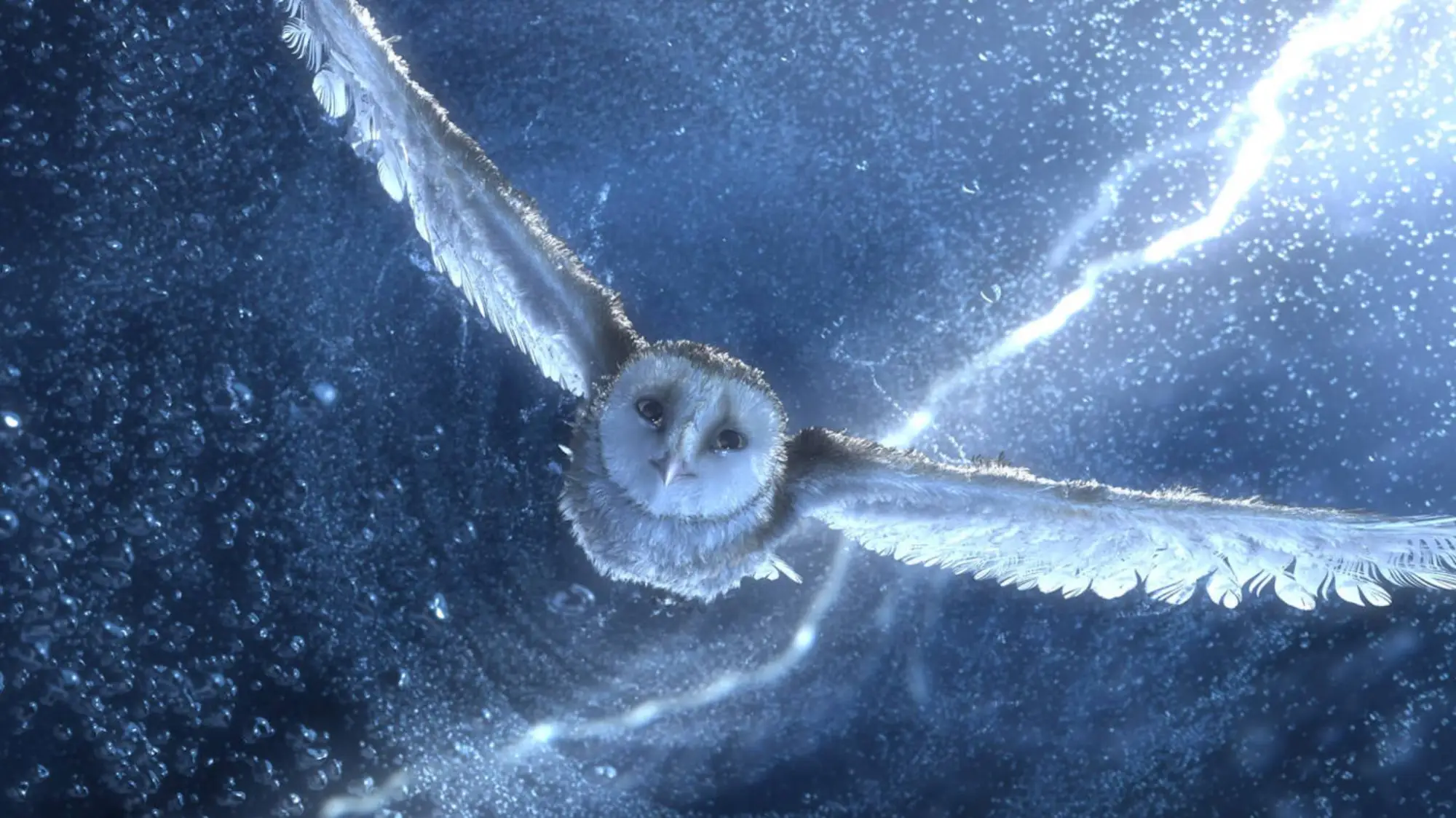
The plot is remarkably simple. Soren and Kludd are young owls just learning to fly. One day, they’re kidnapped by scouts of the legendary Lord Tyto, who’s building an army to conquer the owl kingdom. Soren manages to escape. Instead of returning home, he sets out to prevent the seemingly inevitable attack. His only hope lies with the mythical Guardians, whom he’s heard about in countless stories. Among them is the mysterious hero known as the Lyze of Kiel, who once defeated the evil Tyto. Soren finds him and becomes his pupil. Naturally, the final act culminates in an epic confrontation between the two sides.
In its formal and narrative structure, Legend of the Guardians resembles The Lord of the Rings: The Fellowship of the Ring and the rest of The Lord of the Rings trilogy by Peter Jackson. The resemblance lies in the magical, solemn atmosphere and the characteristic camera work — in this case virtual — composed of smooth, long, majestic tracking shots often circling the characters. Many of the locations inevitably recall places visited by the Fellowship. I don’t see this as derivative but as a creative reworking of familiar patterns into a new story and context. It works remarkably well.

On another level, Legend of the Guardians has something in common with Star Wars: Episode IV – A New Hope and its saga. The resemblance comes mainly from the dynamics between characters and the relationships that develop among them: the lure of evil that claims Kludd, and Soren’s unexpected preparation for his duel with Lord Tyto.
These references may seem distant or subtle at first glance, but Legend of the Guardians operates on similar frequencies as those great predecessors. Snyder doesn’t parody or “improve” them — he aims to gently evoke a similar mood. And he succeeds. It’s also a film with an intriguing, thoughtful moral and a brilliant ending. Yes, it’s a happy ending, but not a complete one — it allows feelings of loss and partial failure to resonate. Snyder’s film raises questions about the nature and function of ancient myths. The director provides answers while also showing how new beliefs are born. It’s truly worth witnessing.


Looking back at DEAD SNOW: A Blizzard of Nazi Gore Fun

DEAD SUSHI: Exotic, Spicy, and Wildly Entertaining

Revisiting ALICE, SWEET ALICE: Dread and Religious Symbolism

PUPPET MASTER: LITTLEST REICH – Achtung! It’s Good!
