
Review
THE GRINCH. The Greatest Enemy of Christmas is Back!
He lives with his dog Max on the outskirts of town, in a cave atop a high, snow-covered mountain. His name is the Grinch and he has decided to steal Christmas.


I have a huge soft spot for the character of the Grinch. In my early youth, I watched the Jim Carrey film practically every year at Christmas. The symbol of the holiday season was never, for me, the young blond boy with Macaulay Culkin’s face, nor the bitter miser from Charles Dickens’ A Christmas Carol, but rather the mean, negative-toward-everything-and-everyone green creature. So when I learned that a new animated version of the Grinch’s story was being made—based on Ron Howard’s iconic 2001 film, the 1966 short, and Dr. Seuss’ classic children’s book—I was overjoyed. I hoped I’d get the chance to feel like a kid again. Did the 2018’s Grinch meet my lofty expectations? At best, only halfway.
The basic plot is rather well-known, but if someone has somehow never come across the extremely popular 2001 version, I’ll quickly try to explain what’s what. In Whoville, everyone loves Christmas. Every year the residents celebrate this special time with great cheer. They lavishly decorate their homes with colorful lights, give each other lovely gifts, feast together at the Christmas Eve table, and finally gather in the town square to sing Christmas carols in one loud, united voice. But there is one citizen who boycotts the festivities year after year.

He lives with his loyal dog Max on the outskirts of town, in a cave atop a high, snow-covered mountain. His name is the Grinch, and for this year’s Christmas—which the Whos want to celebrate more grandly than ever—he has planned something special: he has decided to steal Christmas.
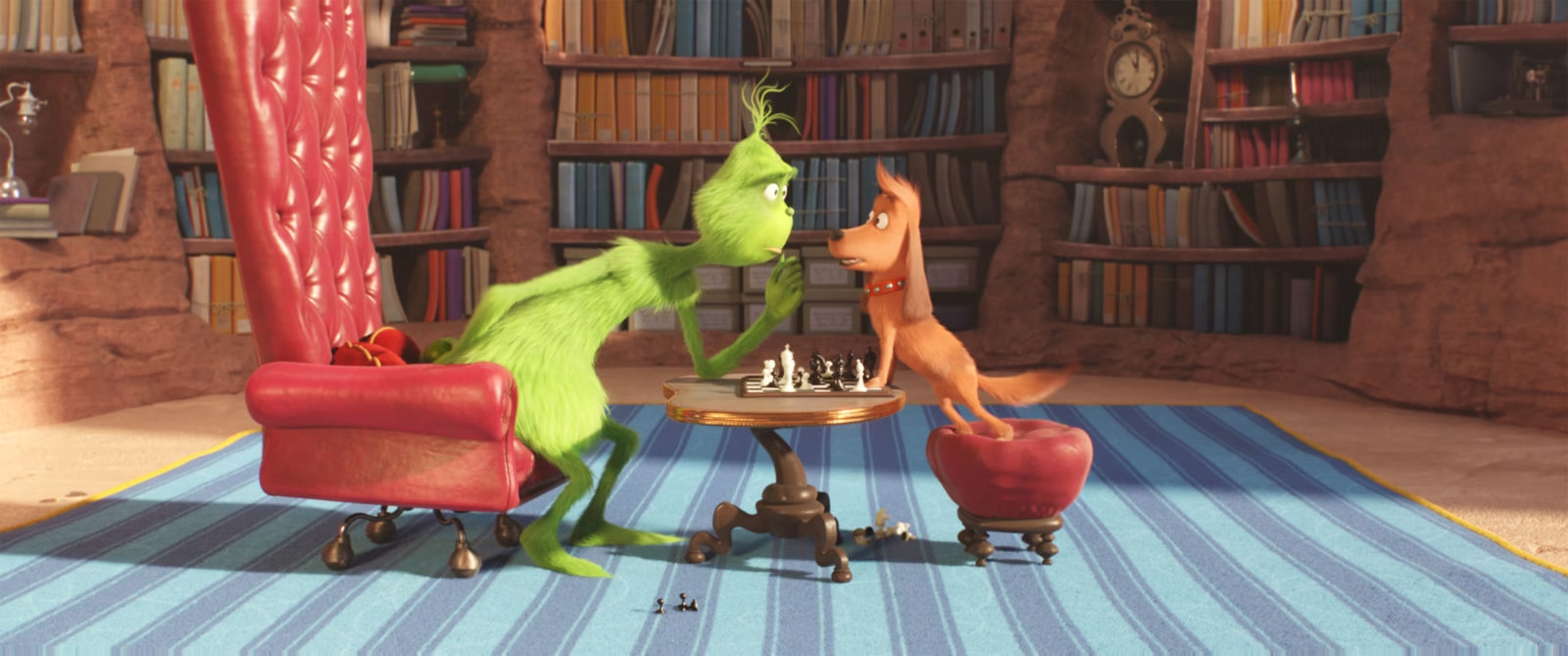
The main question for me was how the creators would choose to portray the title character. From childhood, I remembered the Grinch as a wild, nasty, at times almost demonic figure who instilled something akin to fear in the residents of Whoville. In this new version, all of that demonic quality has evaporated, and much of the craziness is gone as well. The Grinch’s image has been noticeably softened by the filmmakers associated with Illumination. It’s been tailored to the sensibilities of today’s young audience, who would probably be terrified after just a few minutes of Jim Carrey’s antics in the green costume.

Fortunately, the Grinch remains mean. It’s precisely his unfriendly behavior toward the residents of Whoville that brought me the most joy during the screening. Not because I’m a sadist who enjoys watching others suffer. It’s just that in those moments of Grinch’s mischief, I felt as if I were witnessing the return of an old friend. A favorite actor who, after many years of absence, has decided to once again appear on screen in his best, most iconic role. Unfortunately, there aren’t too many of these moments. They all appear in the first half of the film, when the Grinch heads into town to replenish his winter food supplies.
It’s during this risky outing that the green (anti)hero destroys a young Who’s snowman or knocks down a jar of preserves from a high shelf—preserves that a tiny customer had been desperately trying to reach moments earlier. For every Grinch fan, these scenes are a real treat.

In the English-language version, the Grinch is voiced by none other than Benedict Cumberbatch. I can say that the British actor tackled his task brilliantly.
Now we get to the less positive part of this review. I can’t understand why the creators didn’t use the excellent musical theme that first appeared in the 1966 cartoon. Why did they have to rework the wonderful You’re a Mean One, Mr. Grinch into a modern, dreadfully bland hip-hop version performed by Tyler, The Creator? It’s a completely unnecessary move. In the promotional materials, such as the trailers, the original musical theme appeared, promising a nostalgic return to the past.
So when, right at the beginning during the Grinch’s introduction, I heard the modernized version of this song coming from the cinema speakers, I felt simply deceived by Illumination’s creators. This is not how it was supposed to look or sound. This is not what we agreed on.
Still, it’s hard for me to say that watching The Grinch was an unpleasant experience. Thanks to those few moments that allowed me—even for a second—to once again feel like a not-quite-ten-year-old boy, I’m glad this new version exists. I’m also glad because it gives a new generation of children the chance to get to know the story of the green creature who decided to steal Christmas from the cheerful Whos. Perhaps, encouraged by the viewing, one of the kids will someday reach for Ron Howard’s film or the 1966 animation—and that alone would be a huge success.

