
Review
CARRIE. It’s a Poor Mix [REVIEW]
To sum up, for me it’s a poor mix: a disliked carbon copy of Carrie from 1976, plus idiotic—almost irrationally introduced—modern gadgets


I should admit right away—I’m not particularly fond of Brian De Palma’s 1976 adaptation. I also haven’t read Stephen King’s novel. I wasn’t eagerly awaiting the premiere of Carrie, the new screen adaptation of the King of Horror’s prose. It was a film I felt rather indifferent toward. Still, there were several reasons to root for it. First of all, the involvement of Julianne Moore made the project worth supporting. She is an actress who carefully chooses her scripts and is usually associated with ambitious psychological cinema. It also inspired some confidence that this character—so important to the history of horror—was returning to the big screen, presumably for a specific reason.
Either to confirm the relevance of the original or to reinterpret it by suggesting a new perspective. Thus, I wasn’t skeptical about Kimberly Peirce’s film. Also because, in my opinion, solid horror films are still being made. This year’s The Conjuring and Sinister only reinforced my belief that contemporary horror has plenty to offer. With such mixed feelings, I bought a ticket to the latest adaptation of King’s debut novel.
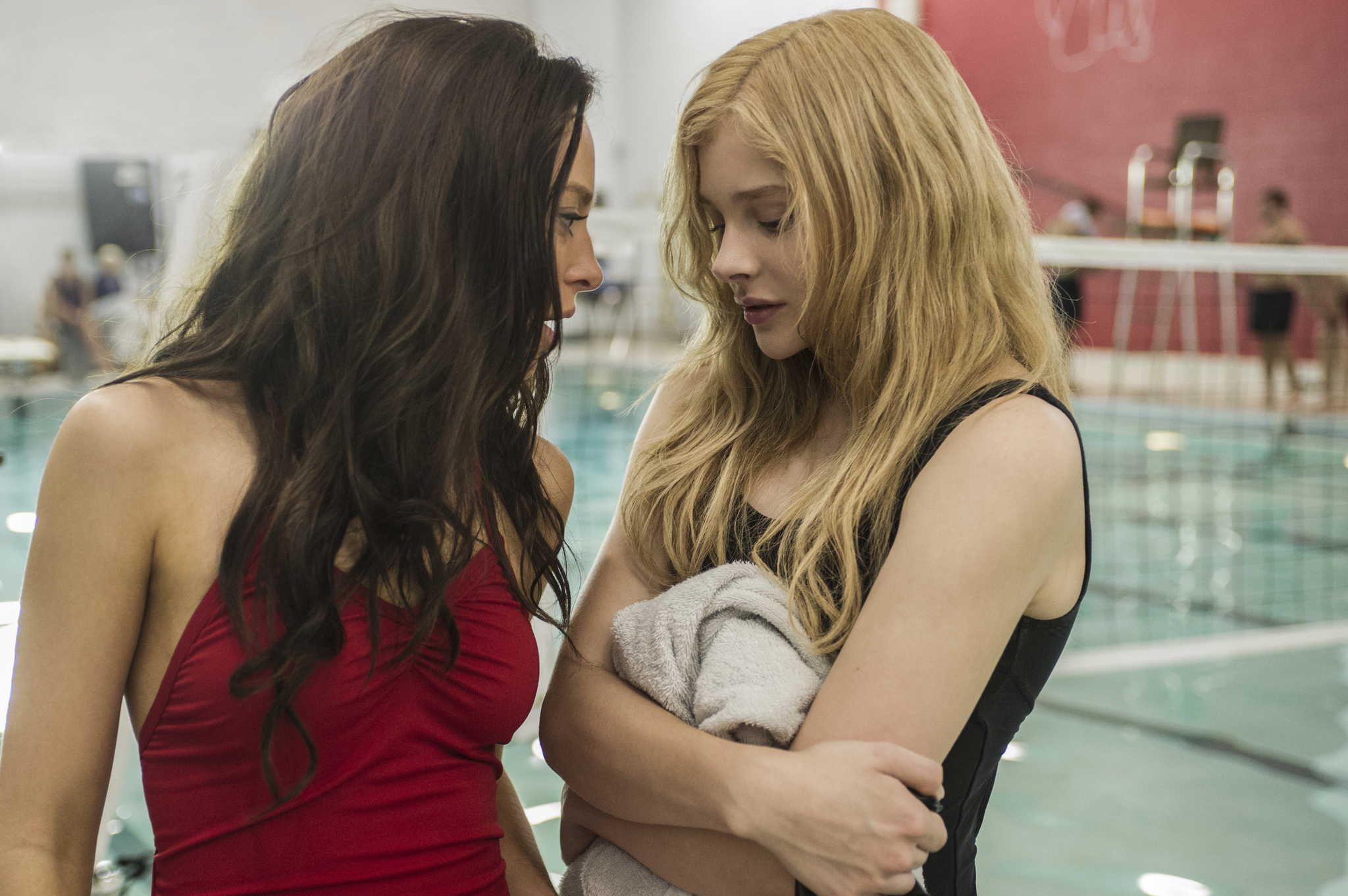
Unfortunately, it didn’t work again. Maybe I simply don’t understand this story. Maybe only in my eyes is this tale built on some absurd foundation. All the fuss around the prom, which constitutes the narrative axis, leaves me completely indifferent. My own prom wasn’t particularly important to me either. (Maybe I’m just not the right person to review this title. There are so many things in it that irritate me and that, in my view, don’t work.)
Undoubtedly, this is a film through which Kimberly Peirce tried to force the viewer to reflect, not just to scare me. However, the conflict presented in Carrie offers no chance for that. The director fulfills neither aim. The disputes in the film are based on such clear antagonisms and oppositions that the viewer doesn’t need to listen to both sides’ arguments to judge who’s right. The wolf is bad and always will be bad, because he looks bad and therefore cannot be good. I felt deprived of the opportunity to engage and make my own assessment. Everything is laid out in black and white.

I don’t know how you felt when Chris—the main school antagonist—shouts during an argument with Sue, “We didn’t do anything wrong to her (Carrie)!” But I know they did. They mocked, lynched, and pelted an innocent, defenseless girl with tampons. They recorded the scandalous incident and posted it online. I don’t believe such a character. Nor do I understand how one can build a film’s intrigue around such motivations. The same applies to the title character’s mother, Margaret White. Her madness is one-directional—consistently evil and consistently pathological. From the outset, the director deprives me of any chance to even attempt to defend this character, to explain her, and thus make her interesting and ambiguous in my eyes.
Knowing the film’s ending, I found myself wondering only how unreliable and unfair it would be to leave the theater after 30 minutes and write a review having seen just a fragment of it. The prospect of getting a refund for the ticket and returning home early certainly argued in favor of that.

Honesty toward myself made me stay. And now I know what irritates me most about this film. That element is, in fact, the De Palma adaptation I dislike. Because Peirce’s film is practically a 1:1 copy of the 1976 movie—both narratively and formally. The number of identical shots and scene compositions is astonishing.
So how does Peirce’s Carrie differ from De Palma’s Carrie? In the 2013 production, the action is moved into the 21st century. Yet I have the impression that Kimberly Peirce watched De Palma’s film over and over and had no idea how to adapt King in a different, original way. She couldn’t escape or free herself from the earlier adaptation. Lacking ideas, she decided merely to modernize Carrie. So the girls play with their phones, listen to contemporary pop hits, and classrooms feature modern computers. To me, this testifies to an enormous lack of creativity on the filmmakers’ part.

These additions introduce absolutely no change to the story and give it no new context. They feel forced. The director seems to have wanted an argument that she had changed something compared to the 1976 film. The present day turns out to be meaningless. Of course, Peirce could copy De Palma’s film—I understand it may be an important work for her. But if she had already abandoned reinterpreting King’s book from the outset, I expected her at least to engage, even minimally, in a dialogue with the work of the creator of Scarface. Unfortunately, I found none of that in her adaptation.
To sum up, for me it’s a poor mix: a disliked carbon copy of Carrie from 1976, plus idiotic—almost irrationally introduced—modern gadgets, and an even more poorly handled conflict. I give the single star solely for the characters of Tommy and Sue. Naturally, that’s also the only element I like in De Palma’s twin film. I value such characters for their empathy, warmth, and smile—but even that is not enough.

