
Review
HORTON HEARS A WHO! Carries a cosmological undertone


Horton Hears a Who! nearly two decades ago flashed through cinemas worldwide. Financially, it certainly didn’t disappoint its producers. It did not, however, receive any special distinctions or nominations for the major awards. I believe that this unusually original production didn’t attract the attention it truly deserved. Horton Hears a Who! is an uneven animation. At its best moments, it can genuinely intrigue with the complexity of the world it presents and the dynamics that govern it. Unfortunately, the creators at times lower the bar, allowing unnecessary naivety to creep in. Still, this does not rob Blue Sky Studios’ production of its charm, nor does it undermine the undeniable ambition of the film. And it is precisely that ambition that significantly elevates the overall impression of Horton.
The film opens with a several-minute, uncut sequence. The creators cleverly use detail, leading us through the fictional jungle of Nool: a leaf shedding a drop of dew, a pebble rolling downhill, and finally, a speck of flower dust carried away by the wind. It is this speck that catches the attention of Horton (voiced in the original by Jim Carrey), a curious elephant with a unique sensitivity. His interest is sparked by a sound coming from within the dust. This unusual, unexpected reaction immediately wins sympathy for Horton: a massive creature focusing intently on an almost imperceptible speck — something from a completely different order and scale.
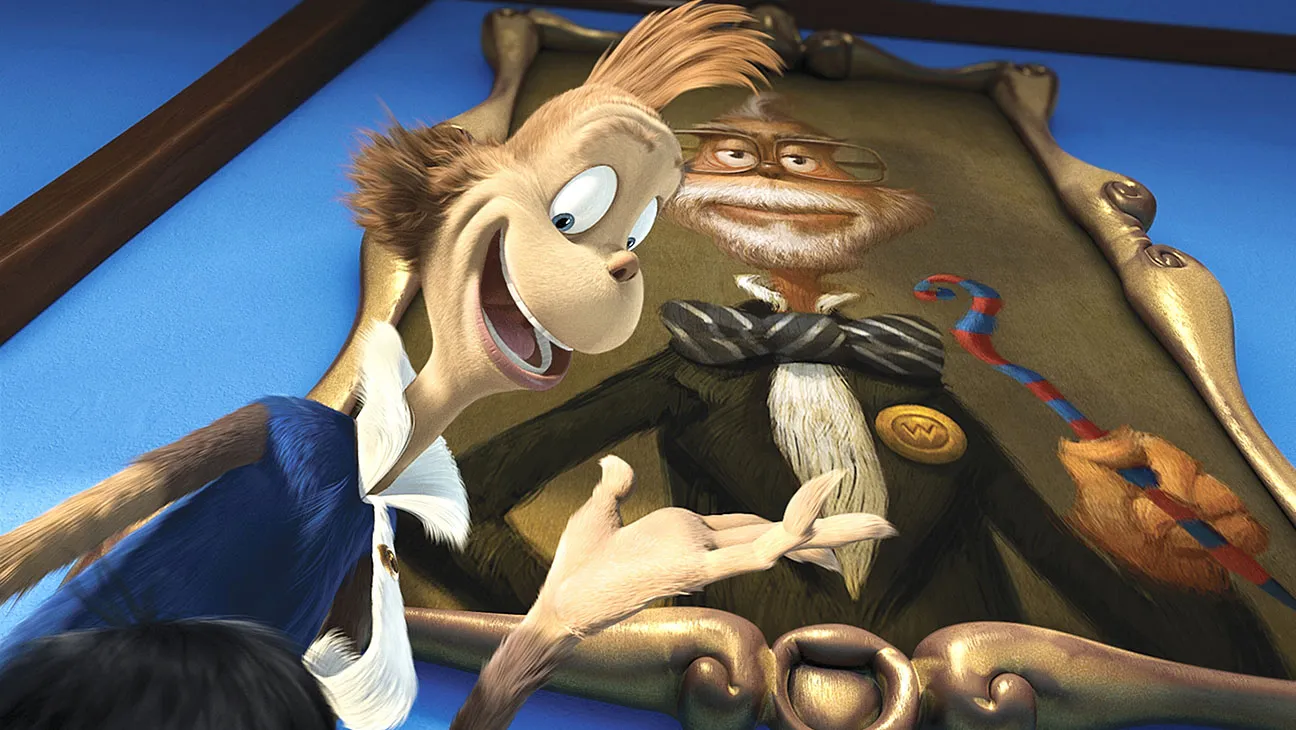
The elephant, however, is right. The speck of dust is actually a planet inhabited by microscopic beings, with its own ecosystem and atmosphere. Its main city, Whoville, has developed architecture and social structure. The wavy, twisted buildings with physics-defying forms may bring to mind the paintings of Salvador Dalí. The Whos form a sophisticated civilization that had, until then, lived in harmony and peace. The second main character and our guide to this world is Whoville’s mayor, Ned McDodd (voiced by Steve Carell). Both protagonists are dynamic, independent figures — individuals who stand out from the communities in which they live.
Their behavior inevitably leads to conflict. Unfortunately, on both narrative levels, this creates certain problems for the film. It’s not about the central theme itself, because that rests on solid ground: Horton tries to convince the other jungle dwellers that life exists on the speck of dust. His views particularly enrage a certain kangaroo, who does not want the younger animals exposed to the elephant’s “subversive” notions. The issue with this antagonist is that she lacks a credible position — she has neither authority nor a clear mandate from the animal community to pose any real threat to Horton. Her determined opposition and aggression therefore don’t quite make sense. They feel plausible enough for Horton, but leave the audience questioning them. As a result, much of the potential dramatic tension slips away, and the somewhat contrived action scenes don’t carry the emotional weight they should.

A nearly identical situation occurs in Whoville, but in the opposite direction. Ned tries to convince his superiors, his family, and the other Whos that beyond their tiny planet lies a vast universe. In both cases, the creators pit conservative, outdated prejudices against the progressive, unconventional actions of an individual. The problem is that the arguments of the opponents are poorly developed, usually reduced to a dismissive: “You’re talking nonsense — there’s nothing out there!” What makes up for this, however, is the creativity shown in the reasoning of the main characters, capable of sharp insights. At first, Ned and Horton are astonished by their discovery; later, the knowledge becomes a tool, a new perspective on the world.
Horton Hears a Who! undeniably carries a cosmological undertone. This animation, in a very accessible way, examines the structure of the universe. It is grounded in the intriguing relativity of phenomena and time. It also explores the possibilities and limitations of perception, proposing a shift in perspective toward everything around us — especially focusing on what, at first glance, appears invisible. The unknown, it suggests, should inspire curiosity, not fear. What I value most in Blue Sky Studios’ film is its educational, exploratory dimension — one that broadens the horizons of thought. I imagine more than one child, after watching it, will look differently at their surroundings. It’s not even about microscopes and telescopes appearing more often on Christmas wish lists. Horton Hears a Who! above all generates questions and provokes thought, sparking an investigative curiosity. That, in itself, is quite an achievement.


Looking back at DEAD SNOW: A Blizzard of Nazi Gore Fun

DEAD SUSHI: Exotic, Spicy, and Wildly Entertaining

Revisiting ALICE, SWEET ALICE: Dread and Religious Symbolism

PUPPET MASTER: LITTLEST REICH – Achtung! It’s Good!
